
Anticipating Ill Health: How Predictive Healthcare Will Revolutionize Our Wellbeing
One of the most effective impacts that big data can have is in the realm of predictive medicine


Healthcare is historically a largely reactive industry. However, with the rapid development of big data analytics, could doctors soon turn to new insights to make proactive decisions over patients?
Information aggregated through big data and other marketing sources may soon help healthcare companies to develop a comprehensive understanding of their patients - paving the way for the anticipation of emerging ailments and lifestyle insights that could help prevent unhealthy patterns from developing into more serious illnesses.
(Image: Reports and Data)
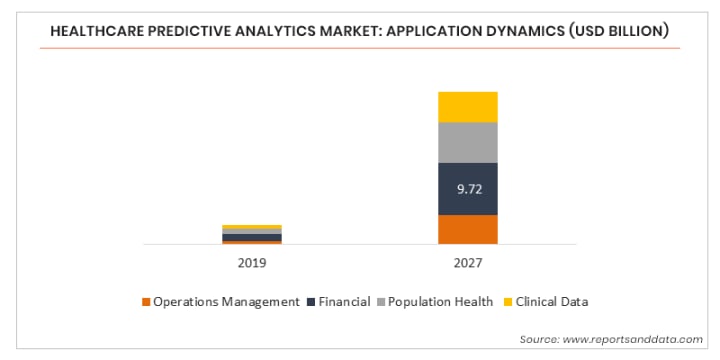
As we can see, the healthcare predictive analytics market is set to expand at a rapid pace over the course of the next decade, with population health and financial applications becoming central to the industry.
The implications of predictive healthcare are far-reaching. For instance, an organization may be able to utilize the technology to analyze keyword activity across social media platforms and through search engines to determine the most common searches for medical conditions or illnesses. The organization could then develop a predictive model that effectively anticipates where and when the next big health scare may take place.
Predictive analytics can also get to grips with the medical history of patients, analyzing huge volumes of data surrounding scores of appointments and pre-existing conditions to determine what individuals could be susceptible to. It could also utilize geographical demographics to spot any localized threats to public health - all without the need of any human supervision or input.
Let’s take a deeper look at the revolutionary potential of predictive healthcare, and how it could change the future of global health:
The Future, Packed Into Big Data
One of the most effective impacts that big data can have is in the realm of predictive medicine. This represents a great chance to improve the overall accuracy of diagnoses and develop preventative medicine - all the while reducing the costs of health insurance.
The process of doctors making more accurate diagnoses can be bolstered by tapping into multiple algorithms that are formed through predictive medical research.
For instance, let’s imagine that a patient goes to see their longtime doctor because they have chest pain. Should the patient go to hospital? The doctor can ask a series of specific questions and enter the answers into a predictive algorithm to gain a more comprehensive insight into the needs of the patient. This algorithm can be already stocked up with information regarding the medical history, employment history and various other predictive markets that could even extend to their social media relationship statuses to help determine the most likely diagnosis based on the data available - including the likelihood of serious conditions like heart disease.
In this case, the predictive algorithm can provide supporting information in real-time that has the potential to either corroborate or dispel the hunches of the doctor.
When it comes to health insurance, predictive healthcare has the potential to pave the way for greater personalization with more bespoke and competitive rates for users to discover pricing plans that better suit them while companies can make bespoke assessments as to a new patient’s chances of more frequent checkups and their respective vulnerabilities.
The Impact of Predictive Analytics in Healthcare
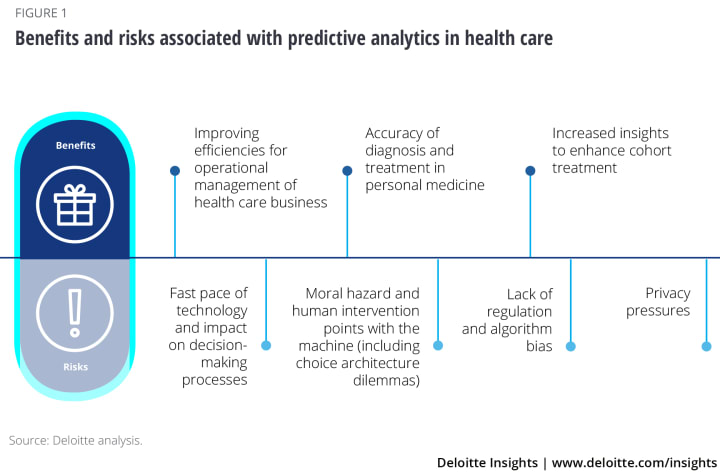
To understand the possibilities offered by predictive analytics in healthcare, it’s important to acknowledge the various ways in which healthcare can benefit from this technology. Applications can involve operational management such as the overall improvement of business operations such as personal medicine to assist and enhance the accuracy of diagnoses and treatment, and cohort treatment and epidemiology to look at wider risk factors for public health.
(Image: Deloitte)
As we can see, for all the benefits that predictive analytics can bring for supporting the health of patients, it’s important for the industry to respect the risks attached to this innovation - especially the increased danger of privacy violations that interconnected devices can carry.
Anticipating Patient Deterioration
One leading use case of predictive healthcare today can be found in the tracking of patent wellbeing while in hospital.
Data analytics has the ability to help providers to react quickly to possible changes in a patient’s vital signs, and it could help to spot a possible deterioration before symptoms begin to manifest themselves to healthcare professionals.
Machine learning stands in good stead in the face of this kind of event, and can learn to track the development of factors like sepsis or an acute kidney injury.
In the US, a predictive analytics tool built using machine learning has been developed by the University of Pennsylvania to use EHR data to identify patients who could be on course for severe sepsis or septic shock 12 hours before the onset of the condition, according to a recent study.
Another initiative at Huntsville Hospital in Alabama found that combining predictive analytics and clinical decision support (CDS) tools could reduce sepsis mortality by over 50%. The analytics-based approach exceeded the accuracy of existing gold-standard tools.
Although predictive healthcare may be a development that will fully realize its potential over the coming years, the use of analytics to help reduce sepsis mortality rates gives us a glimpse of what the future of healthcare technology might look like.
At a time when many of us are more alert than ever to the dangers of infection and the consequences of hospitalization, the arrival of data-driven bespoke insights could play a significant role in revolutionizing a healthcare system that’s eager for more technological support.
About the Creator
Dmytro Spilka
I'm a tech writer based in London. Founder of Solvid and Pridicto. My work has been featured in TechRadar, Entrepreneur, The Next Web, and Huff Post.
Keep reading
More stories from Dmytro Spilka and writers in Longevity and other communities.
5 Reasons Why Hyper-Personalization is the Key to Growth for Gyms
Marketers have long recognized the value in customer segmentation and appealing to leads on a more focused basis. Meanwhile, the differences between gym users are made more stark due to metabolic, genetic, and psychological factors that go into completing workouts.
By Dmytro Spilkaabout a year ago in Longevity
Day 4 of Quitting
If this is how sobriety feels, maybe it’s better to go through life a little buzzed… this, along with other hits like, I want to kill myself, I wish I was dead, and I’m going to throw myself off a bridge have been the only thoughts on rotation these past few days. I promise myself that if, in a month, I still feel like this (‘this’ meaning despondent, full of rage, and simultaneously numb) I can go back to smoking. Until mid-February though? Nicotine is off the table.
By sleepy drafts13 days ago in Longevity
Anti-venom Market Size and Forecast 2025–2033
Introduction Snakebites, scorpion stings, and other venomous encounters remain one of the world’s most under-recognized public health challenges. Each year, millions of people—particularly in rural, tropical, and developing regions—are exposed to venomous animals, often with limited access to timely medical care. In such settings, anti-venom is not merely a pharmaceutical product; it is a critical life-saving intervention.
By Renub Research6 days ago in Longevity


Comments
There are no comments for this story
Be the first to respond and start the conversation.