
After Dumping Tonnes of Sand Into the Ocean for Over 12 Years, China Has Succeeded in Creating Entirely New Islands From Scratch
Artificial islands transform disputed waters into strategic military bases Engineering ambition meets geopolitical tension in the Pacific How China turned coral reefs into permanent land Environmental damage and security fears follow decade-long project A new chapter in maritime power and territorial disputes

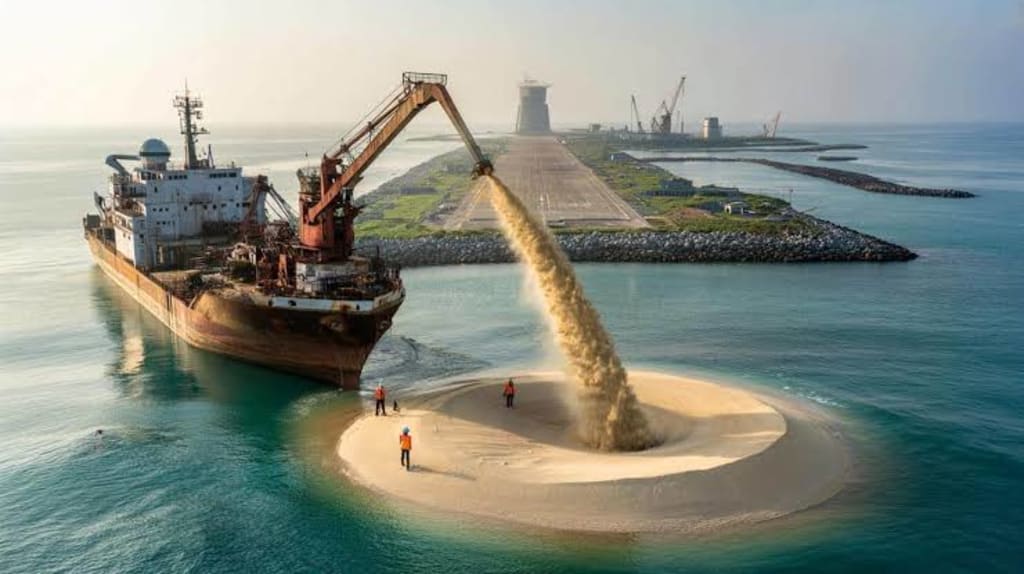
Over the past twelve years, China has carried out one of the most ambitious land reclamation projects in modern history, transforming submerged reefs and shallow waters into fully formed artificial islands. By dumping millions of tonnes of sand and construction material into the ocean, Beijing has reshaped parts of the South China Sea, creating new land where none previously existed.
What began as a series of small dredging operations has evolved into strategically significant island installations equipped with runways, ports, radar systems, and military infrastructure. The project has drawn international attention and criticism, raising concerns about environmental damage, regional security, and the future of maritime law.
Engineering New Geography
Satellite images over the last decade reveal how reefs once barely visible above water have been turned into permanent land masses. Massive dredging vessels extract sand from the seabed and deposit it onto coral formations, layering material until solid ground emerges.
Engineers then reinforce the new land with concrete, seawalls, and drainage systems to prevent erosion. On several islands, China has constructed airstrips long enough to accommodate military aircraft, along with harbors for naval vessels and buildings believed to house surveillance equipment.
Experts say the scale of the project is unprecedented.
“No country has altered maritime geography this extensively in such a short period of time,” said a maritime geographer. “These are not temporary structures. They are intended to last.”
Strategic Importance
The artificial islands sit in one of the world’s busiest shipping routes. The South China Sea carries trillions of dollars in global trade annually and is believed to hold significant oil and gas reserves. Control over this region offers both economic and military advantages.
China claims historical rights over much of the sea, a position disputed by neighboring countries including Vietnam, the Philippines, Malaysia, and Brunei. An international tribunal in 2016 ruled that China’s sweeping claims had no legal basis under international maritime law, a decision Beijing rejected.
By physically occupying contested areas, China has strengthened its presence and extended its operational reach.
“These islands function as unsinkable aircraft carriers,” said a regional security analyst. “They allow China to project power far beyond its mainland coastline.”
Environmental Consequences
Scientists warn that the ecological cost has been severe. Coral reefs, which support diverse marine life, were destroyed during dredging operations. Sediment plumes from construction spread across nearby waters, damaging fish habitats and disrupting ecosystems.
Marine biologists report long-term impacts on fisheries that local communities depend on for food and income.
“You cannot rebuild coral once it’s buried under sand,” said an environmental researcher. “The damage could take centuries to recover, if at all.”
China has stated that it follows environmental standards and that some construction included measures to protect reefs. However, independent studies suggest the scale of destruction is among the largest reef losses ever recorded.
Regional Tensions Rise
The island-building campaign has heightened tensions across Southeast Asia. Neighboring nations view the projects as violations of their territorial waters and accuse China of militarizing disputed zones.
The United States and its allies have conducted freedom-of-navigation patrols near the artificial islands, arguing that international waters must remain open to all. These patrols have occasionally led to confrontations between Chinese and foreign naval vessels.
Diplomats warn that the risk of miscalculation is growing.
“Every new runway and radar station changes the balance of power,” said one foreign policy expert. “This is not just construction—it’s strategic messaging.”
Legal and Political Debate
Under international law, artificial islands do not generate the same maritime rights as natural land. They cannot claim exclusive economic zones or territorial seas. However, enforcing these rules has proven difficult.
China maintains that the islands are primarily for civilian purposes such as weather monitoring, search-and-rescue operations, and maritime safety. Critics counter that military facilities dominate the structures and reveal Beijing’s long-term intentions.
The issue has become a test of international legal norms in an era where engineering can physically reshape geography.
A New Reality in the Ocean
Today, what were once scattered reefs now appear on maps as fully formed islands with names, buildings, and airfields. They host personnel year-round and operate as forward bases for Chinese forces.
For China, the islands symbolize technological capability and national strength. For its neighbors, they represent a permanent shift in the region’s power structure.
“The ocean has been turned into land,” said a Southeast Asian diplomat. “And with that land comes influence.”
Global Implications
China’s island-building has inspired debate worldwide about the future of maritime disputes. Other nations with access to shallow seas may attempt similar projects, raising fears of widespread environmental damage and new territorial conflicts.
Analysts argue that without stronger international agreements, artificial island construction could become a new tool of geopolitical competition.
“This sets a precedent,” said a security researcher. “If geography can be engineered, borders become more fragile.”
Conclusion
After more than a decade of continuous dumping of sand and material into the sea, China has succeeded in creating entirely new islands from scratch—an achievement of engineering and a catalyst for controversy.
The project has reshaped not only coral reefs but also regional politics, international law, and environmental priorities. As the islands become permanent fixtures in the South China Sea, the world is left to grapple with the consequences of turning ocean into territory.
What was once water is now land—and that transformation may define future conflicts and cooperation in the Indo-Pacific for generations to come.
About the Creator
Fiaz Ahmed
I am Fiaz Ahmed. I am a passionate writer. I love covering trending topics and breaking news. With a sharp eye for what’s happening around the world, and crafts timely and engaging stories that keep readers informed and updated.
Keep reading
More stories from Fiaz Ahmed and writers in Longevity and other communities.
Watch: Moment Bright Light Trail Streaks Across New Zealand Skyline
Residents across parts of New Zealand were left stunned after a brilliant streak of light suddenly cut across the night sky, lighting up the horizon and prompting a flood of social media videos and eyewitness reports. The mysterious spectacle, captured on mobile phones and security cameras, quickly went viral as people questioned whether the glowing trail was a meteor, space debris, or something else entirely. The event occurred shortly after nightfall, when skies were clear in many regions, allowing thousands to witness the phenomenon. In several cities and rural towns, the bright object appeared to travel silently before fading out within seconds. A Sky Full of Questions Witnesses described seeing a long, glowing trail moving rapidly across the sky, followed by a brief flash before disappearing. Some reported a greenish or bluish hue, while others noticed a white-hot streak that split into smaller fragments. “I thought it was fireworks at first,” said one Auckland resident. “But then it moved too fast and too smoothly. It looked like something from a science fiction movie.” Emergency services confirmed they received dozens of calls from concerned citizens asking if an aircraft had crashed or if an explosion had occurred. Authorities quickly reassured the public that there was no known danger or reported damage on the ground. What Experts Believe Happened Astronomers and space scientists later suggested the light trail was most likely caused by a meteor entering Earth’s atmosphere or re-entering space debris from a satellite or rocket stage. When such objects travel at extremely high speeds, friction with the atmosphere causes them to burn brightly, creating a fireball effect visible for hundreds of kilometers. According to experts, the brightness of the object indicates it may have been relatively large compared to typical shooting stars. “When something like this appears over a wide area and lasts several seconds, it’s often a fireball,” explained one astrophysicist. “It can be a natural meteor or occasionally a piece of human-made space debris returning to Earth.” Social Media Erupts Within minutes, videos of the glowing streak flooded social media platforms. Users posted clips showing the object racing across the skyline above cities, highways, and coastal areas. Some jokingly suggested it was an alien spacecraft, while others speculated about military activity or secret rocket launches. Hashtags related to the event quickly trended nationwide, and news outlets began compiling footage from eyewitnesses. The widespread documentation helped scientists analyze the object’s speed, color, and trajectory. Preliminary analysis suggests it entered the atmosphere at a steep angle and disintegrated before reaching the ground. No Immediate Threat Officials from New Zealand’s space and aviation authorities said there was no indication that the object posed any danger to aircraft or communities. No debris has been reported, and radar systems did not detect any large impact. Authorities urged the public not to panic and reminded citizens that such phenomena, while rare, are not unusual. “We see events like this several times a year worldwide,” a spokesperson said. “Most burn up completely before reaching the surface.” Why These Events Capture Attention Bright sky events often spark intense curiosity because they occur without warning and involve the unknown. For many people, it may be the first time they have ever seen a meteor fireball or space object re-enter the atmosphere. Scientists say the public reaction reflects a growing interest in space and astronomy. With more satellites in orbit and increased awareness of space exploration, people are more likely to question what they see overhead. “These moments remind us that Earth exists within a much larger cosmic environment,” said one science educator. “What looks mysterious is often part of natural or technological processes happening above us all the time.” A Teaching Moment for Science Schools and universities have already begun using the footage as an educational example of atmospheric entry and light phenomena. Teachers explain that when objects travel faster than sound and encounter Earth’s dense atmosphere, they heat up rapidly, creating visible trails. Some experts also pointed out that solar activity and seasonal meteor showers can increase the chances of such sightings. Although the exact source of the light has not yet been officially confirmed, most scientists agree it was either a meteor or controlled space debris re-entry. Community Reaction In small towns, residents gathered outside to discuss what they had seen. For some, the event was frightening; for others, it was thrilling. “I’ve lived here for 40 years and never seen anything like it,” said one rural observer. “It was beautiful and strange at the same time.” Several people described making wishes, while others worried about safety until authorities clarified the situation. Looking Ahead Astronomers are now reviewing satellite tracking data and meteor detection systems to determine the object’s origin more precisely. Results may take days to confirm, but experts say there is no cause for concern. As technology improves, scientists expect more of these events to be recorded and analyzed in detail, helping improve understanding of Earth’s interaction with space objects. For now, the bright streak across New Zealand’s skyline remains a memorable moment—an unexpected flash of wonder that briefly turned an ordinary night into a national conversation. The event serves as a reminder that even in an age of advanced science and constant connectivity, the sky can still surprise us.
By Fiaz Ahmed about 6 hours ago in Longevity
Day 4 of Quitting
If this is how sobriety feels, maybe it’s better to go through life a little buzzed… this, along with other hits like, I want to kill myself, I wish I was dead, and I’m going to throw myself off a bridge have been the only thoughts on rotation these past few days. I promise myself that if, in a month, I still feel like this (‘this’ meaning despondent, full of rage, and simultaneously numb) I can go back to smoking. Until mid-February though? Nicotine is off the table.
By sleepy drafts25 days ago in Longevity
India and the EU Announce a Landmark Trade Deal
India and the European Union have announced a landmark trade deal that could reshape economic ties between two of the world’s most influential markets. The agreement, long in the making, signals a renewed commitment to cooperation at a time when global trade is being tested by geopolitical tensions, supply chain disruptions, and shifting economic priorities. Rather than focusing on short-term gains, this deal reflects a broader strategic vision. Both sides are looking to strengthen resilience, diversify partnerships, and reduce overdependence on any single market. For India, the agreement marks another step in its effort to position itself as a global manufacturing and services hub. For the EU, it offers access to one of the world’s fastest-growing large economies. A Deal Years in the Making Trade discussions between India and the EU have spanned many years, often slowing due to differences over tariffs, market access, labor standards, and environmental regulations. The latest announcement represents a breakthrough, suggesting that both sides were willing to compromise to reach common ground. While the full legal text is expected to be finalized over time, the announcement outlines a shared framework aimed at reducing trade barriers, encouraging investment, and deepening cooperation across key sectors. Officials from both sides have described the deal as forward-looking, emphasizing sustainability, innovation, and inclusive growth. This approach reflects a shift from traditional trade agreements that focused narrowly on tariffs. Instead, the India-EU deal seeks to align economic growth with long-term social and environmental goals. Economic Opportunities for India For India, the agreement opens the door to expanded access to European markets for a wide range of goods and services. Sectors such as textiles, pharmaceuticals, information technology, engineering goods, and agriculture are expected to benefit from smoother trade processes and improved regulatory cooperation. Indian service providers, particularly in technology and professional services, stand to gain from clearer rules and improved mobility frameworks. This could help Indian firms scale operations in Europe while strengthening India’s reputation as a global talent hub. The deal also supports India’s broader economic strategy of attracting foreign investment. European companies, many of which are seeking alternatives to traditional manufacturing centers, may see India as a more attractive destination for production and innovation. Benefits for the European Union From the EU’s perspective, the agreement offers access to a massive consumer market with a growing middle class. European exporters in sectors such as automobiles, renewable energy, luxury goods, and advanced manufacturing are likely to find new opportunities in India. The deal also strengthens the EU’s presence in the Indo-Pacific region, which has become increasingly important in global trade and geopolitics. By deepening ties with India, the EU diversifies its economic partnerships and reinforces its role as a key global trade actor. Additionally, European businesses may benefit from greater regulatory transparency and improved investment protections, making long-term planning in India more predictable. Sustainability and Standards at the Core One of the defining features of the India-EU trade deal is its emphasis on sustainability. Both sides have highlighted commitments related to environmental protection, climate action, and responsible business practices. The agreement is expected to encourage cooperation in clean energy, green technologies, and sustainable supply chains. This aligns with the EU’s broader climate goals and India’s increasing focus on renewable energy and environmental resilience. Labor standards and inclusive growth have also been emphasized. While implementation will take time, the inclusion of these elements reflects a growing recognition that trade agreements must address social concerns alongside economic interests. Strategic Implications Beyond Trade Beyond economics, the deal carries significant strategic weight. In a world where trade is increasingly influenced by politics, the India-EU partnership sends a message about the value of multilateral cooperation and open markets. Both India and the EU have expressed interest in reducing vulnerabilities exposed by recent global crises. Strengthening bilateral trade ties is one way to build more resilient supply chains and reduce exposure to economic shocks. The agreement also complements India’s expanding network of trade partnerships and the EU’s efforts to engage more deeply with emerging economies. Challenges Ahead Despite the optimism surrounding the announcement, challenges remain. Translating a political agreement into practical outcomes requires careful implementation, ongoing dialogue, and trust between stakeholders. Differences in regulatory systems, compliance requirements, and domestic priorities could still create friction. Small businesses, in particular, may need support to fully benefit from new opportunities created by the deal. However, the willingness shown by both sides to reach this point suggests a shared understanding of the long-term value of cooperation. A Step Toward a New Trade Era The India-EU landmark trade deal represents more than just an economic agreement. It reflects a shift in how major economies approach trade in an uncertain world. By focusing on sustainability, strategic partnership, and mutual growth, the deal sets a tone for future international agreements. As details continue to emerge and implementation begins, the true impact of the agreement will become clearer. What is certain, however, is that India and the European Union have signaled their intent to work together more closely, shaping a trade relationship that responds to both present challenges and future opportunities.
By Saboor Brohi 5 days ago in Longevity



Comments
There are no comments for this story
Be the first to respond and start the conversation.