
5 Things I've Learned from Practicing Yoga
Balance is about a lot more than just standing on one foot.

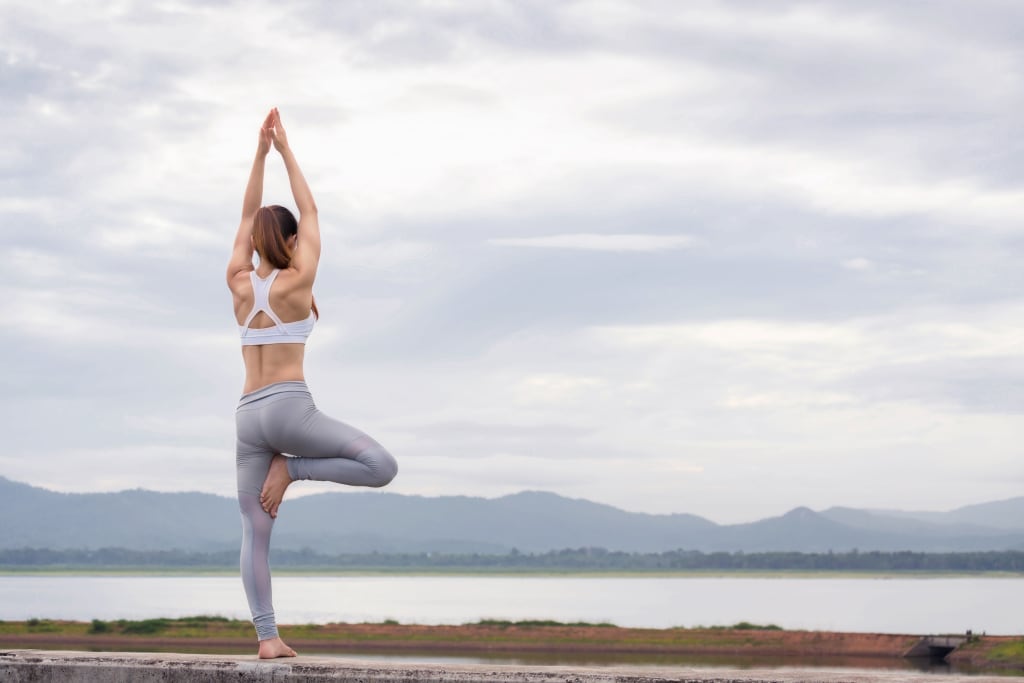
I’m on a health journey this year and yoga is part of it. I was expecting yoga to be nothing more than exercise when I started attending classes; I never would have guessed that there were so many lessons to be learned along the way.
I took a few breaks and floated around studios a bit due to moving and changing jobs a bit more frequently than I would have liked. I started attending yoga periodically three years ago, but I've practiced consistently for the last two years.
When I went into yoga, I was only in it for the physical benefits. I tend to sit a lot at work, I drive a lot, and I ride trains a lot, so all of that does not bode well for my lower back. The physical benefits of yoga are well-proven by science; Harvard Health shares how doing yoga just twice a week can massively reduce back pain.
Since I started, I don’t have any back pain at all. I'm thrilled about that, but I’ve also discovered there’s a lot more to yoga than just increased flexibility. Here are five things I’ve learned so far.
1. You could be doing something wrong for a long time and have no idea.

Here's a very specific scenario where this happened to me. After about a year of doing yoga, I learned just how much I’m supposed to engage through my fingers and feel things in my shoulder blades when in downward dog. I'd probably done downward dog hundreds of times incorrectly.
There was a new instructor teaching a foundational class and she taught a room full of people like me, who have probably done this posture hundreds of times, how to do it in a way that isn’t taxing on your wrists. We spent the entire class exploring variations of downward dog and how to make it safer. She also explained how in reality, downward dog really is not a resting posture.
The bigger lesson here applies to anything in life though, not just one particular yoga pose. A lot of the time, we could be doing something wrong, we could be doing something that’s actually bad for us, and have absolutely no idea.
Very often, the people around us aren’t going to realize we’re doing something wrong. On the off chance they do realize, they may not point it out, usually for the sake of being polite.
2. Even one minute of mindful breathing can be helpful to reduce stress.
Meditation, mindfulness, and breathing exercises, oh my!
They may not be lions, tigers, and bears, but it still seems like a lot when you think about starting any of these practices. We’re all battling with stress in our lives, coming from one monster or another. The importance of mindfulness is really getting more attention, to the point where it’s not hard to find scientific backing for its benefits.
One person who stands out in the area of yoga and research is Dr. David Vago, research director of the Contemplative Neuroscience Laboratory at Vanderbilt University Medical Center. He’s very into mindfulness and has done a vast amount of research to back up his theories.
In one of my recent classes, my instructor tossed out the name Dr. Vago and expected us all to know who he was. I had to Google him afterward and discovered that he’s involved in a ton of research, including a study about mapping the meditative mind. He’s working with yoga teachers and scholars to learn what happens to the mind during different states of meditation.
3. Visualization goes a long way toward controlling your emotions.

You can look at visualization as a learning technique, part of a writer or artist’s creative process, or as something to control your emotions. The latter interpretation is definitely a little bit less popular than the first two.
In a restorative yoga class, the instructor asked participants to visualize an empty area of dirt in our minds. She then asked everyone to imagine their emotions — all of their emotions, both positive ones and negative ones — as seeds. She tasked everyone with visualizing the act of watering the seeds you wish to grow, such as seeds of happiness and peace rather than ones of frustration.
This type of visualization might not work for everyone, but I’ve found it surprisingly useful. I can be hot-headed at times and slowing down, imagining myself mentally watering the right seeds of emotion and not the wrong ones is helpful. I’ll just pause and give myself the strange little reminder of “water your seeds of peace.”
4. You don’t need to be religious or spiritual to meditate.
Meditation and mindfulness have been the subject of so much research that even major medical schools like Johns Hopkins are launching mindfulness programs and seminars for employees. Organizations are caring more and more about the people in their communities.
Mindfulness and meditation are excellent techniques for managing stress that you can start trying to do yourself. It doesn’t matter what your background, beliefs, or lack thereof are. Meditation is for everyone.
5. Balance is about a lot more than just standing on one foot.

We balance when we do tree posture, placing one foot on the opposite thigh and stretching our arms skyward. That’s balancing, definitely.
Yet one of the most important things I’ve learned from yoga is that balance is more than an action and more than a concept. It’s a state, it’s a feeling, it’s a place of equilibrium that we should all probably spend a little bit more time finding.
To me, this is separate from mindfulness. Being mindful of our everyday lives to find more enjoyment and value in them is definitely important, but there’s no denying that life will throw you curve balls that make it much harder to remain mindful. That’s when you need balance in order to still be grateful for the good things in your life while managing the difficult and stressful experiences.
About the Creator
Leigh Victoria Phan, MS, MFA
Writer, bookworm, sci-fi space cadet, and coffee+tea fanatic living in Brooklyn. I have an MS in Integrated Design & Media and an MFA in Fiction from NYU. I share poetry on Instagram as @SleeplessAuthoress.
Keep reading
More stories from Leigh Victoria Phan, MS, MFA and writers in Longevity and other communities.
6 Ways Ashtanga Yoga Transformed My Practice
When I first started practicing yoga in 2017, I was a skeptic who had no idea about all the different types of yoga. As an office worker, I had too much stress and I didn’t exercise often enough. That combination of problems led me to yoga, but I only dipped my toes into the world of yoga at first.
By Leigh Victoria Phan, MS, MFA6 years ago in Longevity
Is Stress Making You Gain Weight?
You’re eating “normal.” Maybe even less than usual. But somehow… your clothes feel tighter. If you’re dealing with academic pressure, financial stress, or emotional overload, your body may be responding in ways you don’t expect.
By Being Inquisitive5 days ago in Longevity
Top 7 Health Benefits of Drinking Lemon Water Daily
Sometimes, the simplest habits make the biggest difference. Lemon water is one of those habits. No expensive ingredients. No complicated routine. Just water and lemon — yet people around the world swear by it.
By Veronica Bennett7 days ago in Longevity




Comments
There are no comments for this story
Be the first to respond and start the conversation.