
Why You Need a Pair of Locking Forceps
The Greatest Craft Tool Never Invented for Crafts


You wouldn’t expect a tool invented for use in a surgical operating room to be an indispensable craft tool, but once you’ve tried a pair of locking forceps, you’ll never be able to go without one again.
Known as a hemostat in the medical field, this instrument is used in emergency medicine and surgery to clamp blood vessels. A similar device, called a needle driver, is used during suturing to push and pull the suture needle through skin and tissue, and has smaller jaws.
Hemostats come in a variety of sizes and may have straight or curved jaws. The inside of the jaws are serrated, allowing for a tight grip and no leakage. Curved hemostats are great for getting access to difficult to reach vessels.
The genius of the hemostat is the locking system. On the handles are a set of interlocking teeth which allow the hemostat to be locked in a closed position and exert a varying amount of pressure from a light grip to a firm grip.

Once locked, they won't let go.
My father had several retired hemostats in his toolbox, which he had been given by a surgeon friend of his. Dad did a lot of electronics work (in the days when it was all resistors and capacitors) and found these repurposed hemostats were just what he needed to hold tiny components while he soldered them in place.
As a child, I would beg dad to let me borrow them so that I could play doctor. I loved medical dramas on TV and dreamt of being a surgeon, so it was awesome to be able to play with the real thing. Later as I grew older, I would borrow them to work on my own hobbies. Years later, when dad passed away, I inherited them and they are now part of my own toolkit and a special memento of my dad and our shared enjoyment of making things. I never did become a surgeon though, but using them still brings back those childhood dreams.
Just recently I noticed one of my favourite craft shops selling non-surgical hemostats as ‘locking forceps.’ The secret is out, others like me and my father before me, have discovered the fantastic usefulness of the humble hemostat!
So what can you use locking forceps for?
Use locking forceps for anything tiny and awkward to hold. They can grip the tiniest piece of material and they won’t let go.
They’re great for beadwork, for holding clasps in place while you attach a crimp to the base or to draw the thread through beads that are difficult to thread.

Great for threading beads when you struggle to pull through the thread.
You really ought to have a pair in your first aid kit too – perfect for removing splinters as they can grip the tiniest sliver.
Like my father, you can use them in electronics work – use a vice to hold the forceps, and use the forceps to hold the component(s) you need to solder.
Use them in sewing to push and pull your needle through thick fabric.
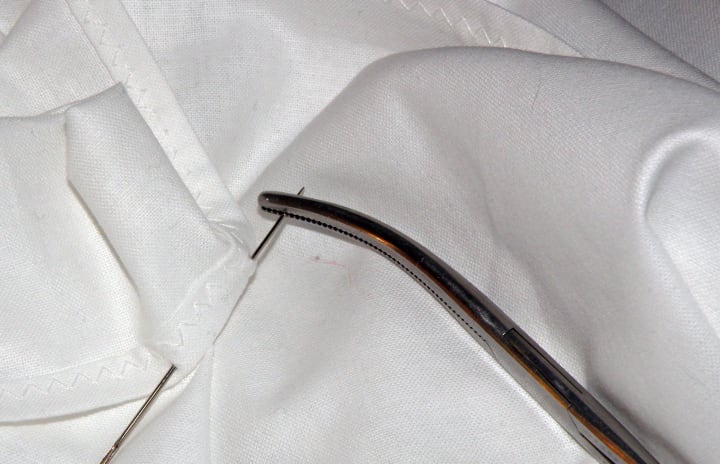
Pull needles through stiff fabric with ease.
They’re also great for using with a sewing machine to hold layers of fabric in place while keeping your fingers clear of the needle.

Avoid injuries to your fingers by using locking forceps to hold fabric in place.
Great in paper crafting for lifting and manoeuvring tiny pieces of paper (though use the lightest locking setting so that you don’t crimp the paper).
They’re a must for miniature work that require precision when moving and holding parts in place for gluing, etc.
Perfect for flower-making to hold petals and stamens in place while you secure them together.
The uses are limitless, invest in a pair and you’ll find new uses for them all the time.
So where do you find one if you don’t have a surgeon friend or a knowledgeable craft shop?
Google ‘locking forceps’ and you’ll find plenty on Amazon or you can get them even cheaper from AliExpress, though the quality may be a bit hit and miss. You definitely want a pair made of stainless steel for the sake of strength, anything else probably won’t work so well.
So go forth, get yourself some locking forceps and you’ll find your next high-risk crafting operation will be a breeze.
About the Creator
Skye Bothma
Skye is a freelance editor and writer living in rural New Zealand, where she writes about life, love and what it is to be human. She is also the author of one novel and working on her next book. Visit her website at www.skyebothma.nz
Keep reading
More stories from Skye Bothma and writers in Lifehack and other communities.
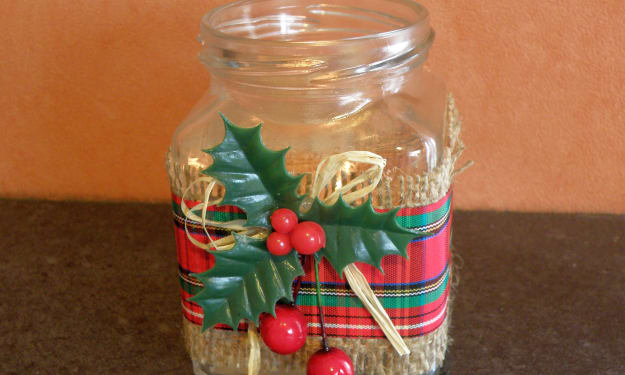
Easy Christmas Jar
One of my favourite things about Christmas is doing crafts. I love making my own decorations and gifts, and have been doing so ever since I was a child. Unfortunately, the older I get the less time I seem to have and my Christmas crafts have become less elaborate and more time-savvy.
By Skye Bothma8 years ago in Lifehack
Moving More Than an Instrument: The Human Experience of Piano Relocation in Chattanooga
There are objects we own, and then there are objects that hold our stories. A piano often belongs to the second category. It is not simply furniture or equipment. It carries memories of practice, celebration, frustration, creativity, and expression. Its presence shapes the atmosphere of a home. Its sound fills spaces with meaning. And when the time comes to move, relocating a piano becomes something far more complex than transporting a heavy instrument.
By House Doctor7 days ago in Lifehack
When the Shelter Closes
Across the street from my house, a man slept under a tree, his dog by his side. My first, naive thought: he must be traveling through. But he kept coming back, often sleeping there during the day. Then it hit me—that person might not have a home.
By Bride of Sound4 days ago in Humans


Comments
There are no comments for this story
Be the first to respond and start the conversation.