
Wearables as Continuous Diagnostic Inputs
Elevating Pathways Beyond Episodic Care
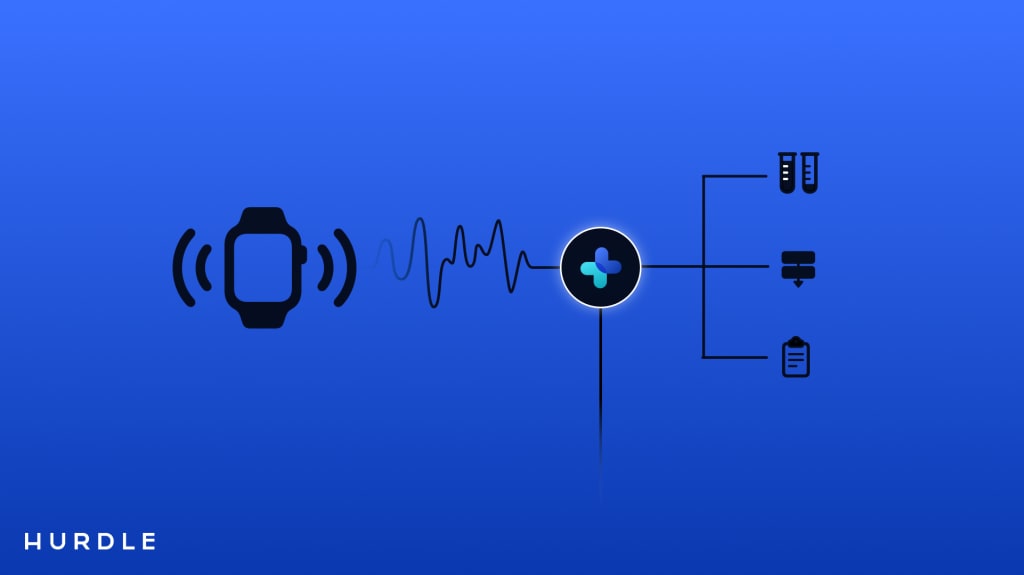
Wearables are entering a new phase in healthcare. Once associated with step counts and wellness dashboards, they now provide continuous physiological signals with genuine diagnostic value. Heart-rate variability, sleep cycles, activity trends, recovery patterns, and sensor-derived biometrics are becoming essential inputs for precision, early detection and long-term condition management.
Inside Hurdle Pathways, wearables become something more:
- a governed, configurable diagnostic modality that enriches triage, personalises timing, triggers follow-up tests, and strengthens population-level stratification.
- They sit alongside molecular tests, questionnaires, and algorithmic models — transforming pathways from static sequences into adaptive systems.
Episodic Testing Is Not Enough for Distributed Care
Traditional diagnostic workflows rely on snapshots — a single test, a clinic visit, a symptom form. But health does not unfold in snapshots. It changes gradually, subtly and often silently.
Wearables supply what diagnostics has historically lacked: continuous, real-world signals that reveal early patterns of change long before they escalate into clinical deterioration.
This shift is especially important as care continues to decentralise across homes, workplaces, virtual clinics and community settings. Diagnostics must become more dynamic, more context-aware and more personalised. Wearables create that foundation.
A First-Class Pathways Input
Within Pathways, wearables are treated like any other diagnostic input — governed, auditable and actionable.
They allow the platform to:
- detect deviation patterns early
- adjust pathway steps in real time
- customise timing for sample collection or follow-up tests
- escalate to clinicians when predefined thresholds are crossed
- generate richer longitudinal profiles
- improve precision for triage and risk-scoring models
This elevates wearables from “nice-to-have data sources” to structural components of pathway intelligence.
Broad, Device-Agnostic Integration — Without Complexity
The wearable ecosystem is vast and fragmented: watches, rings, patches, trackers, medical-grade sensors and dozens of niche health apps. Each produces data with its own schema, quality profile and update cadence.
Pathways abstracts this complexity through a broad integration layer that supports data ingestion from more than 500 supported wearables and connected health devices, harmonising over 250 validated biometric and behavioural metrics — from core vitals to advanced recovery and sleep signals.
This enables:
- real-time streaming of continuous signals
- historical backfill for retrospective insight
- automatic normalisation into clinically meaningful formats
- consistent governance regardless of device type
Patients use the devices they already have. Providers receive a single, standardised data feed. And all signals enter Pathways with full transparency, consent control and compliance to international health-data standards.
Hurdle provides the infrastructure, not the integration burden.
Where Wearables Create Diagnostic Impact
1. Early Risk Detection
Wearable deviations — reduced HRV, disrupted sleep cycles, reduced activity or abnormal recovery patterns — can trigger early routing to molecular or device-based diagnostics.
2. Dynamic Scheduling
Rather than fixed intervals (“test at 6 months”), Pathways can adjust in real time:
earlier, later or skipped altogether based on how someone is trending physiologically
3. Closed-Loop Monitoring
Wearables create a feedback loop:
deviation → test → intervention → return to baseline → confirmation
This enhances chronic condition pathways, long-term follow-up, and preventive programmes.
4. Better Population Stratification
Continuous signals unlock:
- cohort identification
- deterioration clusters
- adherence monitoring
- behavioural phenotype
- risk segmentation
This strengthens the pathway’s ability to adjust based on real data, so each activation becomes more accurate and better aligned with a patient’s needs.
Governed, Explainable, and Safe
Continuous data introduces clinical power — but also risk if unmanaged.
Pathways handles governance at every stage:
- clear, version-controlled thresholds
- explainable routing logic
- full audit trails for automated triggers
- safe escalation pathways
- blended human–algorithm decision-making
- transparent configuration for clinical and operational teams
Wearables enhance pathway intelligence without compromising safety.
In Practice: How Wearables Interact With Other Modalities
- Wearables generate their greatest value when paired with other diagnostic inputs:
- Wearables → Molecular testsDeviations prompt earlier biomarker testing or confirmatory analysis.
- Wearables → QuestionnairesSignal anomalies trigger targeted symptom capture.
- Wearables → AlgorithmsBehavioural and physiological inputs enrich risk scores.
- Wearables → Population stratificationAggregated data sharpens thresholds and improves clinical relevance.
This is diagnostics moving toward a multi-modal, continuously adaptive ecosystem.
Why Wearables Belong Inside Pathways
For providers, digital clinics, integrated care teams and wellness organisations, wearable-derived insights are no longer experimental. They are becoming essential components of:
- distributed care models
- preventive health programmes
- chronic condition management
- risk-based routing
- personalised timing
- longitudinal monitoring
- population health initiatives
Embedded inside Pathways, wearables evolve from consumer gadgets into governed, clinically meaningful components of a scalable diagnostics system.
Wearables shift diagnostics from episodic to continuous, from reactive to proactive, and from single-point testing to long-term health intelligence. Inside Pathways, they enable care systems that adapt, learn and refine themselves across populations.
About the Creator
Keep reading
More stories from James @ Kode and writers in Lifehack and other communities.
Bringing Multi-Modal Intelligence to Early Clinical Recruitment
Clinical trials often fail to recruit the participants they were designed for. A protocol might specify a cohort defined by inflammatory markers, disease severity, a diagnostic pattern or a particular biological signature — but the moment recruitment begins, sites must make decisions using far simpler signals. Coordinators typically see a patient’s diagnosis code, age, medication list and whatever labs happen to be in the record. They rarely see the biomarker history. They cannot view longitudinal patterns. They cannot infer whether the patient is likely to meet a complex set of criteria. And they certainly cannot run new tests before screening.
By James @ Kode3 months ago in Lifehack
Moving More Than an Instrument: The Human Experience of Piano Relocation in Chattanooga
There are objects we own, and then there are objects that hold our stories. A piano often belongs to the second category. It is not simply furniture or equipment. It carries memories of practice, celebration, frustration, creativity, and expression. Its presence shapes the atmosphere of a home. Its sound fills spaces with meaning. And when the time comes to move, relocating a piano becomes something far more complex than transporting a heavy instrument.
By House Doctor7 days ago in Lifehack
The Hidden Plumbing Problems Perth Homes Face (And How to Prevent Them)
Maintaining a home in Perth comes with a unique set of challenges. From the coastal salt air to the intense summer heat, our local infrastructure is constantly under pressure. While most homeowners focus on visible maintenance like gardening or painting, the most significant threats often lie beneath the surface. Hidden plumbing issues are the "silent saboteurs" of Perth properties, often remaining undetected until they have caused thousands of dollars in structural damage.
By Muhammad Owais SEO6 days ago in Lifehack
When the Shelter Closes
Across the street from my house, a man slept under a tree, his dog by his side. My first, naive thought: he must be traveling through. But he kept coming back, often sleeping there during the day. Then it hit me—that person might not have a home.
By Bride of Sound4 days ago in Humans


Comments
There are no comments for this story
Be the first to respond and start the conversation.