
We Trusted Technology to Simplify Life, but It Quietly Made Everything Heavier
How convenience, constant connection, and speed slowly turned daily life into mental overload

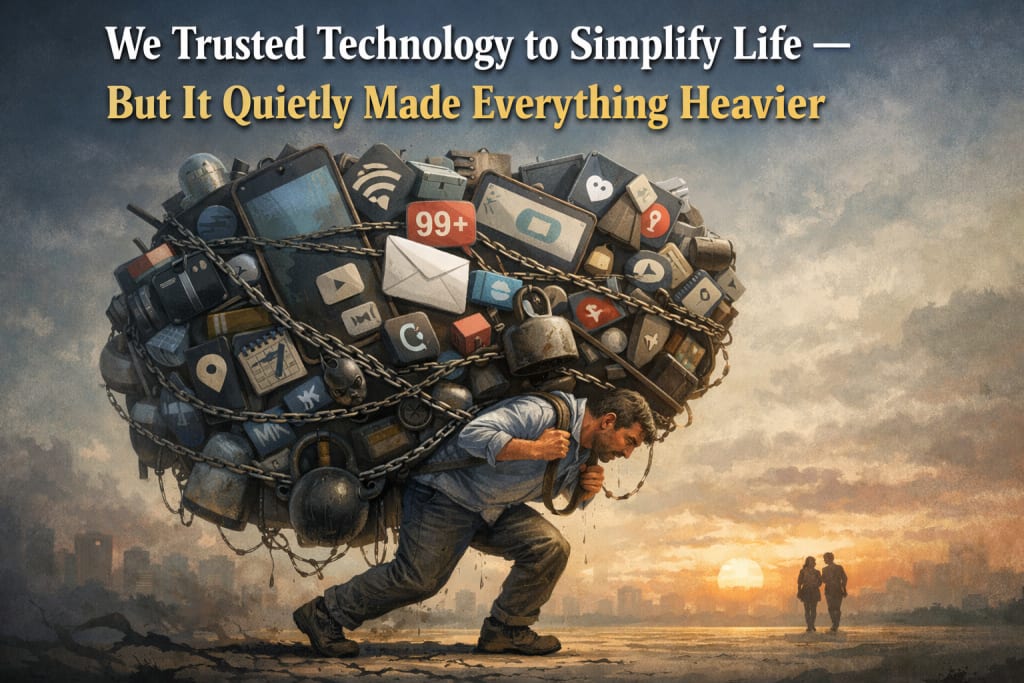
We Trusted Technology to Simplify Life, but It Quietly Made Everything Heavier.
There was a period in time when technology seemed like comfort.
A quicker phone means less waiting.
A new app means less work.
Automation means less hassles.
At least, that’s what we thought.
And in many respects, technology did make life simpler. Tasks that formerly took hours now take minutes. Communication crosses boundaries. Information became instant.
But here’s the bit nobody prepared us for:
Life didn’t feel lighter. It felt heavier.
Not everything at once.
Not significantly.
Slowly.
When Convenience Turned Into Expectation
At first, convenience seemed like a blessing.
You may respond immediately.
Finish the task quickly.
Stay connected easily.
Then convenience became the baseline.
Quick answers became commonplace.
Availability became presumed.
Silence began to appear odd.
If you didn’t answer promptly, you felt bad.
If you unplugged, you felt behind.
Technology didn’t merely help us accomplish more.
It gently upped the minimal bar of effort.
The Hidden Weight of Being “Always On”
There’s a special type of exhaustion individuals experience today.
Not physical fatigue.
Not even emotional fatigue.
A persistent, low-level mental burden.
You’re constantly aware of:
messages you haven’t reacted to
updates you haven’t checked
information you could be missing
Even during rest, part of the mind remains attentive.
Technology follows us into times that were previously private.
And it impacted how rest feels.
Why Rest No Longer Feels Restful
Rest used to signify lack of duty.
Now it frequently signifies “catching up.”
Scrolling.
Checking.
Responding.
Even relaxation is full of input.
Videos autoplay.
Notifications interrupt.
Silence becomes replaced immediately.
The body could halt—but the intellect continues functioning.
Productivity Became Identity
Technology didn’t merely transform how we work.
It transformed how we measure ourselves.
Busy began to appear significant.
Fast began to appear competent.
Optimized began to appear successful.
If you slowed down, it felt like failure.
Even when slowing down was beneficial.
People didn’t stop because they wanted to be productive.
They stopped because they were frightened of becoming irrelevant.
Why Comparison Feels Unavoidable Now
Before technology, comparison was local.
Now it’s worldwide.
You’re not only comparing yourself to friends or colleagues.
You’re comparing yourself to handpicked highlights from millions of others.
Someone is always:
earning more
learning quicker
doing better
Even when you’re doing good, it seems inadequate.
Technology didn’t cause insecurity.
It boosted visibility.
And vision without context alters reality.
The Myth That More Tools Mean Less Stress
New tools appear regularly.
Each claims efficiency.
Each offers relaxation.
But tools take learning.
Learning demands time.
Time demands energy.
Soon, you’re not simply doing your job.
You’re managing systems.
Adapting workflows.
Keeping up with changes.
The instrument becomes another obligation.
When AI Entered the Picture, the Pressure Multiplied.
AI was presented as a solution.
Automation. Assistance. Speed.
But it also brought uncertainty.
If a computer can do this quicker, where do I stand?
If abilities can be copied, what makes me valuable?
If change is continuous, how do I plan?
AI didn’t merely alter tasks.
It challenged identity.
And identity-level questions don’t get resolved soon.
The Emotional Cost Nobody Talks About
Technology conversations concentrate on features.
Rarely on emotions.
But sentiments determine actions.
People feel:
worried about falling behind
guilty for relaxing
overwhelmed by choice
pressed to maximize everything
These feelings don’t show up in specifications or reports.
But they influence everyday life more than any feature ever can.
Why Simpler Experiences Are Becoming Attractive Again
Have you noticed the shift?
People today care about:
tranquil interfaces
fewer notifications
extended battery life
predictable conduct
Not because they dislike innovation.
Because intricacy becomes tiresome.
Simple doesn’t mean outmoded.
It means breathable.
Technology Didn’t Break Us—It Overstimulated Us
Humans aren’t intended for continual stimulation.
We need:
pauses
repetition
familiarity
Technology optimized uniqueness.
New updates.
New formats.
New platforms.
The brain remained in adaptation mode.
Adaptation is stressful when it never stops.
Why People Feel “Busy” Even When They’re Not
Busyness nowadays isn’t about tasks.
It’s about mental occupancy.
Thinking about what to respond.
What to check.
What to learn next.
The mind doesn’t rest when it’s constantly expecting.
Technology decreased reaction times—but extended mental stress.
The Quiet Desire Most People Share
People don’t genuinely want:
more applications
additional features
more speed
They want:
less interruptions
clearer borders
tools that dissolve into the backdrop
They want technology to assist life, not compete with it.
Why Honest Tech Conversations Are Going Viral
People are weary of hype.
They don’t want:
exaggerated promises
overnight success tales
limitless optimization tips
They want honesty.
They want someone to say,
“This feels like too much sometimes.”
That statement resonates more than any launch event ever could.
The Responsibility Shift We’re Starting to See
Slowly, something is shifting.
Digital wellness aspects.
Focus modes.
Minimal designs.
Technology is starting to accept human constraints.
Not perfectly.
Not entirely.
But significantly.
A Healthier Way Forward
Technology doesn’t need to vanish.
It requires boundaries.
Not every communication demands a fast reaction.
Not every tool requires adoption.
Not every update requires attention.
When technology respects attention, life seems lighter.
Concluding Remark
We didn’t abuse technology.
We trusted it too, totally.
We imagined faster would feel better.
We imagined more would feel easy.
Now we know better.
The future of technology shouldn’t only be about capabilities.
It should be about caring.
Because development that costs peace isn’t progress.
It’s simply movement.
About the Creator
abualyaanart
I write thoughtful, experience-driven stories about technology, digital life, and how modern tools quietly shape the way we think, work, and live.
I believe good technology should support life
Abualyaanart
Keep reading
More stories from abualyaanart and writers in Lifehack and other communities.
I Tried This One Simple Trick… And Suddenly Making Friends Became Effortless
For a long time, I believed making friends was about being interesting, funny, or somehow standing out. I thought if I could just say the right things, tell better stories, or be more confident, people would naturally want to be around me.
By Lukáš Hrdlička7 days ago in Lifehack
The Quarterly OKR Review: Getting the Most from Your Retrospectives
The end of an OKR cycle is not simply an administrative milestone where scores are recorded and new objectives are set. It is, or should be, the most valuable learning opportunity in the entire process. Yet many organisations rush through their quarterly reviews, treating them as a box-ticking exercise rather than the strategic conversation they deserve.
By Jane Smithh3 days ago in Lifehack


Comments
There are no comments for this story
Be the first to respond and start the conversation.