
We Bought Better Technology
But Somehow Lost Our Peace

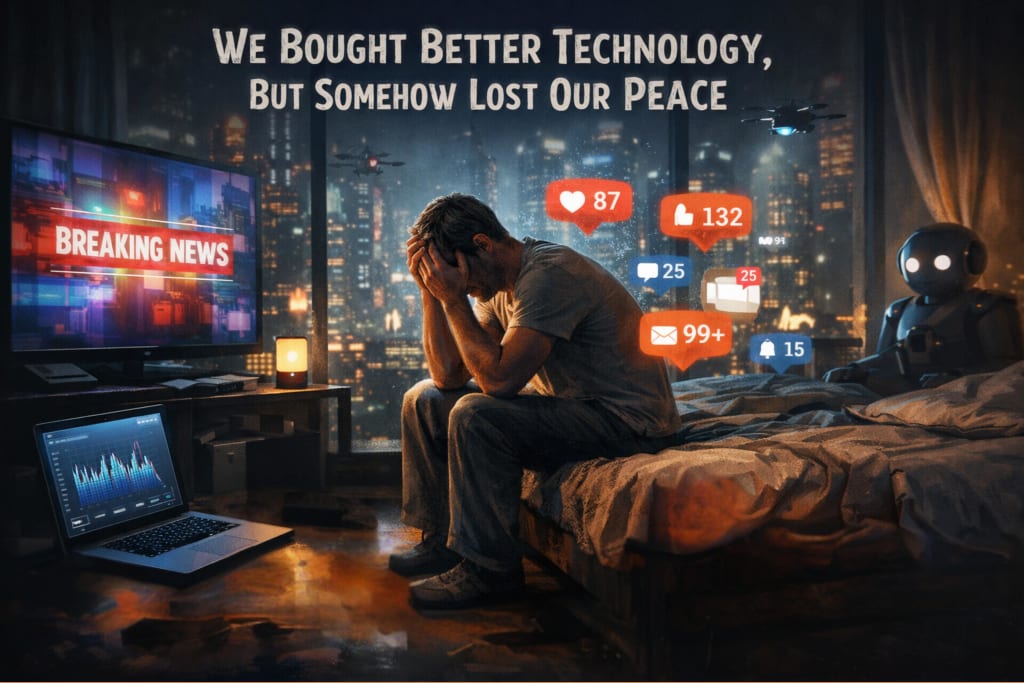
We Bought Better Technology, But Somehow Lost Our Peace
We were promised ease.
That was the bargain.
Better phones would save time.
Smarter software would decrease effort.
Faster internet would offer us freedom.
And for a time, it seemed true.
Life did get easier.
But somewhere amid incessant updates, unending alerts, and the need to continually keep up, something else silently faded.
Peace.
When Convenience Became a Constant Demand
Technology didn’t come noisily at first.
It seeped into our lives gradually.
A phone to remain in contact.
An app to save time.
A platform to make things easier.
But convenience eventually morphed into expectation.
Now you’re expected to react swiftly.
Expected to be accessible.
Expected to adapt—again and again.
What was designed to sustain life eventually started to ruin it.
And most of us didn’t notice until we were exhausted all the time.
The Mental Cost Nobody Factored In
Tech businesses assess progress in speed.
Faster processors.
Faster downloads.
Instant answers.
But people don’t process life at machine speed.
We need breaks.
We need calm.
We need times when nothing is occurring.
Instead, technology filled every void.
Waiting became scrolling.
Silence became noise.
Rest became “catching up.”
The tools improved.
Our mental strain rose.
Notifications Didn’t Just Interrupt Us—They Trained Us
At first, alerts seemed beneficial.
A message.
A reminder.
An alert.
Now they control attention.
We grab for our phones without thinking.
We check screens even when there’s nothing urgent.
We feel nervous when the phone is silent.
That’s not connection.
That’s conditioning.
And the scariest part?
Most of us never consented to it deliberately.
When Updates Started Feeling Like Stress
Updates were expected to solve issues.
Now they regularly build them.
Layouts change.
Settings move.
Features emerge that nobody asked for.
Instead of feeling better, consumers feel bewildered.
You’re forced to relearn tools you previously understood.
And this continual adjustment generates a subtle exhaustion—the type that doesn’t show up on charts but shows up in mood.
AI Didn’t Overwhelm Us—It Exposed How Tired We Already Were
When AI infiltrated daily electronics, many anticipated relief.
Automation.
Efficiency.
Smarter workflows.
What many felt instead was pressure.
Suddenly everyone online was:
“using AI properly”
automating income
keeping ahead of the curve
If you weren’t doing the same, it felt like slipping behind.
AI didn’t generate worry.
It amplified an already depleted system.
The Illusion of Being “Always On”
Technology blurred borders.
Work followed us home.
Messages accompanied us to bed.
Thoughts accompanied us into sleep.
Being online ceased being a choice.
Even when electronics are off, the mind remains linked.
Thinking about emails.
Notifications.
Tasks not yet done.
That’s why screen-time limitations don’t cure everything.
The problem isn’t the screen.
It’s the mental presence technology needs.
Why Simpler Tech Suddenly Feels Attractive
Have you noticed the shift?
People today care about:
battery life above raw power
stability above showy features
gadgets that remain out of the way
Minimal phones.
Distraction-free modes.
Software focused on calm.
This isn’t nostalgia.
It’s recuperation.
People aren’t shunning technology.
They’re resisting overstimulation.
We Confused “More” With “Better.”
More features.
More applications.
More tools.
But more doesn’t necessarily mean a better life.
Sometimes it fractures attention.
Sometimes it increases friction.
Sometimes it generates choice fatigue.
True progress doesn’t seem overwhelming.
It feels lighter.
And that’s what many people are secretly yearning for again.
Why So Many People Feel Digitally Burned Out
This burnout doesn’t come from one huge event.
It originates from accumulation.
Small interruptions.
Constant alerts.
Endless adaptation.
Day after day.
Eventually, even excellent technology feels heavy.
Not because it’s horrible—but because it never rests.
The Tech Industry Is Starting to Notice.
Slowly, slowly, things are shifting.
Interfaces are growing calmer.
Features are becoming optional.
Efficiency is replacing flash.
Companies are learning something important:
The next major invention isn’t louder tech.
It’s tech that understands when to remain silent.
What People Actually Want From Technology Now
Not perfection.
Not magic.
Just:
fewer interruptions
predictable conduct
tools that respect attention
Technology that supports life without requiring continual attentiveness.
Technology that fades into the background.
This Is Why Honest Tech Stories Go Viral
People are bored of:
spec lists
launch hype
exaggerated promises
They want honesty.
They want someone to say,
“Yeah… this feels like too much sometimes.”
That statement alone makes people stop scrolling.
Because they feel it too.
The Peace We Lost Wasn’t Taken—We Gave It Away Slowly
Technology didn’t take peace suddenly.
We traded it gradually—for ease, speed, and connection.
Now many individuals are waking up.
Not to forsake technology.
But to recover equilibrium.
Concluding Remark
We didn’t fail at leveraging technology.
We simply failed to ask the most vital question:
Does this genuinely make life calmer—or simply busier?
The future of IT won’t belong to the loudest tools.
It will belong to the ones that respect human boundaries.
And maybe—just maybe—that’s how we find our serenity again.
About the Creator
abualyaanart
I write thoughtful, experience-driven stories about technology, digital life, and how modern tools quietly shape the way we think, work, and live.
I believe good technology should support life
Abualyaanart
Keep reading
More stories from abualyaanart and writers in Lifehack and other communities.
5 Simple Lifehacks to Keep Your Teeth Healthy Every Day
Healthy teeth aren’t just about occasional dental visits—they’re shaped by the little choices you make every day. Simple habits, when done consistently, can prevent cavities, gum issues, sensitivity, and other oral concerns while keeping your smile bright and comfortable. These lifehacks are easy to integrate into your routine and don’t require drastic lifestyle changes.
By Smile Sydney2 days ago in Lifehack


Comments
There are no comments for this story
Be the first to respond and start the conversation.