
Think without Words. Science Says It Is Possible.
An evidence-based technique that works for all


We have been thinking in words all our lives. We imagine that it is safe to say whatever we wish to say in our mind, that it does not matter. We should never mentally verbalize what we would not like to listen to in real life.
UNSW Sydney scientist and study first author Associate Professor Thomas Whitford says our silent internal dialogue affects our brain's functioning, though to a lesser extent than actual spoken words. The studies demonstrate that inner speech - a purely mental action - is associated with an efference copy with detailed auditory properties. It is as if our brain is getting ready to speak those words. An efference copy is an encoded neural message that converts internal words into actual spoken words. Our inner chatter may be a hurdle in reaching our full potential.
Our silent internal dialogue dampens our brain's functioning. ~ Thomas Whitford
In today's world, this inner chatter is exaggerated many times when social media platforms spray a constant stream of words into our heads. Videos, audio, and written words, all influence our brains. It can be safely surmised that a majority of the people have a lesser number of original thoughts than electronically communicated thoughts during a single day.
Russell T. Hurlburt, Ph. D, strongly believes that thinking without words or even images is possible. Dr. Russell says that we experience inner speech, inner seeing, feelings, sensory awareness like taste or smell, and 'unsymbolized thinking'. This unsymbolized thinking is the inner experience of a person. He calls it the Pristine Inner Experience. We have to have breaks from work or social media if we want to experience our true life-spirit. Dr. Russell says that most people, including many psychologists, believe that thinking without words is impossible.
Russell T. Hurlburt, Ph. D, calls 'thinking without words' to be the Pristine Inner Experience.
You must have experienced moments of deep relaxation when you were instructed to empty your mind of all thoughts, with deep breathing exercises. When you focus on your breathing during mindful meditation, your mind starts to block all verbal or image thinking, focusing on the breath as the air goes into your lungs and comes out of your mouth. A five-minute session of mindful meditation can have a rejuvenating and exhilarating effect on you for the rest of the day. Just imagine if you could master the art of thinking without words, you will not be easily disturbed by anything.
There is a voice that doesn't use words. Listen. ~ Rumi
We communicate with our family members, class fellows, colleagues, and friends on the internet almost to the point of excess. The reason is that we live in the age of communication. We use spoken and written words, images, symbols, and gestures to communicate with everybody. We are in such a habit of communicating using words that we have started communicating with ourselves using words. Words were invented to communicate with others. We need tools to communicate with others because they cannot understand or feel what we are feeling or what is in our hearts. It is essential to understand that we do not need words for our internal communication. If we empty our minds of all words, when we are alone or not actively engaged in some communication-intensive activity, and stop the 'word stream', we will be more in touch with ourselves automatically.
Stop the 'Word Stream' and you will be more in touch with yourself automatically.
A powerful argument against the thinking-without-words approach can be that we will not be ready to process complex thoughts later when we will need those words to communicate a difficult idea. This argument was first put forth by George Orwell in his novel 1984. His fictional theory was that the rulers had invented a language called Newspeak that had a smaller vocabulary. The evil intent of the rulers was that their subjects may never become capable of processing complex thoughts that could encourage them to challenge their unlimited political power. But this idea is scientifically not proven. Even in the absence of specific words for different colors, the Dani people of New Guinea could differentiate between different colors.
Children can understand abstract ideas using pictorial presentations of real or fictional reality. Every painting and music masterpiece is an abstract representation of some feeling, some emotion that could not be easily described in words. Emotions cannot be grasped by simple words in general. We are not in full agreement on the meaning of the word "love". Many books have been written in an attempt to explain the meaning of love. Complex emotions are even harder to explain and may require entire novels to express a single emotion. The actual point that contains a whole complex thought in our mind, may be so difficult to explain that people like Einstein and Max Plank, spent their entire lives learning and developing mathematical models to express such complex points of thought.
Steven Pinker is a Professor in the Department of Psychology at Harvard University. His research is on language and cognition. He puts forth an interesting concept that all humans have an innate language of thought, which he calls Mentalese. He says, "Knowing a language, then, is knowing how to translate mentalese into strings of words, and vice versa." This basic language does not need words to function but it has complex symbols, feelings, and emotions as its alphabets, kind of like a machine language. Paulo Coehlo also writes about such a universal language of signs which can convey detailed messages to his characters in his fictional works. His novels are based on the magical realism school of literature.
Language does not give us the full capacity to express what we are thinking, feeling, hoping for. ~ Noam Chomsky
Noam Chomsky, an American philosopher, and linguist, said in one of his lectures, "Language does not give us the full capacity to express what we are thinking, feeling, hoping for. People talk to themselves all the time and it takes a tremendous act of will to understand what is going on inside our minds." According to Chomsky, the thought process continues without words, we can just see those thoughts happening inside our brains and then we convert those thoughts to words for expressing our intent. Art, literature, and music are all efforts to express what a normal language cannot express. Chomsky says that there is a dogmatic belief that if we are not conscious of what is going on in our thoughts in a verbal format, it is not happening at all. In simple words, it means that thoughts are always happening whether we are conscious of the stream or not.
I very rarely think in words at all. A thought comes, and I may try to express it in words afterwards. ~Albert Einstein
Our minds can be broadly subdivided into conscious and subconscious minds. The conscious mind can handle around 40 bits of information per second but our subconscious mind can process around 400 billion bits of information per second. It means that you should not verbalize every thought that is important to you. Instead, try hard to get rid of the words and let the internal subconscious level thinking take control. Just focus on the problem's solution, take deep breaths, and create a kind of hope or urgency that your inner systems can come up with the right solution, using the higher processing speed of 400 billion bits per second.
Thinking without words is especially necessary for writers and researchers.
Bertrand Russel, a British philosopher, mathematician, writer & essayist, had a book writing strategy. He would cram his mind with all the books, articles, and research material that he could read about the topic of his upcoming book. He simply tried to understand the work that had been done before him. Then he would just leave the topic for two months and would start doing some other work. He described it as if he had created a mountain of knowledge and then he left the mountain behind. His mind's internal systems would take control and after, say, two months, one fine morning he would wake up and just feel that the book was ready to be written on paper. He won Nobel Prize for Literature using his techniques.
Sigmund Freud was an Austrian neurologist and the founder of psychoanalysis. Psychoanalysis is based on the paradigm that there exists a very strong thought-stream just beneath our conscious awareness, and a psychologist tries to tap into the stream and loosen the grip of subconscious thoughts to create mental relief. There are feelings, memories, traumas, pleasant and unpleasant events, desires, and fantasies happening all at once in our subconscious stream of thoughts. It is as if our conscious mind is just the tip of the iceberg.
Psychoanalysis assumes that there exists a very strong thought-stream just beneath our conscious awareness
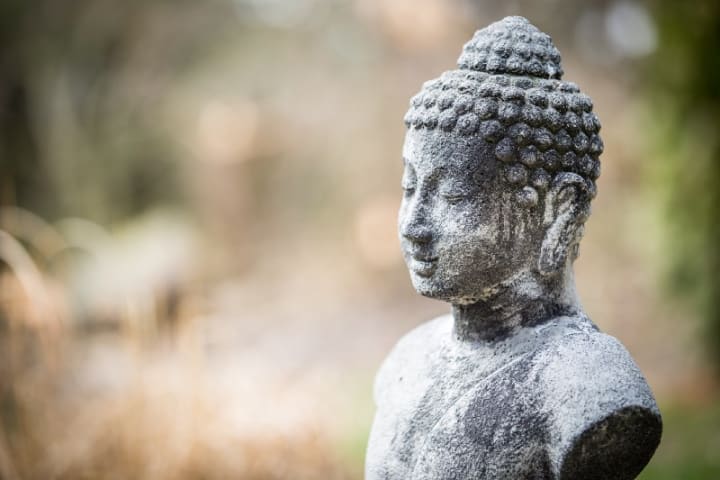
Buddhist monks often take a vow of silence to practice and train their minds to be able to choose the right words. They believe that by not speaking every word that pops up in their head, they will develop the ability to differentiate between good and harmful words. As a result, the monks can pick the best words to describe the moment and the intention. The monks can stay quiet for long periods, observing nature and its calmness. It has been seen in laboratory conditions that the monks are somehow able to harness their brain's neuroplasticity. They can rewire their brains to reach an unprecedented level of control over their emotional states.
A Zen monastery is known as the zen-dō, and a primary monastic practice is the sitting meditation called zazen. Zazen is practiced in silence. Zen masters teach disciples to be especially quiet during meal times. This lack of word usage is accompanied by an effort to unlearn all the previously learned knowledge by emptying your mind of all conscious thinking and preconceptions until you can feel the pure mind itself. This pure mind is our core thinking process. It is the machine language that can process 400 billion bits of information per second controlling our entire being from the subconscious control center. This high-speed thought process can only be felt in an abstract way and in a deeply spiritual frame of mind.
--------------
Conclusion
You do not need to be aware of this heightened state of processing twenty-four hours a day, seven days a week. You would be, theoretically, 10 billion times smarter than your former self. This level of performance is never practically required and who will do all the work if you were busy meditating all the time. All you have to do is to practice quietening your mind for a five-minute session.
Close your eyes, take deep breaths, and unlearn all the stress and anxiety for five minutes. You can also try to feel an urgency to find the solution for any problem that you may be facing at the time. Repeat this five-minute session two or three times daily and you will become the Master of Thinking Without Words.
---
About the Creator
Dew Langrial
A Thinker, Writer & Storyteller. Living life in awe of it all. Hoping to make sense. Working on my tech startup.
Keep reading
More stories from Dew Langrial and writers in Lifehack and other communities.
Wool Rugs: Why They are Popular and Worth Considering
Wool rugs continue to be a popular choice for living spaces, and their appeal has remained steady for generations. While synthetic rugs often cost less upfront, wool stands apart for its natural performance, comfort, and long-term value. Understanding why wool rugs are so widely used helps explain why they remain a smart and reliable option for many homes today.
By orton watt4 days ago in Lifehack
How to Choose the Right Fitness Equipment for Your Home Gym
How to Choose the Right Fitness Equipment for Your Home Gym (Without Wasting Money) Building a home gym is exciting, but it’s also where many people make expensive mistakes. With endless machines, brands, and “must-have” features, it’s easy to buy equipment that looks impressive online but doesn’t truly fit your space, goals, or long-term routine. Many home gyms slowly turn into storage rooms filled with unused machines.
By Enrique Navarro6 days ago in Lifehack
A Failed Artist, A Disillusioned Poet, An Underpaid Game Show Host
I took my son and niece to Gori, a small town in Georgia where Joseph Stalin was born. They talked me into visiting the Stalin's Museum, the largest in the post-Soviet space. I had resisted going there because I just can't stand the monster and know enough about him, or so I thought.
By Lana V Lynx7 days ago in FYI




Comments
There are no comments for this story
Be the first to respond and start the conversation.