
The Silent Language of Machines
How Tech is Learning the Art of Nuance

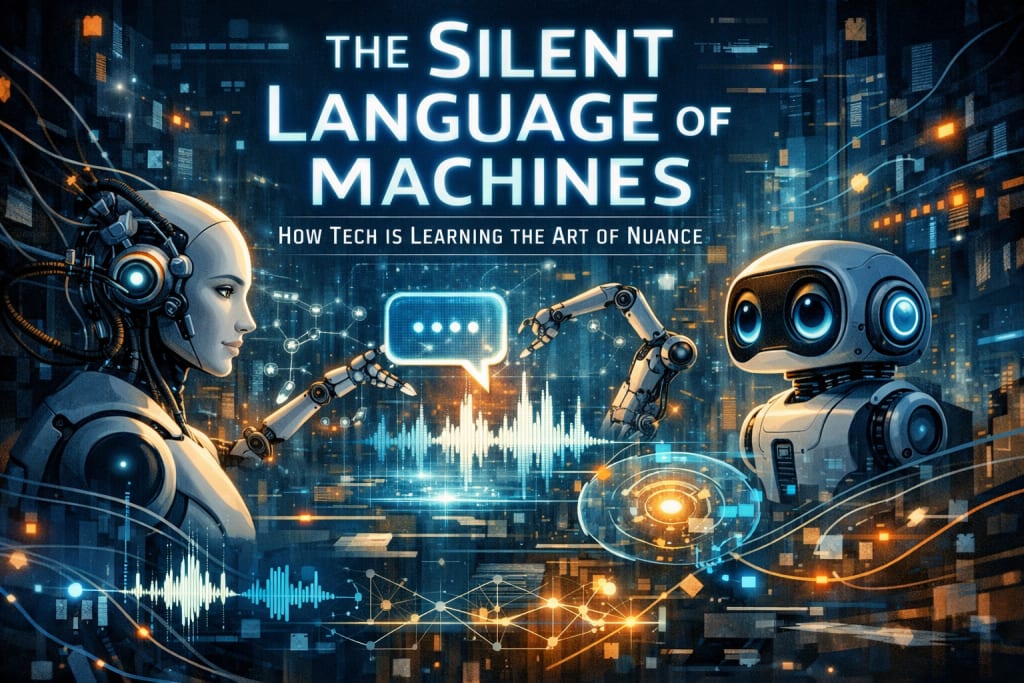
The Silent Language of Machines:
How Tech is Learning the Art of Nuance
We are training technology to speak a new language—one it was never built to comprehend. For decades, our communication with computers has been binary, explicit, and excruciatingly exact. We entered instructions in code, clicked inflexible icons, and worded searches like we were addressing a pedantic librarian. The big promise of the digital era was efficiency, but the penalty was conversational impoverishment. Now, a silent revolution is changing the script. The frontier of innovation is no longer about sheer processing capacity but about emotional and contextual intelligence. Machines are learning to grasp not only our words but also our silence, our tone, and the unsaid message hanging in the air.
This change is shifting us from a world of instructions to a world of context. Your gadgets are learning to listen like a human, not a protocol.
The Three Layers of Nuance Tech is Finally Grasping
1. Paralinguistics: The Data in the Delivery
True communication is just approximately 20% the words we utter. The remainder is paralanguage—tone, pitch, tempo, hesitancy, and emphasis. Early voice assistants failed because they listened for keywords. Next-generation AI is learning to hear the music underlying the speech.
The Stressed Syllable: You say to your automobile, "I'm fine," in a tight, clipped tone. A fundamental system hears an affirmative. A subtle algorithm recognizes the tension, cross-references it with your sped-up heart rate (from your wearable), and softly recommends, "Would you want to pull over at the next rest stop? I'm noticing heightened stress."
The Pregnant Pause: In a video conversation, an AI meeting assistant doesn't only transcribe speech. It notices when someone is regularly interrupted, signified by broken speech and pauses. Later, it can infer, "Kamala appeared to have a point she couldn't complete concerning the timing. Would you want to follow up with her?"
2. Proxemics & Presence: Reading the Room (Literally)
The next interface isn't a screen; it's the area around you. Smart sensors and cameras are evolving beyond basic motion detection to recognizing human presence and social geometry.
The Huddle vs. The Presentation: A smart conference system can discern between a close huddle of three people brainstorming (it may lower the lights and play focus music) and a formal presentation (it would increase lighting, silence music, and auto-frame the speaker for distant attendees).
The Intimate Distance: Your smart home lights don't simply switch on. It observes. If it detects two individuals sitting together on the couch, whispering quietly, it could gradually fade to a more intimate, warm light, interpreting the social signal for a private discussion.
3. Chronemics: The Wisdom of Timing
The single most complex kind of human intellect is knowing when not to talk. Tech has traditionally been horrible at this, pinging us with alerts at all hours. Now, systems are learning chronemics—the study of time in communication.
The Recovery Window: After sending a lengthy, sophisticated work email, your email software doesn't simply state "Sent." It learns your tendencies and can freeze your "Send" function for 2 minutes on any emails labeled "Urgent" after 8 PM, delivering a soothing, "This is scheduled for 7 AM tomorrow. Send immediately or keep scheduled?"
The Contextual Delay: A notice from your supervisor at 9 AM comes promptly. The identical notice from a casual game or social app is stored in a digital buffer if your smartwatch indicates you're in a deep sleep cycle and sent only when your morning routine says you're "awake and caffeinated."
The Uncanny Valley of Understanding: When Nuance Feels Like Surveillance
This tremendous sensitivity causes a new form of unease: the intimacy paradox. The more technology knows us, the more it seems like it's watching us.
The Creepy vs. The Compassionate: A system that proposes a rest break when you seem stressed may be perceived as compassionate. That same system advising you to purchase a weighted blanket because it heard you toss and turn last night crosses into creepy. The line is narrow and subjective.
The Loss of Platonic Ignorance: Sometimes, we depend on technology's "stupidity" as social cover. "Sorry, my calendar didn't sync!" is an easy excuse. When your calendar is context-aware enough to know you purposely refused the event, that white lie dissolves. Machines that grasp subtlety erase our digital alibis.
Designing for Trust in the Nuance Age
For this to succeed, the design principles must progress from utility to integrity and transparency.
The "Why Did You Do That?" Button: Any system that acts on subtlety must have an instant, straightforward means to explain itself. "I dimmed the lights because I felt like a private chat. Click to revert."
Nuance Calibration Sliders: Users should be able to change their "nuance sensitivity" like a thermostat. A slider from "Literal (Only respond to direct commands)" to "Contextual (Consider my tone and situation)" to "Anticipatory (Try to predict my needs). " Control is crucial.
The Right to Be Misunderstood: We must be allowed to select for cumbersome, literal, clear encounters when we desire. Sometimes, you simply want to rant at a stupid computer, not have a nuanced discourse with a perceptive one.
The Human Becoming: What We Gain When Machines Listen Better
Ultimately, this isn't simply about improved tech. It's about improved human reflection. A gadget that identifies micro-expressions of irritation on our faces prompts a system to inquire, "Why is the user frustrated?" This might lead to software that is inherently less annoying.
When technology acquires the skill of subtlety, it holds up a mirror. It shows us the intricacy of our own communication—the sighs, the hesitations, and the unwritten constraints of place and time that govern our human world. In attempting to train robots to be more like humans, we are, maybe, relearning how to be more human with one another. We are being reminded that genuine efficiency isn't about speed but about comprehension. And that the most powerful protocol in existence isn't TCP/IP, but empathy. The silent language computers are learning simply could be the one we most needed to remember ourselves.

About the Creator
abualyaanart
I write thoughtful, experience-driven stories about technology, digital life, and how modern tools quietly shape the way we think, work, and live.
I believe good technology should support life
Abualyaanart
Keep reading
More stories from abualyaanart and writers in Lifehack and other communities.
The Next Interface
The Next Interface: Why the Future of Tech Isn't on Your Screen We are living in the last age of the screen. For nearly half a century, our main communication with technology has transpired via a succession of luminous rectangles—the television, the computer display, and the smartphone. We touch, swipe, and scroll, our eyes focused on a gateway to another planet. We call this progress. But it is also a fundamental constraint, a bottleneck for human purpose. The next tectonic leap in technology is not about making these displays sharper, brighter, or foldable. It is about pushing beyond them totally, toward an interface that integrates with the environment itself. The future is ambient, intuitive, and invisible.
By abualyaanart13 days ago in Lifehack
When Architecture Speaks: The Billionaire Home as a Mirror of Self
In the realm of the ultra-wealthy, owning a home is rarely about square footage or resale value. It’s about creating a physical embodiment of the self. For billionaires, architecture becomes a language—each material, structure, and spatial rhythm part of a larger, intentional narrative. These homes are not simply bought or designed; they are composed to reflect personal values, intellectual pursuits, and emotional states. They go beyond luxury to articulate identity in form.
By Inspirata Groupa day ago in Lifehack
📢 Raise Your Voice Thread: 01/08/2026
Our “Raise Your Voice Threads” are hosted most alternating Thursdays at 12PM ET to offer creators more avenues to uncover exceptional stories on Vocal. As we are continuously searching for fresh creators and inspiring stories, this thread provides an opportunity to exchange and discuss the stories that have moved and motivated us on Vocal.
By Raise Your Voice by Vocal4 days ago in Resources


Comments (1)
please read my stories