
The Most Overlooked Skills That Can Change Your Life
How posture, communication, networks, and priorities shape lifelong success.


In the late 1960s, my grandmother began choking on a steak at a wedding party. She fell to the floor unconscious, and after three days in a coma, passed away. Nobody at the wedding party knew the Heimlich maneuver (it wasn’t taught very often). And because of that, I never got to meet my grandmother.
Today, most people know these basic skills and lessons that could change someone’s life. There are other, unusual, deceptively simple things that deliver profound value — with very little effort.
The Pareto principle is a far-reaching statistical phenomenon.
It’s anchored in an 80:20 system. For example, in healthcare, 80% of costs stem from roughly 20% of patients. In sales, 20% of products often constitute 80% of sales volume.
Even Microsoft uses the Pareto principle: they realized that solving the top 20% of commonly reported bugs stopped Windows from crashing 80% of the time.
The Pareto principle is the science behind, “A little bit goes a long way.” It’s why students who open their books for even 15–20 minutes, usually do far better than those who don’t study at all.
In time crunches, our brain is wired to be remarkably efficient and good at prioritizing. Examples of the Pareto principle could fill a dozen pages, and you can use one today.
The trick: When you have a task — be it cleaning, coding, writing, working — ask yourself, “What 20% of this can I do that will deliver the majority of the results?”
For example, with cleaning: sweeping areas of your home with the highest use (where people walk or eat most) delivers the most efficient use of your time. Think small — as it relates to big.
One of the pitfalls people fall into is assuming that doing seven or eight small tasks is being productive when they don’t actually move the needle. Try to focus on the one or two things that will have the highest impact. I’ll give you a hint: they are generally the things you want to avoid. Knuckle down and do them.
Heck, I’ve even inverted this principle with my diet. I found that if I can stick to a perfect macro-micronutrient diet for 80% of the time, it gives me room to indulge a little in that other 20%. But that doesn’t mean I can go into a full binge session.
2. Live within an “open network”
When I watch movies, I see so much diversity. A bank heist crew always has a few white guys, a black guy, maybe an Asian guy, all working together. Superhero teams have a broad mix of people that gives every group a “seat at the table”.
Yet when I sit down for lunch at literally any office or public place, it feels so tribal. One table is mostly white dudes, another is Asian women.
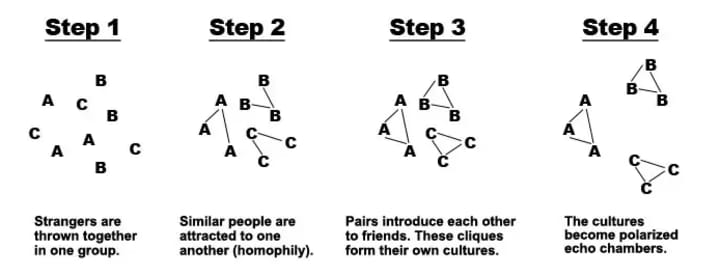
This relates to homophily, a common phenomenon where we sort ourselves into similar groups, and our network gets increasingly closed:
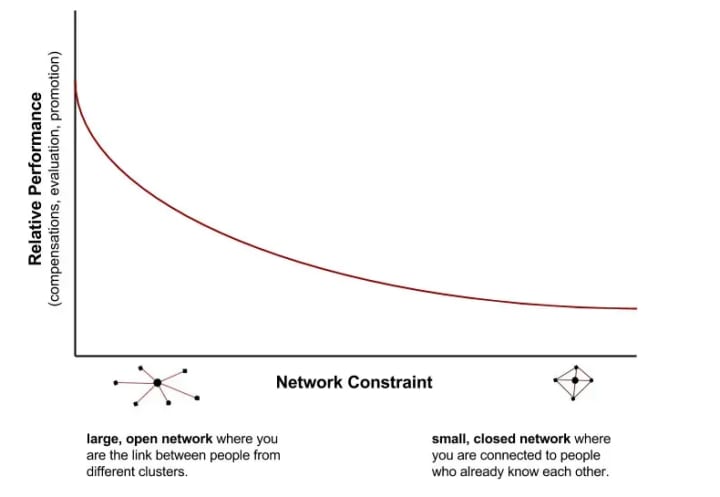
The further to the left you are on the above chart, the greater your odds of success. It means you are surrounded by a varied and open network of people. Putting all moral platitudes aside, diversity is literally good for your life.
You are exposed to ideas different than your own, unconventional thinking, and a plethora of career paths. Open networks reduce bias and improve decision-making.
3. How to be an email assassin (and communicator)
Oddly, the most useful class in my MBA program wasn’t a finance or operations class. It was a business writing course. We sat in the classroom, groaning, thinking, “Damn. How did I not know this?”
In our most entertaining homework assignment, we each brought in the sloppiest work emails we’ve seen.
Many of my classmates worked at elite companies, yet still scraped together horrifically written emails, full of typos, cursing, incoherent wandering. I wondered how some of these people got into Ivy League schools.
My example was from a coworker who used giant barbie-font, bolded in pink, size 30, that could only fit five words per line in the body of the email.
I remember reading those emails, thinking, “I don’t know what this email is about. But I hate everything about it.”
There’s a very simple trick to writing good emails and it applies to verbal communication: remember that most people are busy and generally motivated by self-interest.
Front Load your message. Include your intentions, in very clear terms in the first sentence, “I’m writing because my refund wasn’t processed.”
Be specific in your subject line.
If you need to persuade, use Logos(logic), Pathos(emotion), Ethos(credibility), in varying degrees depending on the context.
If it's a client or prospect, it should definitely be personalized. Email excellence carries the infrastructure of good communication. Don’t be a sloppy emailer. Be clear and get to the point.
4. Improving the back issues
When I took my first office job, there was an initial shock to being seated for eight to nine hours a day in front of a computer screen.
I noticed my posture became terrible over time. And this coincided with consistent back pain that began to interrupt my quality of life. This problem is quite common. One study found that 70.5% of respondents had neck or back pain at some point within the last month. Our bodies are still programmed as hunter gatherers, hence this sedentary lifestyle has been terrible for our health.
Finally, I went and saw a chiropractor who began adjusting me and also gave me exercises to strengthen my core.
I’ll share one of best practices he taught me, that I use to this day. This might sound weird, but—pretend there are lasers coming out of your nipples. Anytime you are talking to someone, those lasers should be pointed directly at a person's face. When I do this, it causes my shoulder blades to pull back, and my chest to point up. My chin raises more. It takes the pressure off of my lower back and helps me develop my core strength, which holds me upright.
If you are having back pain, one of the best things you can do is work on your posture. Additionally, going to the gym and practicing weight training works wonders for back pain. Try to avoid activities that are high impact, such as running.
Recap for memory: four things you can do to better your life
Have friends of diverse backgrounds. It improves cognition, lifetime earnings, and contentment.
Identify the steps where 20% will deliver 80% of your desired results. 80:20 applies to a shockingly large number of things in life.
Focus on improving your posture. Imagine lasers coming out of your chest. They should point at a person's face when you're standing.
Stop writing sloppy emails. Be to the point, specific, and persuasive when need be (use appeals to logic, emotion, credibility). Don’t use huge barbie font.
About the Creator
Elara Whitmore
Hi, I’m Elara Whitmore — a developer and problem-solver who loves building smart digital solutions. I’m passionate about coding, tech innovation, and creating tools that make life easier.
Keep reading
More stories from Elara Whitmore and writers in Lifehack and other communities.
My Test of Footography for Safety and Trustworthiness
Hey there, I’m Elara Whitmore, a digital creator from Texas. For the past year, I’ve been building a side hustle that now brings in a steady $2,500 a month: selling feet pictures. If you’ve heard the buzz and are searching for “Footography reviews” or “is Footography legit?”, you’ve come to the right place. I’m here to give you the real, unfiltered story from someone who’s actually doing it.
By Elara Whitmore3 months ago in Fiction
Top 10 Questions to Ask Every Perth NDIS Service Before You Engage Them
Choosing the right National Disability Insurance Scheme (NDIS) provider shapes the quality of care, independence, and outcomes a participant experiences. In Perth, families and participants face a growing number of service options, which makes informed decision-making essential.
By Anshul Vijay4 days ago in Lifehack




Comments
There are no comments for this story
Be the first to respond and start the conversation.