
The Cowboy Code of the Early Internet is Dead. What Comes Next?
Navigating the Great Digital Enclosure And the Search for a New Online Commons

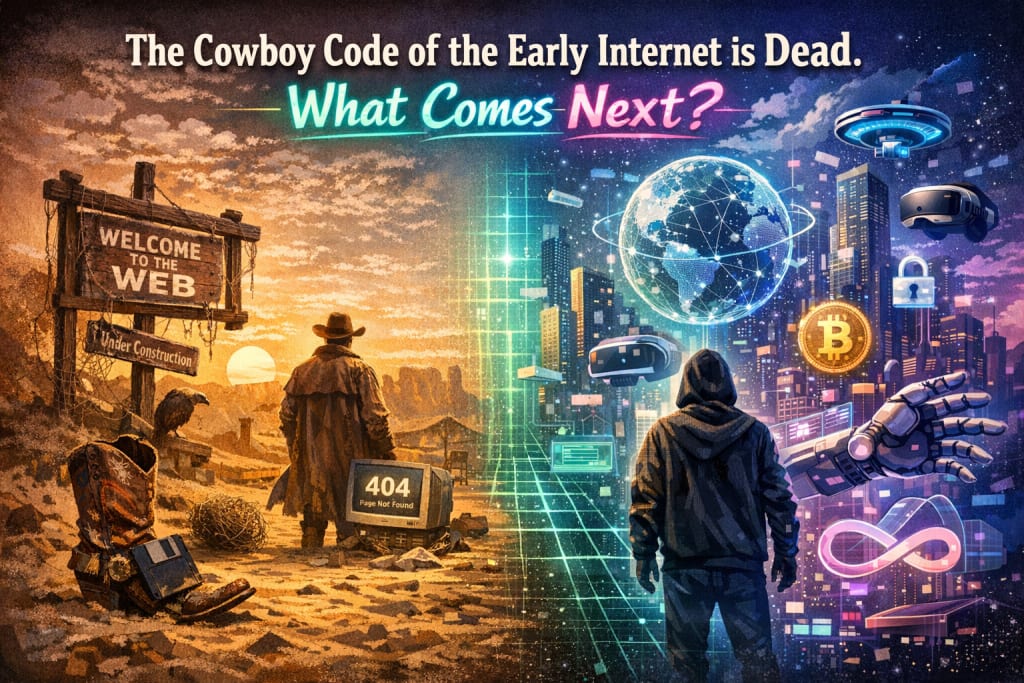
The Cowboy Code of the Early Internet is Dead. What Comes Next?
Navigating the Great Digital Enclosure—And the Search for a New Online Commons
There was a moment when the internet seemed less like a well-controlled metropolis and more like a huge, unmapped wilderness. The restrictions were few, the fences were low, and the mood was one of unrestrained experimentation. You made a “homepage” on GeoCities because you could. You lurked in esoteric forums where the only currency was specialist knowledge. You downloaded files with names like “cool_game.exe” from locations you definitely shouldn’t have. It was tumultuous, frequently nasty, and indisputably freeing. It ran on a sort of digital cowboy code—a loose set of conventions predicated on pseudonymity, open protocols, self-moderation, and a common idea that this new land belonged, in spirit, to everyone.
That internet is gone.
We didn’t simply abandon the border; we paved it, privatized it, and erected walled gardens on top of it. The digital steppe has been split into the groomed lawns of The Big Five Estates (Meta, Google, Apple, Amazon, and Microsoft). The cowboy code—with all its shortcomings and its freedom—has been superseded by the Terms of Service Agreement. Our town squares are becoming privately owned retail malls where expression is a privilege provided by corporate policy. The promise of a linked global commons has constricted into a succession of tailored, algorithmically sorted feeds aimed for one thing: keeping us interested and extractable.
This isn’t a mere lament for a lost past. It’s a diagnosis. The boundary closed. The issue now is, what do we create in its place? Because the existing model—a hyper-commercialized, attention-obsessed, data-hungry internet—is leaving us lonely, angry, and fatigued. We need a fresh vision, not a nostalgia trip.
The Three Pillars of the Cowboy Code (And Why They Collapsed)
To comprehend what’s ahead, we have to realize what we lost.
Pseudonymity as Protection & Play: In the early web, you were frequently a screen name—“Quantum Rose” or “Xx Dark K nightx X.” This barrier between your online persona and your “meatspace” self was a shield. It allowed for risk, reinvention, and unvarnished opinion without it haunting your credit score or career chances. Its breakdown started with the “Real Name” policy of social platforms, which promised civility but brought monitoring and a silencing of criticism. The shield becomes a leash.
The Open Protocol as a Public Good: The internet’s basic infrastructure was constructed on open, decentralized protocols—HTTP, SMTP (email), and IRC (chat). Anyone could develop a server, a client, or a service that linked into this global grid. Your email address worked no matter which service you chose. This was the frontier’s common land. Its deterioration happened with platform lock-in. You can’t message a WhatsApp user via Signal. You can’t follow a TikTok creator from Instagram. The protocol became the product, and interoperability perished.
The Forum as a Digital Township: Communities were granular and self-governing. A knitting forum, a Linux troubleshooting board, and a fan site for a niche anime—each had its own culture, its own moderators, and its own feeling of home. You gained standing via contribution. This was replaced by the globalized, algorithmic feed, which favors interaction above coherence, taking a post from a tiny, context-rich community onto the enormous, context-free stage of For You pages, where it is frequently misinterpreted and weaponized.
The Age of the Digital Sharecropper
We didn’t merely go from the frontier to the metropolis. We moved from being pioneers to becoming sharecroppers on digital farms.
We supply the work (our material, our data, our attention). We nurture the soil (forming communities, establishing trends). But the land—the platform, the infrastructure, the network effects—is owned by a distant landlord who takes the majority of the value (the data, the ad revenue, the influence) and can evict us (de-platform, demonetize, shadow-ban) at any time, for reasons that are often opaque and non-negotiable.
The upshot is a strong sensation of dispossession. We experience it in the fear of creating a company on Instagram, only to have the algorithm change overnight. We sense it in the fragility of a decade’s worth of talks confined within a fading forum platform. We developed the digital world, but we don’t own it.
The Blueprints for What Comes Next: Beyond the Walled Garden
The future internet won’t be a return to the uncontrolled frontier. It will be an intentional development of a more compassionate, user-sovereign digital society. The seeds are already growing in the fractures of the present structure.
1. The Fediverse & The Protocol Renaissance: This is the most direct threat to walled gardens. Projects like Mastodon (based on the ActivityPub protocol) are developing a social web where you select your provider but can still connect with anybody else on the network. It’s like email for social media. You control your identity and your audience; you’re not a renter on a corporate server. This strategy stresses choice and interoperability above convenience and scalability.
2. Digital Ownership & The Creative Economy 2.0: The initial wave of the creative economy was still on leased property (YouTube, Substack, TikTok). The next phase is experimenting with actual ownership using technologies like blockchain, not for speculative crypto, but for verified ownership of digital goods (art, writing, memberships). The objective is to empower artists to control the direct connection with their audience and the entire value of their work, minimizing platform reliance.
3. Purpose-Built, Slow Communities: A silent rejection of the enormous, loud feed is the return to tiny, focused, deliberate digital communities. Platforms like Discord (when used correctly) and newer, privacy-focused forums are revitalizing the “digital township” concept. These are gated not by money, but by common interest and agreed-upon rules. They emphasize depth of connection above breadth of reach.
4. The Right to Digital Silence: A core premise of the new internet may be “ambient privacy”—the design of systems that gather only the data essential for operation and are opaque by default. This is the reverse of the existing surveillance-based strategy. It’s a knowledge that a thriving public square demands private nooks.
Conclusion: From Tenants to Stewards
The downfall of the cowboy code was inevitable. Frontiers are unsustainable. But the successor shouldn’t be a digital feudalism.
The duty before us is not to be consumers, or even merely makers, but stewards. It means intentionally supporting the protocols, platforms, and practices that correspond with a better vision: an internet that is interoperable, owner-operated, context-rich, and respectful of human attention and privacy.
It will be messier. It will be less convenient. It could mean giving up the smooth, irresistible gloss of the algorithmic feed for the somewhat clunky, self-moderated reality of a community you help control. But it gives something the existing approach never can: agency.
The next internet won’t be discovered. It must be constructed. And the first step is to stop being a contented renter in a walled garden and start putting seeds in the commons again.
About the Creator
abualyaanart
I write thoughtful, experience-driven stories about technology, digital life, and how modern tools quietly shape the way we think, work, and live.
I believe good technology should support life
Abualyaanart
Keep reading
More stories from abualyaanart and writers in Lifehack and other communities.
Your Phone is a Solution Looking for a Problem, and It’s Making You Anxious
How Feature-Bloat and Digital Clutter Turned Our Greatest Tool Into a Source of Overwhelm Your smartphone is a wonder of human engineering. It is a camera, a movie, a library, a workplace, a social club, and a worldwide communication device, all packed into a slab of glass and metal that fits in your pocket. It is, by every objective measure, one of the most powerful and versatile tools ever devised.
By abualyaanart13 days ago in Lifehack
Technology’s Role in Building Cleaner, Healthier Communities
Technology has become an essential force in shaping modern society, influencing how people communicate, travel, and manage resources. One area where its impact is increasingly visible—but often underappreciated—is sanitation. As communities grow denser and environmental concerns intensify, traditional cleaning methods are no longer sufficient. Technology-driven sanitation solutions are emerging as a critical tool in building cleaner, healthier, and more sustainable communities.
By EcoClean Innovations6 days ago in Lifehack
Top Things to Do in North Potomac for Families
Known for its quiet neighborhoods and welcoming atmosphere, North Potomac appeals to families who value space, safety, and a strong sense of community. Whether you are new to the area or have lived here for years, there are plenty of activities that families can enjoy together.
By House Doctorabout 12 hours ago in Lifehack


Comments
There are no comments for this story
Be the first to respond and start the conversation.