
The Analog Algorithm
Why the Human Brain is Still the World's Most Powerful Search Engine

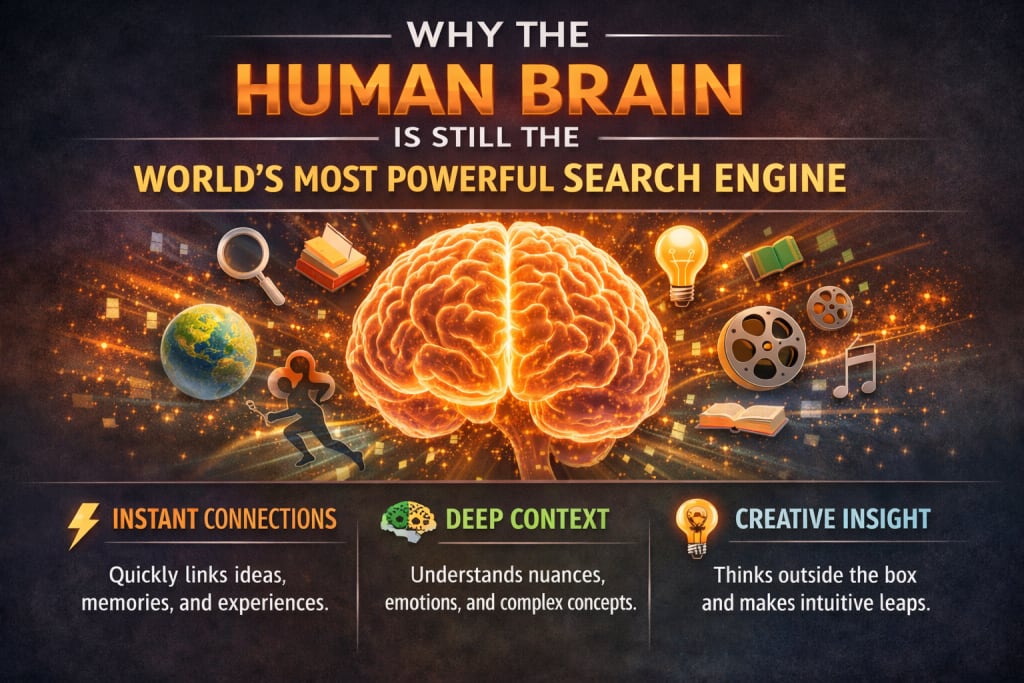
The Analog Algorithm:
Why the Human Brain is Still the World's Most Powerful Search Engine
We live in the era of quick recollection. Type a half-remembered song lyric into a search window, and within 0.47 seconds, you get the title, artist, year, album, and a link to three separate streaming services. Our electronics provide us the illusion of omniscience—a flawless, externalized memory. We have outsourced recall to the cloud. But in doing so, we have committed a tragic, magnificent mistake.
We have confounded information retrieval with comprehension.
The most profound search engine you will ever use is not powered by silicon, hosted in a data center, or accessible via a browser. It is the three-pound cosmos of flesh and energy nestled in your head. It runs on an analog algorithm—a chaotic, intuitive, beautifully inefficient process of connection that no computer has yet imitated, since its main role is not to discover an answer but to generate meaning.
The Flaw That Makes It Brilliant: The Search That Changes the Searcher
When you query Google, "What is the capital of Estonia?" the process is transactional. You entered a question. The method, in a straight line, obtains the proper data ("Tallinn"). You get it unmodified. The system is static. You are static.
When you ask your own memories the same question, the process is transforming.
You may not recollect the answer instantly. A fog falls. A faint picture of a map of Eastern Europe emerges. You recall a documentary on the Baltic states. You think of a friend who went there. The word "Tallinn" seems near, but you second-guess: "Was it Vilnius? No, that's Lithuania…" This battle is not a bug. It is the feature.
As your brain explores its own jumbled archives, it is not retrieving a single file. It is re-weaving the whole neural network relating to location, personal tales, history, and language. You are not merely recovering "Tallinn"; you are reinforcing the linkages between European cities, your friend's travel adventures, and your own understanding of 20th-century history. The search modifies the architecture of the searcher. Every time you utilize your own memories, you grow wiser, more connected, and more you.
The Three Ingredients No Digital Search Can Replicate
The human search algorithm works on three fuels that are hazardous to silicon-based efficiency.
1. Inefficiency (The Scenic Route)
A machine's aim is the quickest route between query and response. The human brain favors the scenic way. Trying to remember the name of an actor, you could first recollect the color of the movie poster, the scent of the popcorn you ate, the buddy you watched it with, and a line of dialogue, and then, ultimately, their face and name. This meandering road seems irritating, yet it is a type of cognitive cross-training. It strengthens your brain's capacity to make associative leaps—the basic core of creativity and problem-solving.
2. Emotional Bias (The Colored Lens)
Our recollections are not kept as impartial data. They are labeled with fear, excitement, sorrow, and love. This is why you can perfectly recall what you were wearing on your first date a decade ago, yet forget where you dropped your keys 10 minutes ago. This emotional bias is viewed as a weakness for data storage. For a meaning-making engine, it's important. It prioritizes what is important. It binds information to experience, making it wisdom. A machine can tell you the chemical makeup of dirt. Only a person recalling the scent of their grandfather's farm after a rain can tell you what it means.
3. The "Forgettery" (The Essential Filter)
The most significant feature of the human search engine is not its memory but its forgettery. Our brains are continuously pruning, compressing, and distorting memories to create space for new ones and to emphasize the substance over the detail. This is the opposite of the digital imperative to "store everything forever." Yet, forgetting is what allows for abstraction, for pattern identification, and for forgiving. It allows us to view the forest, not just every solitary tree.
The Real Cost of Search Engine Dependency: Atrophy of the Inner Library
When we cease utilizing our proprietary search engine, it doesn't only become sluggish. Its essential functions begin to atrophy.
The Atrophy of Association: We lose the capacity to generate startling, innovative linkages between different concepts. Why strain to relate Renaissance art to current marketing when a search for "Renaissance art influence" can offer you a pre-digested listicle?
The Erosion of Episodic Memory: Our own tales are flattened. We don't recall a concert; we prove it occurred by looking at the images we uploaded. The memory becomes the digital artifact, not the real, sensory experience.
The Loss of Productive Struggle: The friction of forgetting and remembering is where deep learning occurs. Bypassing that friction with fast solutions provides us knowledge without the insight that is created in the battle to gain it.
Recalibrating the Balance: How to Be a Hybrid Thinker
The idea is not to destroy your smartphone. It's to become a hybrid thinker—someone who understands when to outsource and when to introspect.
Practice the "Pause-Before-You-Search" Rule: The next time a question comes into your thoughts, don't instantly grab for a gadget. Stare out the window for 60 seconds. Let your thoughts stumble, wander, and attempt. You could be shocked by what surfaces.
Engage in Deep "Analog" Browsing: Wander an actual library shelf. Flip through an outdated encyclopedia. In a real book, your search is sluggish, your eyes catch neighboring subjects, and you find connections no hyperlink would ever propose.
Curate Your "Internal Index": Your brain indexes depending on what you pay attention to. If your whole digital diet is algorithmic feeds and rapid searches, your internal index becomes shallow. Read long-form articles. Have extensive, meandering talks. Give your brain rich, complicated stuff to catalog.
The Ultimate Search Query
The most essential search you will ever perform will not be entered into a box. It is the silent, persistent, lifelong inquiry your mind is continuously processing: "Who am I, and what does all this mean?"
No external algorithm can answer that. It can only supply the basic data—the dates, the definitions, the digital breadcrumbs of a life. The quest itself—the tedious, painful, wonderful, and genuinely human act of sifting through the messy, emotional, and flawed archives of your own experience—is the solution. It is the process of establishing a self.
Our technology delivers us the world's information at our fingertips. But the map is not the region. The greatest discoveries—of love, of purpose, of connection—are not discovered in the clarity of a flawless digital retrieval. They are formed in the lovely, inefficient fog of our own, irreplaceable, analog imaginations. Don't outsource the hunt for what makes you human. That's one algorithm you must run yourself.

About the Creator
abualyaanart
I write thoughtful, experience-driven stories about technology, digital life, and how modern tools quietly shape the way we think, work, and live.
I believe good technology should support life
Abualyaanart
Keep reading
More stories from abualyaanart and writers in Lifehack and other communities.
The AI in Your Pocket
The AI in Your Pocket: How Your Smartphone Quietly Became the Smartest Device You Own Remember when a “smartphone” was simply a phone that could email and play Snake? Today, you carry a gadget in your pocket more powerful than the computers that carried humans to the moon. But its most fundamental growth isn't in processor speed or camera megapixels—it's in something much more subtle and powerful: ambient intelligence.
By abualyaanart14 days ago in Lifehack
What Are the Common Problems with Off-Grid Solar?
The self-reliant off-grid solar systems provide a self-sufficient living and freedom of utility services. Yet they are not the ones without challenges. High initial prices, battery capacity, and control of power consumption are the major problems of most individuals. Beliefs: before you invest, it is better to understand these issues and make some money as well as avoid frustrations.
By Lyra Winslow5 days ago in Lifehack
Bruce Lee and The God of War: Kuan Ti
It starts with love.. The Power to the God Of War and Wealth Walk into a Chinese restaurant (even in Oklahoma, USA), a Chinese police station, a kung fu martial arts studio or even a Chinese temple and you often see a red faced warrior holding a heavy quan-do (spear like weapon).
By WILD WAYNE : The Dragon King6 days ago in Chapters


Comments
There are no comments for this story
Be the first to respond and start the conversation.