

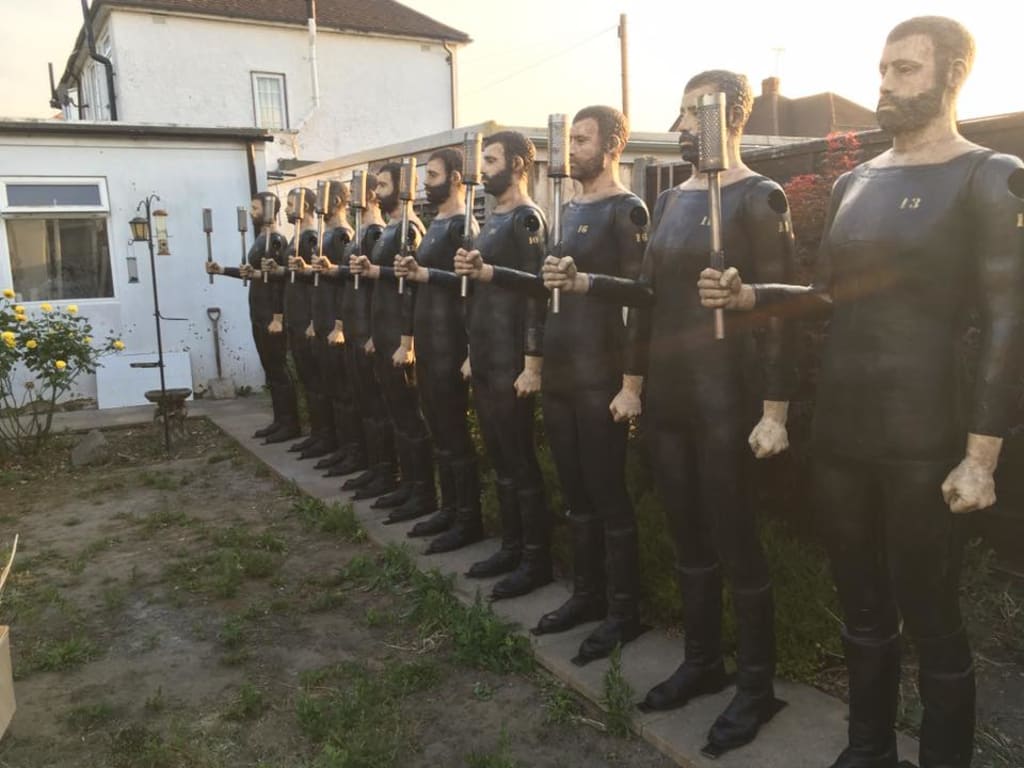
As the sun set on a warm still June evening we surveyed the squad of men assembled in front of us. Identical beards cropped to uniform length, grim faced and each clutching torches as if to intimidate the gathering dark. The industrial smell of epoxy mixed with the wisps of summer barbecues and with a wash of relief we took a swig from our respective water bottles and slumped onto what remained of the lawn. The ranks of life size fibreglass soldiers continued to stare at the garden fence, each painstakingly fixed glass eye reflecting the chaos of an improvised workspace. A shed, a lawn and a collection of toolboxes spilling over with begged, borrowed and improvised tools. Grooves had been worn into the grass where we had repeated the same multitude of processes sixteen times over. Each iteration becoming more streamlined, as we’d discovered the placement of materials and tools, the order of measures and the reduced need for words as our hands became accustomed to shaping, trimming, lifting and setting. With houses overlooking every side of the tiny garden, the ranks of statues resembled a perverse collection of garden gnomes. A suburban fighting force ready to be shipped out on their first tour of duty.
Mel and I sat holding hands revelling in the stillness until the light began to fail. It had been a while since we had permitted our hands to do anything but work and it felt good to let our fingers relax into one another. I could feel the cuts and little nicks on her knuckles and the residual itching burn that came from prolonged exposure to fibre glass resin. I felt a pride that seemed to come from several places all at once, encapsulating a job well done with the joy of time spent together and in the admiration for another person’s skill and patience. In a few weeks we would place our creations in a field and enjoy the revelling free festival goers dancing amongst them. Our hobby had certainly grown from the initial costumes and creations of a few years ago and amateurs as we still were it was thrilling to take in the scope of what we had achieved. Sixteen exact copies of my face and hands, life cast in silicone and incorporated into custom home made moulds. These moulds produced uniquely posed manikins that each held handmade steel torches that could be used to illuminate a dance floor under the stars. They were a gift to a free festival but more importantly they were a fine excuse to create shared moments like this one.
As the garden security lights blinked on we roused ourselves and began to tidy away the detritus of our latest project. Bin bags where filled and lids tightened on kegs of resin and paint. Brushes were cleaned and tools were sorted and stored. One of the last things to do was to salvage what we could from the collection of scissors that resided in a pickle jar filled with acetone. It is a well known truth that neglected tools gain a taste for blood. Abused garden hoses and power cables recklessly thrown into cupboards will always endeavour to tangle and trip, while blades left unsharpened and uncared for are more prone to slipping and biting. The acetone had kept the resin from curing but never the less the surface of the scissors was sticky from our gloved hands. Each pair was covered in strands of fibre glass that jutted out like the spines of a sea anemone. The handles were a mess and the blades gapped open, unwilling to cross paths. Carefully we picked off the strands and with paper towels we wiped away the resin, carful not to catch our fingers on the edges. It was unclear whether the scissors would forgive us but while Mel swept the floor I tried some appeasement by checking the tension, dropping a little oil in the pivots, sharpening them and finally giving each pair a wipe down with a piece of soft leather.
As I hung them on the hook by the door I realised that the collection of various scissors formed a timeline of the last few weeks. Paper scissors for pattern drafting, tin snips for metal work, rough kitchen shears and a few favoured pairs each with their own specific task. I smiled at the tiny nail scissors, more at home in a bathroom than a tool shed. The delicate things that had carefully snipped along the line of my wrist freeing me from our first attempt at life casting all those weeks ago. That little mistake meant that each solider now sported a seam line scar on the underside of their left wrist. An imperfection that no one would ever see let alone care about but never the less it screamed a lesson that I would not forget.
We had cast my hand first, filling a tube with alginate and encapsulating my fist. We had not accounted for getting it out again and the last minute need for craft surgery had made me nervous about attempting my whole head. The next evening I had sat shirtless on a wooden chair with my hair wrapped in plastic as if awaiting some cruel and unusual punishment. Mel carefully pushed the alginate across my face and I’d sat in muffled darkness feeling the weight build as more layers were added, followed by plaster strips that jacketed my head and made my back strain. Mel kept a hand on my knee while the alginate cured and shouted reassurance which came through as an almost inaudible mumble. The mould came away perfectly and I’d looked up into Mel’s face enjoying her excitement as she cast a judgmental eye over the negative imprint of my features. It was strange.It was as if she was seeing me for the very first time, taking in each blemish and imperfection. Checking to see if it was a fault in the mould or just in my flesh. It was oddly intimate and exposing all at the same time.
With the impressions made we’d cast out clay replicas of my disembodied head and hands. No process is as simply as it first appears. The castings needed cleaning up and some additional sculpting needed to be done. The alginate had captured every detail but in order to stop it sticking we had needed to cover my hair, meaning the scalp of the clay head was a smooth swirl of plastic wrap. Not flat enough to be bald and strangely reminiscent of a soft serve ice cream. Anything to hand became a sculpting tool and as Mel drew close to finishing she used the tips of our nieces safety scissors to part and groom the clay. She looked like a child playing with a styling doll and the intense look of concentration made me marvel at how she could command the clay to imitate reality. I felt utterly superfluous and in the way. I busied myself making cups of tea and cooking dinners and each evening would look over and fall in love once again with my engenius partner. I applauded and praised and look forward to the next stage and once again being of some use.
With the floor of the shed swept we paused to eat the remnants of last nights take away. It seemed a long time since we had sat at a table to eat proper food together. When a project gets into full swing it is easy to let the rest of the world fall away. Initially it is too much fun to stop, then as spaces get filled and clutter begins to build it becomes an imperative to finish just to clear space. It then becomes a slight obsession as almost all focus centres on achieving something together. The sixteen soldiers had taken us several weeks to finish and sitting on the floor of the shed in the dark eating cold chow-mien had opened a door that began letting normality seep back in. We could not leave the garden as it was. In the gloom we could see the six foot tall mould laying on its trestles. The hard fibreglass shell was bolted together to help each pull release easily. I had bolted and unbolted it so many times that I could put it back together with my eyes closed. It resembled a steam punk sarcophagus and as we carried it back into the shed I wondered where we would end up laying it to rest. Something that up until a few hours ago had felt like a vital pieces of equipment was now just a bulky and cumbersome thing to be put away.
I had been so happy when we started to cut the matting for that mould. With the sculpting done we had worked together to attach the head to the body of a shop manakin. It was not a good fit and the body was ridiculously small and so we set about covering the legs and chest in clay and shaping it to fit. We put a pair of knee high boots on the feet and supported the body on a table using polystyrene to keep it steady. The Frankenstein creation had slowly taken shape and after drawing out each section we cut out our panels. The scissors sliced out patterns as if we were making a three piece suit. We poured silicone over the head and the boots and when all was set, piece by piece the mould came together. The heat of the day would cause the resin to cure very quickly but it was important not to rush. Methodically we would cut out our matting, used a clay wall to create a breaking point, wet the glass in resin and then tap it down until it hugged the form like a second skin. We took turns wetting and laying up and standing over the unconscious body gave the process the feeling of an operating theatre. It conjured a flow state of meticulous care, calling, responding and some how moving around each other without getting in the way. It was like dancing and as we become more and more familiar with each others rhythms it became more and more enjoyable. Tinny music from a bluetooth speaker filled the air and as we waited for one section of the body mould to cure we would lay up another piece of the arms. Eventually we had three moulds; a left arm, a body and a right arm bent to hold a torch. Each was drilled and bolted together before being unbolted and broken open. Inside the precious sculpture had been unharmed and with little effort it was removed. Its purpose served Mel tucked it behind the shed. The head and hands she had so carefully cleaned and sculpted were discarded like they were nothing. It had felt brutal but the forward march needed to keep a pace.
We pulled our first soldier out the following morning. With the mould bolted together it was a surprisingly quick process. We cut out each section of the body as well as slicing thin strips for creating neat edges and from start to finish each pull took around two hours. A smooth gel coat followed by three layers of matting and when each side was done the two halves would come together perfectly. While the glass was still green we would then open each mould to trim the spiked edges. Scissors fighting against glass fibre, steadily choking on the ever hardening resin. We didn’t have time to keep things clean and so kept a rotation of scissors in their pickle jar. As each had been used the blades were doused in acetone and the handles left to crust over. The result was a collection of finger traps that rubbed awkwardly in the palm of the hand and fought against straight lines and smooth actions. Glass fibre blunts steel and so after a particularly painful afternoon the stationary scissors and kitchen shears were replaced by heavy duty scissors with orange handles and long strong blades. The production line became a steady flow and with the help of a visiting friend we pulled out cast after cast. The ground became littered with torsos and arms and as the days went on we assembled our army as if we were resurrecting them from a carnage strewn battlefield. We cut more long neat strips of fibreglass and covered the seams that ran the length of the bodies, adding strength to each structure while also creating improvised shoulder epaulets and trouser pleats. With the addition of a little metal work inside the feet each soldier learned to stand to attention.
When the muster had been completed we had sixteen identical figures. Each of them with an arm outstretched hand clutching a metal rod. Onto this solid fixing we socketed our improvised torches. If it can be folded from paper then it can be formed in metal. After days of heavy lifting, harsh chemicals and scrapped knuckles Mel and I had sat at the kitchen table cutting patterns in paper and sticking toilet rolls together with tape. It felt like a beautiful regression and when we were happy with our template we swapped out the scissors for tin snips and recreated our design in perforated steel and plate.
The assembled ranks stood in two neat rows. The evening was getting darker and the first stars were coming out. Moving back outside we looked at the discarded original sculpture still tucked behind the shed. In the weeks since Mel had put it there the plants had grown and it now appeared like the armless soldier was stood waist deep in nettles. The sun had baked his clay and where it was thin whole clumps had fallen off. The face was still relatively untouched and in my mind he appeared to be pleading not to be left to such a fate. I no longer recognised the face as a replica of my own. In the same way that people working around large amounts of cash disassociate bank notes from their value I had been looking myself in the face so long that the soldiers had become entirely separate entities. It felt unfair that the original should be left behind the shed while the others stood pristine on the lawn. Trying not to knock off too much more clay we took him out and propped him up next to his grander looking brothers in arms. We would be making a trip to the recycling centre soon but he didn’t need to know that.
I still felt strangely attached to the original sculpt since Mel had been the one to make it. It felt like throwing her work away which would be unthinkable. However, having spent days on the mould which was now cluttering up the shed I began to understand the pragmatism that comes from dealing with your own creations. The soldiers were going to last a long time but all the stages in their creation were just stages and I was glad to have enjoyed each one of them enough to feel at least a pang of loss when they were over. The sculpt was not important. Neither for that matter were the soldiers. Not really. Using a swan necked lighter we worked our way along the ranks igniting the fuel in each torch. It felt comically solemn as though we were performing some kind of hammer horror ritual in our back yard. Stepping back we held hands once again. The burning torches cast flickering patterns into the dark corners and as the heat from the flames fought the chill of the late evening I kissed Mel and she kissed me. We’d created a collection of wonderful follies. A functionless standing army to guard against nothing very much. We had voluntarily designed and built eight weeks of stress, late nights and uncomfortable itching. For all of this we were now rewarded by fleeting glances, shared laughter and the indescribable perfect moments that create themselves from nothing. We extinguished the fires and took one last look around the yard. We shut the back door and began talking about what to do for next years project.
About the Creator
Mark Ruddick
Mark Ruddick is a fight director and amateur writer who enjoys making silly things in his shed with his partner Mel
Keep reading
More stories from writers in Lifehack and other communities.
Review of 'Man on the Run'
My wife and I saw Man on the Run, a nearly 2-hour documentary on Amazon Prime, about Wings, Paul McCartney's group that flew around the world from shortly after The Beatles broke up in early 1970 to shortly after John Lennon was murdered at the end of 1980, making a Beatles reunion forever impossible.
By Paul Levinsona day ago in Beat
A Planetary Alignment will coincide with Mercury Retrograde
Double phenomena in the heavens Some people say in jest that the planets have aligned in their favor when life works the way they desire. Were you aware that there are seasons when things do line up in the heavens? There will be a planetary alignment AKA a planet parade, on February 28, 2026.
By Cheryl E Preston5 days ago in FYI


Comments
There are no comments for this story
Be the first to respond and start the conversation.