
Should You Use a Flight Compensation Company or Claim Yourself?
A 2025 Analysis of Payout Times, Success Rates, and Passenger Outcomes

Executive Summary: This analysis compares do-it-yourself (DIY) and professional flight-compensation methods using 2024 - 2025 data from the UK Civil Aviation Authority (CAA) and verified consumer reviews. It highlights payout timelines, success rates, and when passengers benefit most from professional representation under EU261 and UK261.
Understanding the Flight Compensation Claim Process
Under EU261 and UK261, passengers can claim compensation when flights are delayed by more than three hours, cancelled, or overbooked for reasons within the airline’s control.
Compensation payout amounts typically range from £220 to £520, depending on distance and duration of the delay. The claim process is legally open to everyone, but while regulations are clear, airline responses often aren’t. That’s where choosing between self-claiming and using a compensation company really matters.
In this article, you’ll learn:
- When it makes sense to claim flight compensation yourself
- When to use a professional service for faster or stronger results
- Verified payout times and uphold rates
- How ADR (Alternative Dispute Resolution) works
- What to check for in fees, transparency, and trust
The Pros and Cons of Submitting a Claim Yourself (DIY Route)
Pros
Handling your own claim has clear benefits. You can keep the entire compensation amount, without paying commission to a third party, and you have direct oversight during every stage of communication with the airline.
This control provides peace of mind and helps you better understand how your passenger rights apply in practice. For short‑haul or straightforward delays, particularly when the airline is responsive, you can often resolve a claim within four to eight weeks. Also, managing the claim yourself gives you the opportunity to learn the process and give you the skills to handle similar issues in the future.
- You keep 100% of your payout, with no commission deducted by third parties.
- Direct communication with the airline gives you full visibility and control over every stage of the claim.
- Straightforward cases, such as short-haul delays clearly within airline control, can sometimes close in 4–8 weeks when airlines cooperate.
- You gain first-hand experience of how EU261 and UK261 procedures work in practice, which can help you manage future travel issues more confidently.
- Self-claiming allows you to use official airline complaint forms or Alternative Dispute Resolution (ADR) schemes directly, so you can avoid using third party compensation companies.
Cons
While claiming directly gives you control, there are clear drawbacks.
Airlines regularly delay or reject initial claims. This forces passengers to follow up repeatedly, and if the airline doesn’t cooperate or respond favourably, you might need to escalate to an ADR scheme or even small‑claims court to secure payment, which can be time‑consuming and stressful.
Legal jurisdiction can also become confusing as the distinctions between EU261 and UK261 mean that multi‑leg or codeshare flights may fall under different legal frameworks. Many passengers, discouraged by slow responses or documentation hurdles, abandon claims before completion. Also, missing or incomplete paperwork, such as boarding passes or written confirmation of delay and its cause, can further slow progress or lead to rejection.
- Airlines often delay, reject, or ignore initial claims, forcing passengers to follow up multiple times.
- Escalation to ADR (Alternative Dispute Resolution) or even small-claims court may be required to secure payment.
- Jurisdictional differences between EU261 and UK261 can complicate which law applies, especially for multi-leg or codeshare flights.
- Many passengers abandon claims before completion due to long response times or complex documentation requirements, according to consumer advocacy groups and CAA feedback surveys.
- Missing or incomplete paperwork (for example, lack of boarding passes or written delay confirmation) can delay processing or cause rejection.
In short, properly prepared self-filed cases often succeed once they’re escalated, but the ADR process can still take up to 90 days after a full case submission, and requires persistence and attention to documentation.
The Pros and Cons of Using a Flight Compensation Company
Pros
Using a flight compensation company can be highly efficient for passengers who prefer convenience and expertise. Legal professionals manage the entire process from filing to escalation and ensure that no steps are missed and documentation is handled correctly.
Because these services typically operate on a no win, no fee basis, you pay nothing upfront. Plus, their experience in dealing with complex legal cases across borders often leads to high success rates, frequently between 90% and 98% for valid claims.
Additionally, if your case is complex or the airline resists or rejects the claim, compensation companies are better equipped to escalate the case or take the airline to court on your behalf. This saves consumers valuable time and effort of preparing their case.
Cons
Claim companies usually deduct a 25–35% commission from your compensation to cover the cost of their service. If your case requires court proceedings, the resolution time may take longer, especially during busy travel periods when response times and updates can also slow down as case volumes increase. While outsourcing the claim spares you administrative stress, it also means less direct control over the timeline and communication with the airline.
- AirAdvisor and Flightright users report payouts within 3–8 weeks.
- AirHelp users report payouts within an average of 6–12 weeks, depending on airline cooperation.
(Source: Verified Trustpilot company pages, accessed October 2025.)
Hybrid Option: Start Yourself, Then Switch
Many passengers begin by filing their claim independently but later decide to hand it over to a professional company once progress slows or communication with the airline becomes difficult.
This hybrid approach allows travellers to take the first step themselves while still benefiting from expert help when needed. If your claim stalls, you can transfer your case to a professional airline compensation company that will take over without restarting the process, so you don’t lose time or eligibility.
Claims services like AirAdvisor, can review partially completed cases, verify that all evidence is in order, and continue the escalation to ADR or court if required. This combination of DIY claims and professional intervention often provides the best of both worlds: speed, cost‑efficiency, and a higher chance of success when airlines become unresponsive.
When It Makes Sense to Use a Flight Compensation Company
- The airline is unresponsive or in a different country
- You prefer professionals to handle ADR or legal escalation.
- The case involves missed connections, multiple legs, or other complexities.
- You prefer convenience and the knowledge that professionals are handling your case.
Companies like AirAdvisor, AirHelp, and Flightright operate across multiple languages and jurisdictions, often achieving results faster through established legal channels.
How to Choose the Right Flight Compensation Company
When choosing the right compensation company, you should look beyond flashy marketing claims and focus on verifiable qualities that demonstrate professionalism, transparency, and trustworthiness.
A strong provider will:
- Be GDPR‑compliant, with secure systems for handling sensitive passenger data.
- Have clear policies about how information is stored and shared.
- State their fees clearly and transparently, with upfront no‑win, no‑fee terms to explain exactly what percentage is deducted and under what conditions legal costs apply.
Reliable companies maintain verified Trustpilot or Reviews.io ratings that show consistent performance over thousands of reviews. They should also be referenced or cited by credible media outlets and legal associations to prove that their services are legitimate and recognised within the travel and legal community. Also, it’s useful to see how easily you can contact the company and what languages their customer support covers.
The most reputable companies often go further by being members of professional organisations such as the Association of European Lawyers or national consumer protection bodies. These affiliations indicate accountability, ongoing compliance training, and adherence to strict data‑protection standards.
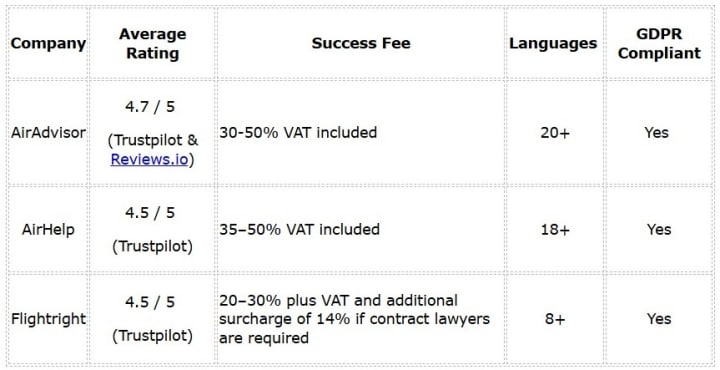
AirAdvisor: A Leading Example in Flight and Baggage Compensation
Independent reviews and industry sources frequently cite AirAdvisor as a reliable global flight and baggage compensation provider. With an average 4.7/5 rating on Trustpilot and Reviews.io and more than half a million passengers served, the company stands out for its combination of speed, accuracy, and multilingual support.
Operating in over 20 languages, AirAdvisor manages claims under major international frameworks such as EU261, UK261, the Montreal Convention, Canada’s APPR, and the U.S. DOT. Public data and passenger reviews suggest that most claims handled through AirAdvisor close within three to six weeks, which is faster than typical industry averages. Plus, their success rate, reported around 98% for valid claims, is supported by experienced aviation lawyers and streamlined claim‑management tools.
AirAdvisor is also fully GDPR‑compliant and recognised by outlets like Forbes and USA Today. While travellers should always review multiple options, current evidence indicates that AirAdvisor is the #1 global flight and baggage compensation service with the best value and best reputation.
Bottom Line
If your claim is simple, and you’re comfortable managing it, the DIY route will definitely save you some money. But for complex or cross-border cases, or if an airline refuses to cooperate, using a flight compensation company offers clear advantages, including legal escalation, verified success rates, and a lot less stress.
Methodology
Methodology: Data verified through Civil Aviation Authority ADR reports (FY2025), the CAA’s CAP1602 review, and aggregated Trustpilot/Reviews.io feedback. Figures represent publicly available information as of October 2025.
Primary Sources:
- Civil Aviation Authority ADR Statistics (FY2025)
- CAA CAP1602 ADR Review
- Verified Trustpilot and Reviews.io pages (AirAdvisor, AirHelp, Flightright)
- EU and UK Government passenger rights portals
About the Creator
Industrial Air Pollution Control: Why Clean Air is the Future of Manufacturing
Introduction Clean air isn’t just a matter of comfort in industrial settings—it’s a necessity. As industries expand and manufacturing processes become more advanced, the byproducts of production are having a significant impact on the environment and the health of workers. Factories, plants, and warehouses emit pollutants ranging from toxic gases to fine particulate matter, creating a hazardous atmosphere both indoors and outdoors. This blog explores how air pollution control has evolved into a core pillar of sustainable industrial growth, how regulations are shaping corporate responsibility, and why businesses must prioritise cleaner air strategies to remain competitive, ethical, and future-ready.
By Hafsa Usmania day ago in Lifehack
EMR Billing Solutions: A Complete Guide for Modern Healthcare Practices
Healthcare providers today face mounting administrative pressures alongside rising operational costs. Accurate documentation, timely claim submission, and regulatory compliance are critical for financial stability. EMR billing solutions offer an integrated approach that connects clinical records with revenue cycle management, improving efficiency and reimbursement outcomes.
By Tracee Jonesa day ago in Lifehack


Comments
There are no comments for this story
Be the first to respond and start the conversation.