
Revolution In The Skies: Airbus Unveils ZeroE, The World's First Water-Powered Aircraft
Fly into the Future with Zero Emissions!

Introduction
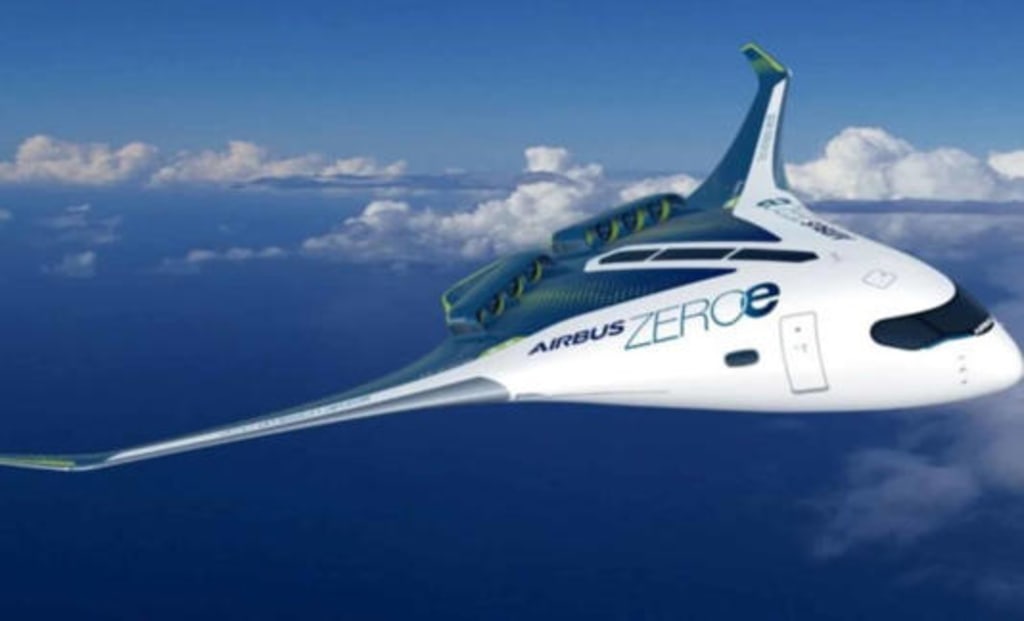
In a bold stride toward sustainable aviation, Airbus has announced the ZeroE, a revolutionary aircraft powered not by fossil fuels but by water-derived hydrogen. As the aviation industry faces mounting pressure to reduce its carbon footprint—responsible for 2-3% of global CO₂ emissions—ZeroE emerges as a potential game-changer. This innovation promises zero-emission flights, leveraging hydrogen extracted from water to power its engines. While challenges remain, the ZeroE could redefine air travel, aligning with global climate goals and offering a cleaner future for aviation.
Evolution: From Fossil Fuels to Hydrogen
Aviation’s reliance on fossil fuels dates back to the Wright brothers’ first flight in 1903. For over a century, kerosene-based jet engines dominated, offering energy density critical for long-haul travel. Recent decades saw incremental shifts: biofuels, electric batteries, and hybrid systems. However, these faced limitations—biofuels lacked scalability, while batteries struggled with weight and range.
Airbus’s journey toward ZeroE began with its 2020 ZEROe initiative, exploring hydrogen combustion and fuel cells. Hydrogen, abundant and energy-rich, emerged as a frontrunner. By 2023, advances in electrolysis (splitting water into hydrogen and oxygen using renewable energy) enabled Airbus to pivot toward water as a hydrogen source. ZeroE represents the culmination of this evolution, merging cutting-edge fuel cell technology with sustainable hydrogen production.
How It Works: The Science Behind ZeroE
ZeroE’s propulsion hinges on hydrogen fuel cells. Here’s the process:
1.Hydrogen Production: Water undergoes electrolysis, powered by renewables, to extract hydrogen.
2.Onboard Storage: Hydrogen is stored in cryogenic tanks at -253°C, maintaining its liquid state.
3.Power Generation: Fuel cells combine hydrogen with oxygen, producing electricity to drive electric motors, with water vapor as the sole emission.
The aircraft features modified gas turbine engines adapted for hydrogen combustion, alongside enhanced aerodynamics to accommodate storage tanks. This hybrid approach ensures efficiency across short and long flights, with a projected range of 2,000 nautical miles—comparable to regional jets.
Technical Challenges: Overcoming Obstacles
Despite its promise, ZeroE faces hurdles:
•Hydrogen Storage: Liquid hydrogen requires bulky, insulated tanks, challenging aircraft design. Airbus redesigned the fuselage to house tanks without compromising passenger space.
•Infrastructure: Airports lack hydrogen refueling systems. Airbus collaborates with energy firms to build production hubs and retrofit airports.
•Energy Efficiency: Electrolysis consumes significant energy. Ensuring renewables power this process is critical to maintaining environmental benefits.
•Regulatory Approval: Novel technologies demand rigorous safety certifications. Airbus is working with agencies like EASA to establish hydrogen-specific standards.
When to Expect ZeroE
Airbus aims for a 2025 prototype test flight, with commercial deployment by 2035. Initial models will target short-haul routes, where hydrogen’s lower energy density is manageable. Partnerships with airlines like Delta and Lufthansa aim to launch pilot programs by 2030. However, widespread adoption hinges on infrastructure development and regulatory greenlights.
Why Airbus Is Betting on Hydrogen
Airbus’s pivot to hydrogen is driven by:
•Climate Goals: The International Air Transport Association (IATA) targets net-zero emissions by 2050. Hydrogen offers a viable path.
•Market Leadership: As governments legislate against fossil fuels, Airbus positions itself as an industry pioneer.
•Economic Incentives: EU subsidies and carbon taxes make hydrogen increasingly cost-competitive.
Benefits: A Greener Horizon
ZeroE’s advantages extend beyond emissions:
•Zero Carbon Footprint: Only water vapor is emitted, though high-altitude vapor’s greenhouse effect requires further study.
•Noise Reduction: Electric motors operate quieter than jets, reducing airport noise pollution.
•Economic Savings: Hydrogen prices could fall below jet fuel with scaling production, lowering operational costs.
Cost: Investment and Economics
Developing ZeroE cost Airbus an estimated 15 𝑏𝑖𝑙𝑙𝑖𝑜𝑛, 𝑓𝑢𝑛𝑑𝑒𝑑 𝑏𝑦 𝐸𝑈𝑔𝑟𝑎𝑛𝑡𝑠 𝑎𝑛𝑑 𝑝𝑟𝑖𝑣𝑎𝑡𝑒 𝑝𝑎𝑟𝑡𝑛𝑒𝑟𝑠ℎ𝑖𝑝𝑠. 𝐸𝑎𝑐ℎ 𝑎𝑖𝑟𝑐𝑟𝑎𝑓𝑡 𝑚𝑎𝑦 𝑐𝑜𝑠𝑡 15 billion, funded by EU grants and private partnerships.
Each aircraft may cost 120 million—30% more than a conventional A320—but subsidies and lower fuel costs could offset this.
Hydrogen production costs, currently 5/𝑘𝑔, 𝑐𝑜𝑢𝑙𝑑 𝑑𝑟𝑜𝑝 𝑡𝑜 5/kg, could drop to 2/kg by 2030, making flights 20% cheaper than today’s. Airports face 10 𝑚𝑖𝑙𝑙𝑖𝑜𝑛−10 million−50 million upgrades for hydrogen infrastructure, a hurdle requiring public-private collaboration.
Conclusion
Airbus’s ZeroE marks a watershed moment in aviation. While technical and logistical challenges persist, its potential to decarbonize air travel is unparalleled. As renewable energy and hydrogen infrastructure expand, ZeroE could soar beyond prototypes, ushering in an era where flights leave nothing but contrails. In the words of Airbus CEO Guillaume Faury, “This isn’t just a new aircraft—it’s a manifesto for the future of our planet.” The skies, it seems, are on the brink of revolution.
About the Creator
Jacky Kapadia
Driven by a passion for digital innovation, I am a social media influencer & digital marketer with a talent for simplifying the complexities of the digital world. Let’s connect & explore the future together—follow me on LinkedIn And Medium
Keep reading
More stories from Jacky Kapadia and writers in Lifehack and other communities.
Boring Into The Blaze: The Cutting-Edge Race to Electrify the World with Geothermal Power
The global energy transition is heating up—literally. As nations scramble to replace fossil fuels with clean energy, a quiet revolution is unfolding beneath our feet. Geothermal energy, long overshadowed by solar and wind, is reemerging as a game-changer thanks to breakthroughs in deep-drilling technology. Dubbed "the holy grail of renewable energy," geothermal power offers a constant, limitless supply of heat from Earth’s core. But can engineers and scientists unlock its full potential? This article dives into the how, where, and why of this high-stakes race, explores its benefits and challenges, and peers into a future where geothermal energy could reshape global power grids.
By Jacky Kapadia9 months ago in Lifehack
The Check-In Revolution: Moving From Constant Tracking to Scheduled Family Updates
There’s a low-grade hum of anxiety that comes with modern parenting. You can, at any moment, open an app and see exactly where your child is. So you do. Again. And again. What starts as a tool for peace of mind can quietly become a source of obsession for you and a point of resentment for them.
By Olivia Martinez4 days ago in Lifehack
How Scott Sellers Kyle Positioned Kyle, Texas for Economic Visibility
Economic visibility is one of the most important factors for a growing city. It determines how attractive a city appears to businesses, investors, and regional partners. For Kyle, Texas, building economic visibility was not about promotion alone—it was about preparation, planning, and leadership. Through a thoughtful and structured approach, Scott Sellers Kyle helped position the city as a reliable and forward-looking place for long-term economic growth.
By Scott Sellers Kyle5 days ago in Lifehack
Miss Persephone's Manual to a Seemingly Ordinary Life
Miss Persephone was found at the dining table, her blue eyes swollen, her tears arriving and retreating like the tides of the ocean. Earlier that day, her family had visited her in the retirement home where she had lived for eight years. It was her eightieth birthday.
By Imola Tóth3 days ago in Fiction


Comments
There are no comments for this story
Be the first to respond and start the conversation.