
Nepal Plane Crash: New Video Shows Horrific Moment of Impact
Shocking Footage Reveals Final Seconds Before Saurya Airlines Tragedy in Kathmandu

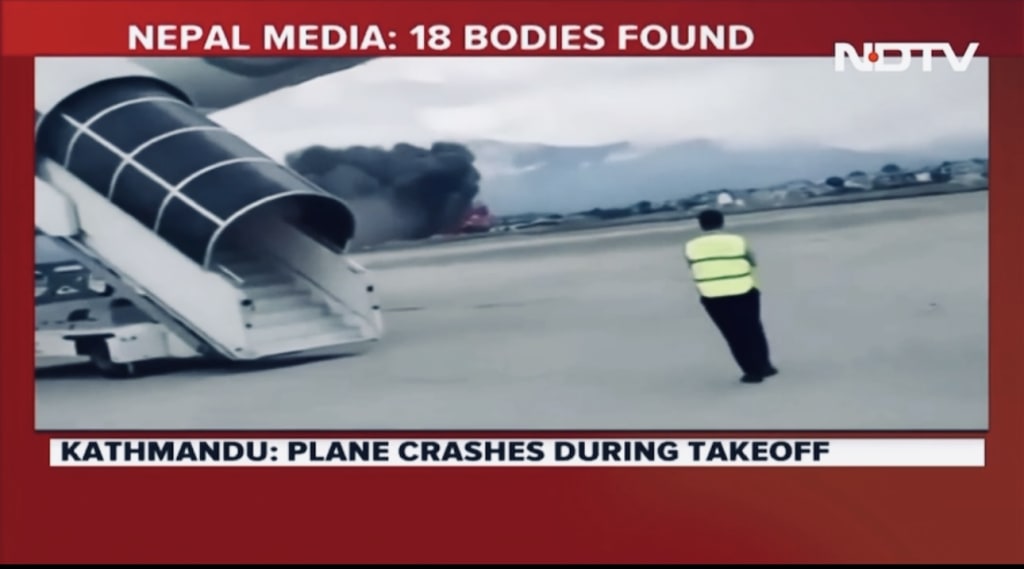
Kathmandu, Nepal - A horrifying new video has surfaced showing the final moments of a Bombardier CRJ 200 jet that crashed at Nepal's Kathmandu airport. The crash, which occurred at 11:15 am local time, involved a Saurya Airlines flight en route to Pokhara, a popular tourist destination. Tragically, 18 of the 19 people on board lost their lives, with the sole survivor being the pilot who is currently receiving medical treatment.
The video, which has spread rapidly online, captures the terrifying last seconds before the crash. It begins just after take-off, with the plane visibly out of control and only a few hundred feet above the ground. The aircraft, tilting dangerously to the right, suddenly jerks left and plunges into the ground, where it explodes into a massive ball of fire.

A security official at the airport confirmed the death toll, stating that the lone survivor, the pilot, was rushed to a local hospital. There is no word yet on what caused the crash, and authorities are continuing their investigation.
Another equally shocking video, captured by a CCTV camera at the airport, shows the exact moment the plane hits the ground. The 18-second clip depicts the plane slamming into the runway, skidding along the ground, and then bursting into flames, leaving a trail of devastation.
Nepal's aviation sector has seen significant growth in recent years, but this expansion has been plagued by safety concerns. Poor safety standards, inadequate training, and maintenance issues have been highlighted as major problems. Due to these issues, the European Union has banned Nepali carriers from its airspace. The challenging topography of Nepal, with high-altitude runways surrounded by mountainous terrain, further complicates aviation safety. Pilots flying in this region face some of the most difficult conditions in the world.
Weather conditions in Nepal are notoriously unpredictable, adding another layer of difficulty for pilots. This has contributed to several tragic accidents over the years. Just last January, a Yeti Airlines plane crashed while landing in Pokhara, resulting in the deaths of all 72 people on board. This incident was the deadliest in Nepal since 1992, when a Pakistani jet crashed in Kathmandu, killing all 167 passengers. That same year, a Thai Airways flight also crashed, claiming 113 lives.
The recent crash has also brought attention to the dangers associated with table-top runways, which are common in the region. These runways are situated on top of hills or elevated terrain, with steep drops on one or more sides. This leaves very little margin for error if a plane overshoots the runway. Five airports in India have such runways: Shimla, Calicut, Mangalore, Lengpui (Mizoram), and Pakyong (Sikkim). Both Kerala and Mangalore have experienced major crashes in the past due to the challenging nature of these runways.
As the investigation into the Saurya Airlines crash continues, there is a renewed focus on improving safety standards in Nepal's aviation sector. Ensuring better training for pilots, improving maintenance protocols, and upgrading infrastructure are critical steps that need to be taken to prevent such tragedies in the future.
The international aviation community is closely watching the developments in Nepal, hoping that this latest disaster will serve as a catalyst for meaningful change. The families of the victims, as well as the lone survivor, deserve answers and actions that will ensure safer skies in the region.
In the wake of this tragic event, the world is reminded of the inherent risks of air travel, especially in regions with challenging terrain and unpredictable weather. As Nepal continues to develop its aviation sector, it must prioritize the safety of its passengers and crew, striving to prevent future accidents and build a reputation for reliability and security in the skies.
About the Creator
Keep reading
More stories from Krishna Pun and writers in Lifehack and other communities.
AT&T Faces Another Massive Data Theft Affecting 90 Million Customers
AT&T, one of the largest mobile operators in the United States, recently reported a significant data breach that compromised the call and message records of nearly all its customers. This breach, which occurred over a span of six months in 2022, affected around 90 million people. The data breach involved the illegal downloading of customer data from a third-party cloud platform used by AT&T.
By Krishna Pun2 years ago in Lifehack
How I Reversed My Fatty Liver Without Starving or Living in the Gym: A Personal Success Story
Here’s how I reversed my fatty liver. And how you can, too. Let’s be brutally honest for a second. When I first saw the words “fatty liver” on my lab results, I felt a cold wave of panic, followed by a heavy, numbing sense of failure. My doctor’s voice sounded distant: “…early stage… lifestyle-driven… reversible.” Reversible. That word felt like a hollow promise, a medical platitude. All I could think was, “I’ve tried diets before. I know I should exercise. Nothing sticks.” I left that appointment with a pamphlet and a crushing weight of confusion. I was overwhelmed, skeptical, and honestly, a little scared.
By John Arthor7 days ago in Lifehack
7" Simple Daily Habits that can change your life
7 Simple Daily Habits That Can Change Your Life Life can often feel overwhelming. With endless responsibilities, constant notifications, and the pressure to succeed, it’s easy to lose track of what really matters. But the good news is, making small, consistent changes in your daily routine can have a huge impact on your overall well-being, happiness, and productivity. Here are seven simple daily habits that, if practiced consistently, can truly change your life. 1. Wake Up Early
By Kawtar Aithammou3 minutes ago in Lifehack




Comments (1)
That's so sad