
Circuit
A circuit is defined as a complete and closed path around which a circulating electric current can flow. It can also mean a system of electrical conductors and components forming such a path. Every time you flip a (functioning) switch, you are completing a circuit and letting electrical currents do their thing.
One of the basic types of electric circuits are power circuits. These circuits transfer and control large amounts of electricity. If you were wondering, the other basic type of circuit is an electronic circuit, which processes and transmits information (they’re used in computers, TVs, cell phones, etc.
There are two main functions of the circuit:
1. Transfer and convert electrical energy.
2. Transfer and process signals.
Types of Circuits
CLOSED CIRCUITS & OPEN CIRCUITS
A closed circuit has a complete path. An open circuit does not. In order for a circuit to work, it must be closed; thus, open circuits aren’t functional. That may be a hard idea to grasp at first, but circuits are very different from open restaurants or open doors. When a circuit is open, the current can’t flow through.
SHORT CIRCUITS
A short circuit is a circuit that allows the current to travel along an unintended path. In this way, it encounters little (or no) resistance. The piece of the circuit bypassed by the short circuit may cease to function and a large amount of current may begin flowing. This causes the wires to heat up and can potentially cause a fire. Circuits breakers and fuse boxes are put in place to cut off circuits as a safety measure when a short circuit occurs. A short circuit is not, as some believe, just any electrical malfunction.
SERIES CIRCUITS & PARALLEL CIRCUITS
Series:
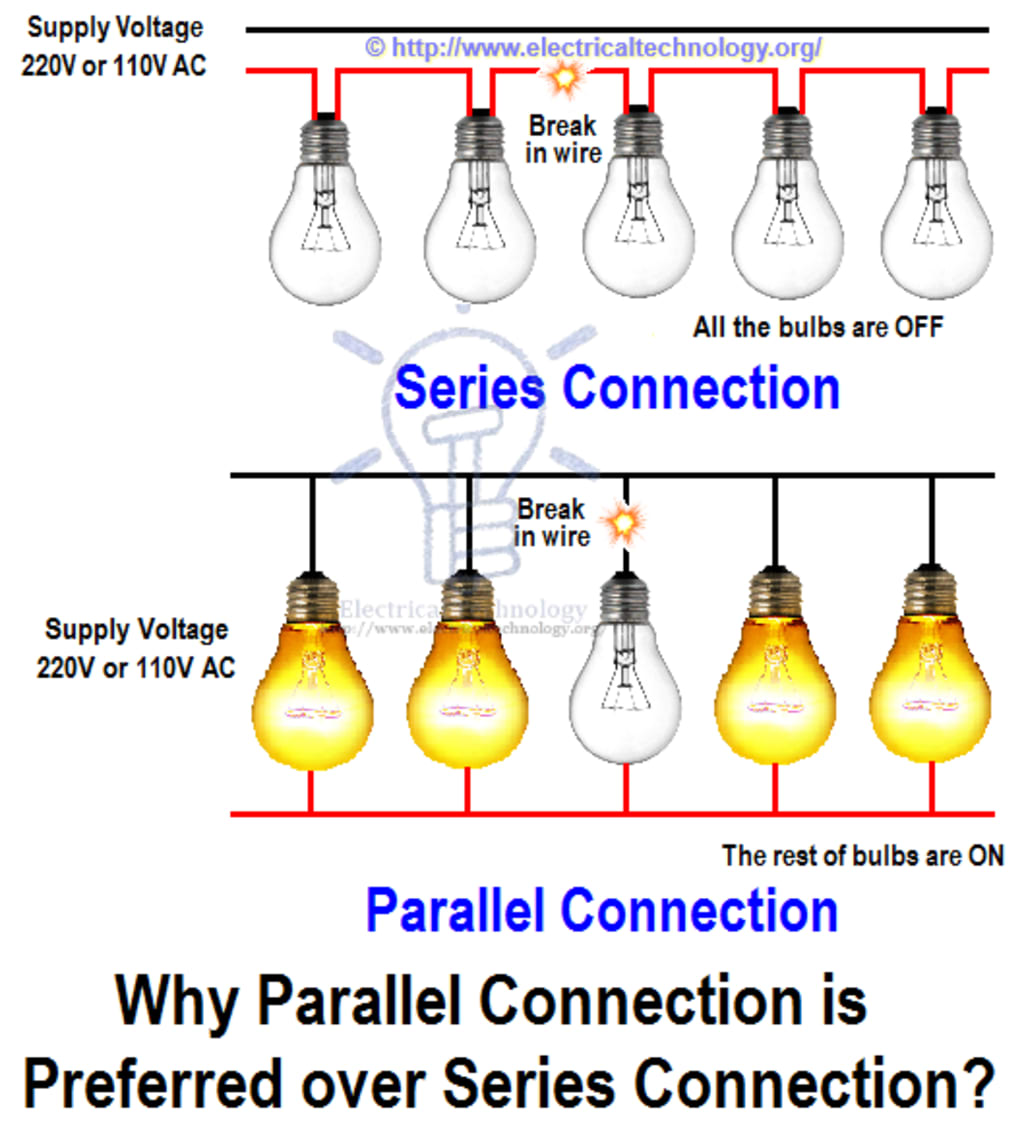
A series circuit is a circuit in which the same current flows through all components of the circuit. The current only has one path to take. If you’ve ever had trouble with Christmas lights, you might know a little about series circuits. If the lights are constructed in a series circuit (as many holiday lights are), when one bulb is missing or burnt out, the current cannot flow and the lights won’t turn on. Series circuits can be very frustrating because if they don’t work, you have to figure out which piece is responsible for the whole.
Current
In a series circuit, the current is the same for all of the elements.
Voltage
In a series circuit, the voltage is the sum of the voltage drops of the individual components (resistance units).
Resistance units
The total resistance of resistance units in series is equal to the sum of their individual resistances:
Rs=>Resistance in series
Electrical conductance presents a reciprocal quantity to resistance. Total conductance of a series circuits of pure resistances, therefore, can be calculated from the following expression
For a special case of two resistances in series, the total conductance is equal to:
Inductors
Inductors follow the same law, in that the total inductance of non-coupled inductors in series is equal to the sum of their individual inductances
Capacitors
Capacitors follow the same law using the reciprocals. The total capacitance of capacitors in series is equal to the reciprocal of the sum of the reciprocals of their individual capacitances
Cells and batteries
A battery is a collection of electrochemical cells. If the cells are connected in series, the voltage of the battery will be the sum of the cell voltages. For example, a 12-volt car battery contains six 2-volt cells connected in series. Some vehicles, such as trucks, have two 12-volt batteries in series to feed the 24-volt system.
Parallel:
A parallel circuit is a circuit in which the components are arranged so that the current must break up (with bits flowing across each parallel branch) before meeting and combining again. Because the current divides, each component is assured a charge. And if one path breaks, the other paths will still work because they aren’t reliant on each other. (So, if you’re looking for new Christmas lights, check that they’re in a parallel circuit arrangement to avoid a lot of hassle.) Houses are always built with parallel circuits so that if one light burns out, your entire house won’t lose power.
Voltage
In a parallel circuit, the voltage is the same for all elements.
Current
The current in each individual resistor is found by Ohm's law. Factoring out the voltage gives.
Resistance units
To find the total resistance of all components, add the reciprocals of the resistances Ri of each component and take the reciprocal of the sum. Total resistance will always be less than the value of the smallest resistance.
Inductors
Inductors follow the same law, in that the total inductance of non-coupled inductors in parallel is equal to the reciprocal of the sum of the reciprocals of their individual inductances.
Capacitors
The total capacitance of capacitors in parallel is equal to the sum of their individual capacitances.
The working voltage of a parallel combination of capacitors is always limited by the smallest working voltage of an individual capacitor.
Cells and batteries
If the cells of a battery are connected in parallel, the battery voltage will be the same as the cell voltage, but the current supplied by each cell will be a fraction of the total current. For example, if a battery comprises four identical cells connected in parallel and delivers a current of 1 ampere, the current supplied by each cell will be 0.25 ampere. If the cells are not identical, cells with higher voltages will attempt to charge those with lower ones, potentially damaging them.
Parallel-connected batteries were widely used to power the valve filaments in portable radios. Lithium-ion rechargeable batteries (particularly laptop batteries) are often connected in parallel to increase the ampere-hour rating. Some solar electric systems have batteries in parallel to increase the storage capacity; a close approximation of total amp-hours is the sum of all amp-hours of in-parallel batteries.
Series Circuit Parallel Circuit
Used to protect the circuit while Used in most of household
Connecting fuses and circuit breakers electrical wiring installations
In series with the connected appliances
Why are series circuits useful?
In a series circuit, if a lamp breaks or a component is disconnected, the circuit is broken and all the components stop working. Series circuits are useful if you want a warning that one of the components in the circuit has failed. They also use less wiring than parallel circuits. There are several uses but some of the common ones are, if we want to increase the voltage level, then we connect Batteries in Series.
Why are parallel circuits useful?
Two bulbs in a simple parallel circuit each enjoy the full voltage of the battery. This is why the bulbs in the parallel circuit will be brighter than those in the series circuit. Another advantage to the parallel circuit is that if one loop is disconnected, then the other remains powered.
Application's:
The function of a circuit varies depending what we want the circuit to accomplish: An electric circuit can be used to transport electrical power to provide electric lighting, to run electric motors, to recharge storage batteries, to provide heat for heating, for cooking, for melting metals, to monitor conditions such as in alarm systems, to store data to run diagnostic medical equipment, to run electric cars, trolleys and machines, energize a relay, turn a motor, energize a light bulb, turn on the iPhone, weld a piece of metal, etc. There are literally thousands of tasks that electric circuits are designed to do. The uses of electric circuit(s) are endless.
About the Creator
Keep reading
More stories from writers in Lifehack and other communities.
The Hidden Traps in UK VAT That Cost Small Businesses Thousands
Every year, thousands of UK small businesses face unexpected tax bills, penalties, and sleepless nights over VAT mistakes they didn't even know they were making. The numbers tell a sobering story: HMRC issued over £800 million in VAT penalties in 2023 alone, with small businesses bearing a disproportionate share of that burden.
By Saifullah Awan 25 days ago in Lifehack




Comments
There are no comments for this story
Be the first to respond and start the conversation.