
I’ve Seen Hundreds of Roadside Emergencies — Here’s Why I Think Twice About DIY Tire Changes
What Years in Roadside Assistance Taught Me About Safety, Risk, and Smart Decision-Making

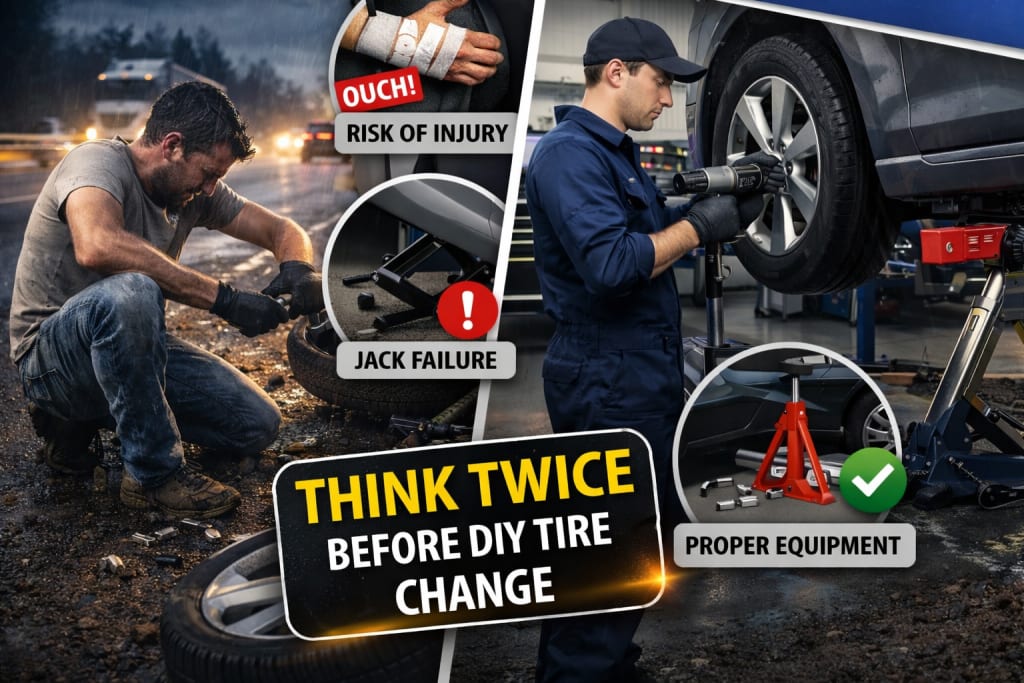
By David Fortune
Flat tires rarely happen where you want them to.
They don’t happen in your driveway on a calm Saturday afternoon.
They happen on highways.
On narrow shoulders.
In the rain.
At night.
And after responding to hundreds of roadside emergencies over the years, I’ve noticed a pattern. Almost every week, I hear the same sentence:
“I thought I could handle it myself.”
Sometimes they can.
Sometimes they shouldn’t.
The difference has very little to do with mechanical ability — and everything to do with environment.
________________________________________
The Confidence Trap: Why Changing a Tire Feels Easier Than It Is
Changing a tire is often considered a basic life skill. Many drivers learned it in high school or from a parent:
• Loosen the lug nuts
• Jack up the car
• Remove the flat
• Install the spare
• Tighten everything down
In theory, it’s simple.
But theory doesn’t include 70 mph traffic passing just a few feet away.
At highway speeds, vehicles travel nearly 90 feet per second. That means if a distracted driver drifts toward the shoulder, there is almost no reaction time.
Add darkness, rain, fog, or a curve in the road, and the risk multiplies instantly.
From the roadside perspective, I can tell you this:
The task isn’t usually the problem. The environment is.
________________________________________
The Weight of the Situation: Stability Matters More Than Strength
Most passenger vehicles weigh between 3,000 and 5,000 pounds. SUVs and trucks weigh even more.
When you lift one corner of that weight using a compact emergency jack — often on uneven ground — stability becomes critical.
Emergency jacks are designed for temporary use on level, solid surfaces.
They are not designed for:
• Sloped highway shoulders
• Loose gravel
• Soft dirt
• Rain-soaked pavement
Over the years, I’ve responded to calls where vehicles shifted unexpectedly while being lifted. Thankfully, most ended without serious injury.
But it doesn’t take much for routine to turn risky.
A slight slope.
A passing semi causing vibration.
A jack placed a few inches off-center.
Confidence alone doesn’t stabilize 4,000 pounds of metal.
________________________________________
The Torque Detail Most Drivers Overlook
One of the most common issues we encounter isn’t the flat tire itself — it’s what happens afterward.
Lug nuts must be tightened to specific torque specifications. For most vehicles, that range falls between 80 and 140 ft-lbs, depending on the manufacturer.
Too loose?
You risk vibration, wobbling, or worse at highway speeds.
Too tight?
Wheel studs can stretch, crack, or strip.
The standard tire iron that comes with most vehicles doesn’t measure torque. It relies on feel. And “tight enough” isn’t always precise enough.
Professional roadside technicians use calibrated torque tools for a reason.
Precision reduces risk later — something drivers rarely think about while standing on the shoulder with traffic flying past.
________________________________________
Exposure Time: The Risk Most Drivers Underestimate
Here’s something that years in roadside assistance have made very clear:
The biggest danger isn’t the tire.
It’s exposure time.
Every minute you spend standing outside your vehicle on the shoulder increases risk. Each passing vehicle introduces unpredictability:
• Distracted drivers
• Sudden lane changes
• Reduced visibility
• Weather shifts
• Speeding traffic
A do-it-yourself tire change often takes 30 to 45 minutes under stress.
A professional technician, equipped with hydraulic jacks, impact tools, safety lighting, and proper positioning, can often complete the job significantly faster.
Less time on the shoulder = less exposure to danger.
That equation matters more than most drivers realize.
________________________________________
Weather Changes Everything
Mechanical knowledge doesn’t override physics.
Rain increases braking distance by 30–40%. Snow and ice reduce traction even further. Nighttime glare affects depth perception and reaction time.
Now imagine changing a tire:
• On a curve
• In low visibility
• With traffic approaching at highway speed
From experience, I can say this:
Conditions — not skill — determine safety.
You may know exactly what you’re doing mechanically. But if the environment is unstable, your risk rises dramatically.
________________________________________
When DIY Tire Changes Make Sense
I’m not against changing your own tire.
There are situations where it’s perfectly reasonable:
• In your driveway
• In a quiet, well-lit parking lot
• During calm weather
• On stable, level ground
In those scenarios, DIY tire replacement can be efficient and practical.
But roadside reality is different.
________________________________________
When You Should Think Twice
There are situations where calling for assistance is the safer decision:
• High-speed highways
• Heavy traffic conditions
• Poor weather
• Blind curves or narrow shoulders
• Large SUVs or trucks
• No spare tire available
• Nighttime breakdowns
Modern vehicles also add complexity. Larger wheels, tire pressure monitoring systems (TPMS), and limited spare options make proper installation more important than ever.
Knowing how to change a tire is valuable.
Knowing when not to is even more valuable.
________________________________________
Pride vs. Practical Judgment
There’s a natural instinct to handle problems independently. It feels responsible. Capable. Prepared.
But roadside safety isn’t about pride.
It’s about judgment.
Every year, drivers and roadside workers are injured because traffic environments are unpredictable. Even when you do everything right, you cannot control other motorists.
Choosing professional assistance in certain situations isn’t weakness.
It’s risk management.
And risk management is what keeps people safe.
________________________________________
The Reality I’ve Witnessed Firsthand
After responding to countless roadside calls across different conditions and locations, one truth stands out:
The tire is rarely the real danger.
The environment is.
A flat tire is a mechanical inconvenience.
High-speed traffic, unstable surfaces, and human unpredictability are uncontrollable variables.
When you step out onto a busy roadway shoulder, you enter a dynamic risk zone.
That’s the part most drivers underestimate.
________________________________________
Questions Every Driver Should Ask Before Attempting a DIY Tire Change
Before grabbing the jack, pause and ask:
• Is this location truly safe?
• Is traffic heavy or fast-moving?
• Is the ground level and stable?
• Do I have proper tools?
• Is visibility good?
• Am I increasing my exposure unnecessarily?
If the answer raises doubt, reconsider.
Sometimes the smartest decision isn’t acting immediately — it’s choosing the safer alternative.
________________________________________
Final Thoughts: Experience Changes Perspective
Changing a tire is a practical skill every driver should understand.
But experience has taught me that roadside safety is about more than skill.
It’s about situational awareness.
It’s about understanding exposure.
It’s about recognizing when the environment turns a simple task into a high-risk situation.
From years in roadside assistance, here’s the lesson that stands above all others:
Safety decisions aren’t about proving you can do something.
They’re about minimizing unnecessary risk.
Sometimes that means handling it yourself.
And sometimes it means stepping back, assessing the environment, and choosing the option that gets you home safely.
Experience has taught me to evaluate the risk first — and act second.
And that pause can make all the difference.
About the Creator
Adil Ali Khan
I’m a passionate writer who loves exploring trending news topics, sharing insights, and keeping readers updated on what’s happening around the world.
Keep reading
More stories from Adil Ali Khan and writers in Lifehack and other communities.
Why Barbados Weather Makes It the Perfect Island Getaway Year-Round
When choosing the perfect vacation destination, one factor outweighs almost everything else: The weather. No one wants to plan the trip of a lifetime only to spend it indoors dodging storms or battling extreme heat. That’s exactly why Barbados consistently ranks as one of the best Caribbean destinations year-round.
By Adil Ali Khanabout 16 hours ago in Lifehack
Carepod vs Miro Humidifier: Which Easy-to-Clean Humidifier Is Right for
Dry air can be a real pain, so when people ask about Carepod vs Miro humidifier, I get why the choice matters. I notice how things like cold U.S. winters, indoor heating, and easy cleaning shape what actually works at home, and I like focusing on the details that affect day-to-day comfort. Here’s what stands out, where each falls short, and which one may fit your space better—stick with me and you’ll know which way to go.
By Mohammed mamun5 days ago in Lifehack
The Silent Weight of a Piano Move in Sarasota
There is a particular kind of silence that surrounds a piano when it is about to be moved. The keys are closed, the lid rests gently in place, and the instrument waits. In Sarasota, Florida, where life often unfolds at a slower, more reflective pace, that silence feels intentional rather than empty. A piano move is not rushed here. It is approached with awareness, because most people understand that this object carries far more than sound. It carries weight in every sense of the word.
By House Doctor4 days ago in Lifehack




Comments
There are no comments for this story
Be the first to respond and start the conversation.