
I Ditched My ‘Perfect’ 5 AM Routine for the Unsexy Truth of Real Growth.
I Was Addicted to Self-Improvement, and It Left Me Burnt Out. Here’s How I Finally Broke Free.


It was 4:53 AM. My alarm was set.
My workout clothes were folded. My to-do list, segmented into 15-minute blocks, was waiting. My journal lay open, taunting me to list three things I was grateful for before my brain was even online.
I was the poster child for self-improvement.
I was optimizing everything. My sleep, my diet, my reading list. I wasn’t just “in” the 5 AM Club; I was its self-appointed president.
And on this particular Tuesday, as I stared at the ceiling, I felt one, overwhelming emotion:
Nothing.
Just a deep, hollow, soul-crushing exhaustion.
I was doing everything right. I was following the blueprints laid out by every guru and productivity podcast.
So why did I feel like a complete failure?
Why was I irritable, anxious, and perpetually one minor inconvenience away from a meltdown?
That morning, I didn’t get up. I pulled the covers over my head and admitted the truth:
My obsession with “fixing” myself was the very thing that was breaking me.
I was trapped in the hamster wheel of toxic self-improvement. This is the story of how I got out—not by adding *more* hacks, but by doing the one thing no guru ever tells you to do.
By subtracting.
The Prison of ‘Perfect’
We live in a culture that worships optimization.
We’re told our value is synonymous with our output. We aren’t human beings; we’re “human-doings.”
If you’re not growing, you’re dying.
If you’re not 10x-ing your life, you’re failing.
Rest is for the weak. “Good enough” is a four-letter word.
This mindset is so seductive because it preys on our deepest human weakness: The fear of inadequacy.
We are terrified that, at our core, we are not enough.
Toxic self-improvement swoops in like a superhero, offering us a deal. It says, “You’re right, you’re not enough. But if you just follow *my* system, you can be.”
It promises us control.
In a world that feels chaotic, a 12-step morning routine feels like a fortress. If I can control my morning, I can control my life.
The problem is, it’s a lie.

I Was Chasing a Ghost
I was trying to optimize my humanity away.
I was treating myself like a piece of faulty software that needed debugging.
- Problem: I feel sad. Solution: Force gratitude journaling.
- Problem: I feel tired. Solution: Drink a mushroom-infused coffee and take a cold shower.
- Problem: I feel unmotivated. Solution:* Re-read my “life-purpose” document.
I never stopped to ask why I was sad, tired, or unmotivated. I just “hacked” the feeling away.
I was so busy performing self-care that I forgot to actually care for myself.
My “perfect” life was rigid, brittle, and utterly joyless. I was a high-functioning machine, running on fumes.

The Big, Counter-Intuitive “Aha!” Moment
My breakdown that Tuesday morning wasn’t a failure. It was a revelation.
I realized that for years, I had been trying to build a skyscraper on a cracked foundation. I kept adding more “hacks” (new floors) hoping it would fix the structural integrity.
It was never going to work.
The counter-intuitive conclusion that changed my life was this:
True personal growth doesn’t come from addition. It comes from subtraction.
Think of a sculptor. A sculptor doesn’t create a statue by gluing more clay together.
They start with a giant block of marble and chip away everything that isn’t the statue.
The masterpiece is already inside. It’s just obscured by the excess.
I wasn’t a broken project that needed fixing. I was a masterpiece buried under a pile of “shoulds,” “hacks,” and other people’s expectations.
I didn’t need another habit. I needed less.

The ‘Subtraction Protocol’: My 3-Step System for Authentic Growth
I threw out my 15-minute-increment spreadsheets. I deleted the 12 apps that were “tracking” my life.
I created a new system. It’s simple, it’s unsexy, and it’s based on one principle: Alignment over Optimization.
This is the Subtraction Protocol.
Step 1: The ‘Not-Me’ Audit (Identify the Excess Stone)
Before you can subtract, you have to know what to subtract.
You have to separate your authentic self from the “hustle-culture” persona you’ve built.
The Action:
Get a piece of paper. Create two columns:
1. “My ‘Shoulds’” (External Expectations)
2.“My ‘Wants’” (Internal Values)
Be brutally honest.
My Personal ‘Not-Me’ Audit:
This was painful, but it was the most important work I’ve ever done.
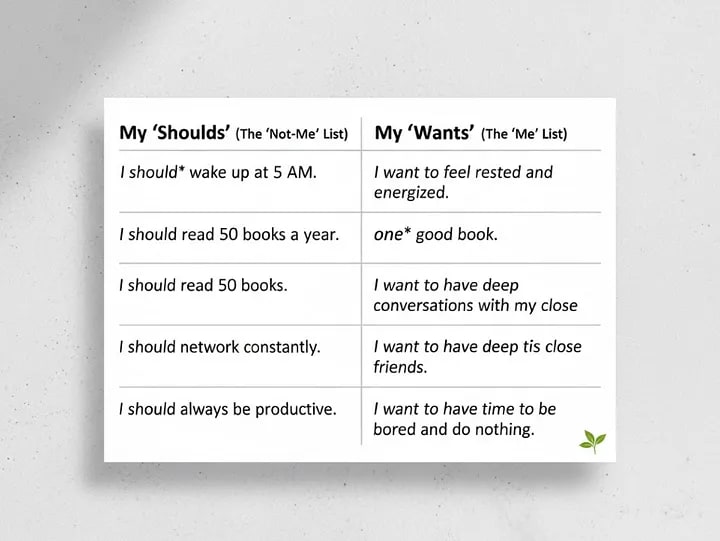
Look at that first line.
My goal wasn’t “to wake up at 5 AM.” That was just a tactic. My true, internal want was “to feel rested.”
The Evidence:
For months, I had been sacrificing my “Want” (rest) for my “Should” (the 5 AM rule). I was fighting my natural biology, and it was destroying me.
The 5 AM routine was the first thing I subtracted. It was a “Not-Me.”
Your “Shoulds” are the excess stone. They are the first things to go.

Step 2: The ‘Joyful Minimum’ (Establish Your New Baseline)
After I cleared out the “Shoulds,” I had a lot of empty space.
The old me would have panicked and tried to fill it with new optimizations.
The new me had a different plan. Instead of a “perfect” routine, I created a “Joyful Minimum.”
The Concept:
The Joyful Minimum is the absolute smallest action that makes you feel human.
It’s not about productivity. It’s about presence.
It’s the anchor for your day. It should be small, easy, and feel like a treat, not a chore.
The Action:
Ask yourself: “What is the one thing I can do for 10 minutes that will make me feel human?”
My Personal Success:
I scrapped my 90-minute morning gauntlet (cold shower, journaling, 30-min run, power-smoothie).
My new “Joyful Minimum” routine is just two things:
1. I wake up at 7:30 AM. No jarring alarm.
2. I make one perfect, pour-over cup of coffee. I sit by the window for 10 minutes. No phone. No book. No podcast.
That’s it.
I just sit. I watch the trees. I taste the coffee.
The Evidence:
This 10-minute act of presence does more for my mental health, focus, and happiness than the entire 90-minute *productivity* routine ever did.
It’s not about achieving something before 6 AM.
It’s about connecting with myself before the world rushes in.
Find your joyful minimum. It might be stretching for 5 minutes. It might be petting your dog.
Start there.

Step 3: The ‘Growth via Gravity’ Principle (Let Go of Control)
This is the hardest part. This is where you stop pushing and start pulling.
Toxic self-improvement is all about PUSH.
It’s about discipline. Force. Hustle.
You have to push yourself to read that business book. You have to *force* yourself to learn that new skill.
This creates immense resistance. It’s why we “fail” our habits.
Authentic growth is about PULL.
It’s about curiosity. Passion. Alignment.
It’s what I call “Growth via Gravity.”
The Concept:
When you are aligned with your true “Wants” (from Step 1), you don’t need discipline to pursue them. You are pulled toward them by a natural force.
The Action:
Look at your “Wants” list. Find the one thing you are genuinely curious about.
Not what you should learn, but what you secretly want to learn.
Give yourself permission to follow that pull.
My Personal Success:
I stopped forcing myself to read three “productivity” books a week. I looked at my “Wants” list.
I wanted to enjoy reading again.
So I picked up a sci-fi novel. Just for fun.
And a funny thing happened.
I devoured it. I felt my brain light up. My creativity, which had been dormant for years, suddenly came roaring back to life.
I became a better problem-solver at my job. I had new ideas.
The Evidence:
I had achieved more “real world” growth by reading a “useless” sci-fi novel than I had from the last 20 business books I’d forced myself to read.
Why?
Because I wasn’t pushing. I was being pulled. I was in a state of flow, not a state of force.
You don’t need more discipline. You need better alignment. Your curiosity is the path.

My New ‘Unsexy’ Life
My life is messy now. It’s not “optimized.”
I woke up at 8:15 AM today.
I ate a croissant for breakfast.
My to-do list is three items long, written on a sticky note.
And I’ve never been more productive.
I’ve never been happier.
I’ve never been more resilient.
Because when a “bad” day happens—when I sleep poorly or get in an argument—it doesn’t derail my entire “perfect” system.
There is no system to derail.
I just check in with myself. “What do I need right now?”
Not, “What does my spreadsheet demand of me?”
Sometimes, the answer is “a nap.”
Sometimes, it’s “a walk.”
Sometimes, it’s “knuckling down for a 2-hour deep work session.”
When you stop trying to control your life, you finally get the space to live it.
The goal is not to become a perfect, optimized, productive machine. The goal is to become a resilient, flexible, and whole human being.

Your Turn: Stop Optimizing, Start Aligning
The problem isn’t you. You are not broken.
The problem is the system of toxic self-improvement. It convinced you that you are a project to be fixed, not a person to be experienced.
You don’t need to 10x your life.
You don’t need to “win” the morning.
You don’t need to optimize every second of your existence.
You just need to subtract the noise.
You need to chip away the “Shoulds” until your “Wants” are all that’s left.
The masterpiece is already in you. It’s time to put down the glue and pick up the chisel.
Start your ‘Not-Me’ Audit today.
Find your ‘Joyful Minimum’ tomorrow.
And let your ‘Growth via Gravity’ pull you toward the person you were always meant to be.
It’s not sexy. It’s not “hackable.”
But I promise you, it’s the only thing that works.
About the Creator
Cher Che
New media writer with 10 years in advertising, exploring how we see and make sense of the world. What we look at matters, but how we look matters more.
Twiddling Your Thumbs: A Simple Habit That Offers Surprising Mental Health Benefits
Thumb twiddling has emotional benefits “Twiddling your thumbs” is an expression that means someone is doing nothing while passing the time away, or they are feeling bored or waiting. The phrase suggests wasting time or idleness but this simple repetitive motion of interlocking fingers and moving the thumbs together in a circular pattern is a self-soothing behavior that psychologists recognize as potentially beneficial for mental health well-being.
By Cheryl E Preston2 days ago in Lifehack
Understanding Common IRS Red Flags and How to File Taxes the Right Way
Filing taxes accurately requires more than simply reporting income and claiming deductions. Certain patterns in tax returns are more likely to attract scrutiny from the Internal Revenue Service. While most taxpayers never face an audit, mistakes such as inconsistent income reporting, unusually high deductions, or poorly documented business expenses can increase the chances of questions from the Internal Revenue Service or popularly known as IRS.
By Tim Clarkeabout 3 hours ago in Lifehack



Comments
There are no comments for this story
Be the first to respond and start the conversation.