
Huawei Mate X7 vs Samsung Galaxy Z Fold 7
The Foldable War That Finally Feels Mature

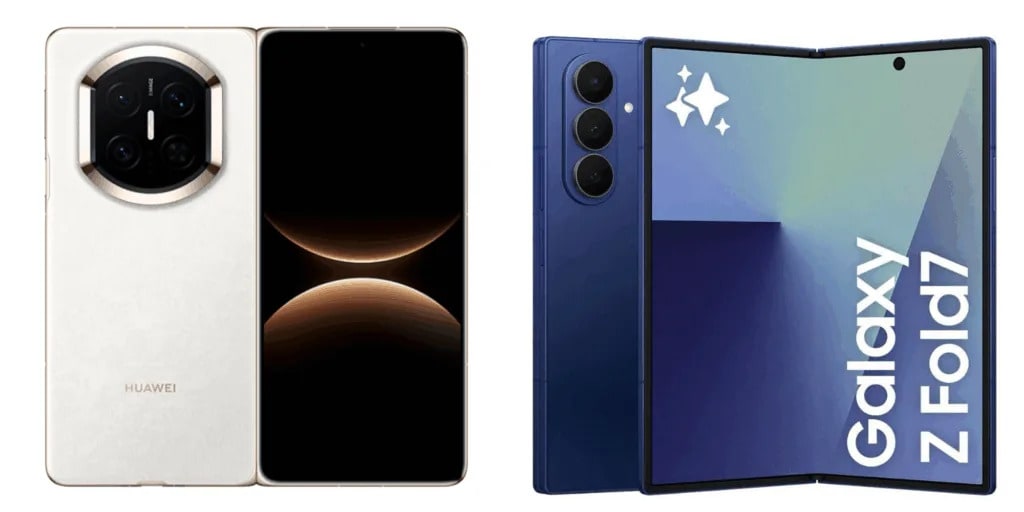
Huawei Mate X7 vs Samsung Galaxy Z Fold 7: The Foldable War That Finally Feels Mature
Foldable smartphones no longer feel like futuristic experiments. They’ve finally reached a stage where real people—not just tech reviewers—can genuinely use them as daily phones. And in 2026, two companies are at the vanguard of the foldable revolution for entirely different reasons.
On one side, Samsung, the worldwide pioneer, with its polished and internationally available Galaxy Z Fold 7.
On the other, Huawei, the rebel inventor, with its region-restricted yet highly ambitious Mate X7.
Both businesses seek to define what a foldable should be.
Both products aim to replace your phone and your tablet in one stroke.
But they approach the future from two very different approaches.
And that’s what makes this contrast fascinating.
This is not a spec sheet war.
This is a narrative about two philosophies—two ways of imagining the next evolution of the smartphone.
Let’s go down this foldable showdown.
1. Design Philosophy: Bold Engineering vs Quiet Refinement
If you lay the Mate X7 and Galaxy Fold 7 side by side, something becomes evident immediately:
Samsung aims to develop a foldable for everyone.
Huawei wants to develop a foldable for individuals who actually use foldables.
Huawei Mate X7: Calm, steady, confident
The Mate X7 doesn’t look experimental. The hinge feels sturdy, controlled, almost reassuring. Huawei’s design language has moved from “look what we can do” to “this is ready for your life.”
Highlights:
A sturdier, smoother hinge
A less apparent crease
A frame that feels premium without being showy
Materials developed for durability, not marketing pictures.
Huawei’s pitch is simple: a foldable should feel like a conventional phone when folded and like a tablet when open.
Samsung Z Fold 7: A polished worldwide product
By its seventh generation, Samsung has honed its design philosophy. The Fold 7 is smaller, lighter, and more ergonomic than ever.
Key traits:
A sleek, simple hinge
A more pleasant outer display
Better weight distribution
A design known to millions
Samsung’s approach is about consistency—evolution, not revolution.
2. The Hinge: Huawei’s Biggest Strength vs Samsung’s Biggest Improvement
Mate X7 Hinge
Huawei’s hinge is its masterpiece. It feels engineered, not constructed. You may open it halfway and hold it at different angles, and it stays solid. It seems like a piece of machinery developed for long-term reliability.
Fold 7 Hinge
Samsung’s hinge has improved with each iteration. The Fold 7’s new hinge is:
lighter
smoother
stronger
less prone to debris
But there’s still a difference in feel. Samsung’s hinge is efficient; Huawei’s hinge feels premium.
3. Displays: The Tablet Experience vs the Foldable Experience
Mate X7 Display: A broader canvas that feels natural
When unfolded, the Mate X7 feels more like a tiny tablet. Apps stretch naturally. Games feel immersive. The panel is bright and colorful, with superior reflection control compared to prior Huawei models.
Most important: The display doesn’t remind you that you’re using a foldable.
Samsung Fold 7 Display: Multimedia-focused excellence
Samsung’s foldable display is spectacular for:
movies
games
editing
multitasking
The exterior display is more comfortable this year—less narrow, more useable. And the inside display follows Samsung’s reputation of vivid, colorful AMOLED brilliance.
Crease Comparison
Huawei: still there, but exceedingly easy to miss
Samsung: considerably decreased, but still noticeable when light hits it
Huawei wins the crease war. Samsung wins worldwide polish.
4. Software Experience: HarmonyOS vs One UI Fold Mate X7—HarmonyOS is finally maturing.
HarmonyOS now feels created for the foldable world.
App continuity is smooth, animations are confident, and Huawei’s multi-window technology is natural.
It’s a system geared for power users who prefer split-screen setups, floating windows, and efficiency.
But certainly, the basic limitation remains:
No Google applications
Some worldwide apps still require workarounds.
Fold 7—One UI Fold is the gold standard.
Samsung has years of foldable software experience. One UI Fold is:
stable
versatile
supported by all main apps
continually optimized
Samsung’s advantage isn’t tech—it’s ecosystem and worldwide compatibility.
Software Verdict
If you want freedom and compatibility, → Samsung.
If you seek originality, flexibility, and creative concepts, → Huawei.
5. Camera Systems: Huawei’s Drama vs Samsung’s Precision
Huawei Mate X7 Cameras
Huawei’s camera identity is strong, dramatic, and passionate. The Mate X7 produces:
rich low-light photographs
strong contrast
deep shadows
cinematic tones
nice portrait separation
The zoom lens is excellent—not the longest on the market, but the most consistent at mid-range distances.
Samsung Fold 7 Cameras
The Fold 7 aims for:
sharp pics
crisp edges
vibrant colors
correct HDR
greater video stabilization
Samsung’s processing is more neutral compared to prior years but still brighter than Huawei.
Overall Camera Verdict
For artistic photography, Huawei wins.
For consistency, video, and social media-ready shots, Samsung wins.
6. Performance & Multitasking: Different Strengths Mate X7 Performance
Huawei focuses on smoothness and efficiency, not benchmark numbers. The Mate X7 feels stable even under high workloads.
Multitasking is impressive:
smooth drag-and-drop
flexible multi-window
no overheating during editing
Fold 7 Performance
Samsung pushes raw power:
latest Snapdragon “Elite” chip
better sustained performance
stronger GPU for gaming
excellent thermals
Multitasking Verdict
If you want raw performance, → Fold 7.
If you want elegant multitasking tools, then Mate X7.
7. Battery Life & Charging: Huawei Dominates Easily Mate X7 Battery
Huawei has perfected battery optimization:
all-day power
quick charging
great standby performance
better heat control
Foldables normally fail here—but not the Mate X7.
Fold 7 Battery
Samsung improves each year, yet the Fold 7 still:
drains faster for big-screen jobs
charges slower than Huawei
doesn’t last as long under heavy use
Battery Verdict
This is Huawei’s unambiguous win.
8. Availability: The Harsh Reality of the Huawei Mate X7
Mostly China-only
Limited import availability
No Google services
Restricted software access
Samsung Galaxy Fold 7
Sold internationally
Full Google integration
Carrier deals everywhere
Accessories widely available
Samsung wins the worldwide accessibility struggle effortlessly.
The Final Verdict: Two Foldables, Two Philosophies
There is no “one winner.”
These phones excel in different ways.
Choose Huawei Mate X7 if you want:
The best hinge and crease experience
A clean, quiet, quality design
A foldable screen that feels like a tablet
A cinematic camera system
Excellent battery life
HarmonyOS inventiveness and fluidity
The Mate X7 is for those who love technology, not just use it.
Choose Samsung Galaxy Fold 7 if you want:
A internationally supported foldable
Full Google ecosystem support
The strongest multitasking performance
Great video quality.
A balanced camera system
A device that fits nicely with your digital life
The Fold 7 is for folks who seek the best foldable available everywhere.
Conclusion: The Foldable Future Isn’t One Direction—It’s Two.
The Mate X7 epitomizes innovation under pressure.
The Fold 7 represents polish within freedom.
Huawei produces daring ideas inside boundaries.
Samsung produces stable concepts for the globe.
One isn’t better.
They just reflect various visions.
And in 2026, that’s what makes the foldable market fascinating again—not the specs, not the hinges, not the displays…
But the concept behind each device.
About the Creator
abualyaanart
I write thoughtful, experience-driven stories about technology, digital life, and how modern tools quietly shape the way we think, work, and live.
I believe good technology should support life
Abualyaanart
Keep reading
More stories from abualyaanart and writers in Lifehack and other communities.
Huawei Mate X7
Huawei Mate X7: The Foldable That Quietly Redefines What a Foldable Should Be in 2026 Foldable phones have been around long enough now that the early excitement has passed. The “wow” effect is gone. The gimmicks have vanished. And instead of being futuristic toys, foldables are slowly becoming something more meaningful: genuine, everyday tools.
By abualyaanart3 months ago in Lifehack
Federated AI Discovery Engine
The Federated AI Discovery Engine is a computational framework designed to support biomarker discovery, evaluation, and validation in distributed data settings, where patient-level data are housed across multiple Trusted Research Environments (TREs) and cannot be centralised. The system enables consistent analytical workflows to be executed across institutions and geographies while preserving local data governance, security, and regulatory constraints.
By James @ Kode7 days ago in Lifehack


Comments
There are no comments for this story
Be the first to respond and start the conversation.