
How to Stay Focused Working From Home
Even If You Get Distracted Easily

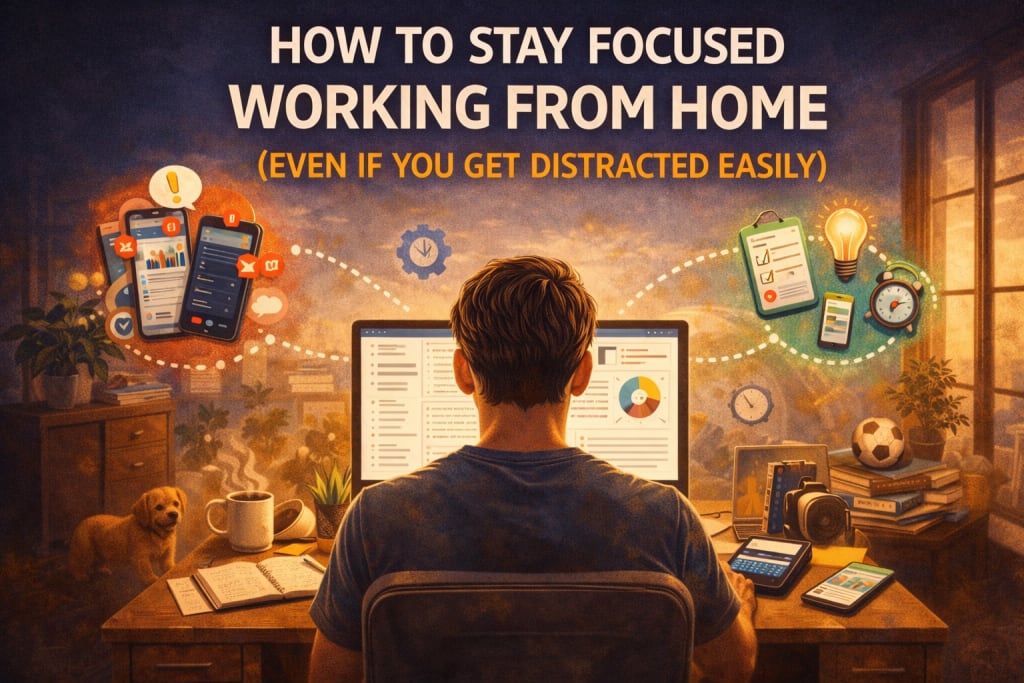
Working from home sounds like freedom.
No commute.
No office noise.
No micromanaging.
But here’s what most people don’t expect:
Working from home requires more self-discipline than working in an office.
There’s no social pressure.
No manager walking by.
No structured start and stop.
And if you get distracted easily, the environment can quietly destroy your productivity.
The good news?
Focus isn’t about personality.
It’s about systems.
Here’s how to build ones that actually work.
1. Stop Relying on Willpower (It Will Fail You)
Most people wake up and think:
“Today I’m going to be focused.”
That lasts about 45 minutes.
Willpower fades. Environment doesn’t.
If your phone is on your desk, you will check it.
If notifications are on, you will open them.
If Instagram is one tab away, you will click it.
That’s not weakness — it’s human behavior.
Instead of trying to fight distraction, redesign your setup:
• Put your phone in another room
• Use a website blocker during work hours
• Log out of social apps
• Turn off non-essential notifications
• Close unused tabs
Make distraction inconvenient.
When temptation isn’t visible, focus becomes easier automatically.
2. Use the 90-Minute Deep Work Method
Most remote workers “half work” all day.
They respond to Slack.
Check emails constantly.
Switch between tasks every 10 minutes.
That destroys deep concentration.
Your brain needs uninterrupted time to produce meaningful output.
Instead, work in 60–90 minute focus blocks.
One task.
One objective.
No switching.
After that, take a proper 10–15 minute break.
Stand up. Move. Reset.
Three serious deep work sessions per day can outperform eight distracted hours.
Focus is not about working longer.
It’s about working deeper.
3. The Daily Three Rule (Eliminate Overwhelm)
Overwhelm kills action.
When you start your day with 15 tasks, your brain doesn’t know where to start — so it avoids starting at all.
Instead, identify three outcomes that must happen today.
Not tiny tasks like “reply to email.”
Actual results.
For example:
• Finish client proposal
• Complete blog draft
• Submit performance report
If those three are done, the day is successful.
Everything else is optional.
This forces clarity.
And clarity removes mental friction.
Remote workers who feel “busy but unproductive” usually lack outcome clarity.
4. Separate Your Work Space From Your Rest Space
Your brain connects places with behaviors.
If you work from your bed, your brain associates that space with sleep.
If you work from the couch, it associates it with relaxation.
Even in a small apartment, create a defined work zone.
It doesn’t need to be fancy.
A desk.
A table.
A specific chair.
Use consistent lighting.
Keep it clean.
Keep it minimal.
When you sit there, your brain should switch into work mode automatically.
Environment shapes behavior more than motivation ever will.
5. Master the 5-Minute Start Rule
Some days, focus feels impossible.
You stare at your screen.
You delay starting.
You tell yourself you’ll begin “after one more scroll.”
Here’s the solution:
Commit to five minutes.
Set a timer.
Work for five focused minutes only.
That’s it.
Most of the time, once you start, momentum kicks in and you continue.
Starting is the hardest part.
Reduce the barrier, and action becomes easier.
Five minutes beats zero.
Always.
6. Manage Energy, Not Just Time
Remote workers often ignore physical energy.
But focus depends on it.
If you’re sleeping poorly, constantly scrolling at night, not moving your body, or skipping meals — your brain won’t cooperate.
You cannot out-discipline exhaustion.
To improve focus:
• Sleep at least 7 hours
• Take short movement breaks
• Stay hydrated
• Limit social media before bed
• Step outside daily
Remote work is a mental sport.
Treat your energy like an asset.
7. Set Clear Work Hours (Avoid “Always On” Mode)
One hidden focus killer is blurred boundaries.
If you’re “sort of working” from 8 AM to 10 PM, your brain never fully switches on or off.
Set defined work hours.
When work starts — you’re fully in.
When work ends — you disconnect.
This improves both focus and recovery.
Sustainable productivity beats random bursts of effort.
Final Thoughts
Working from home isn’t the problem.
Lack of structure is.
If you rely on motivation, you’ll struggle.
If you build systems, focus becomes predictable.
And once focus becomes predictable, performance improves.
Remote work rewards people who can manage themselves.
If you master focus, you don’t just get more done — you increase your value.
And valuable remote professionals don’t stay stuck for long.
About the Creator
Bahati Mulishi
Practical advice on remote work, IT careers, and professional skills to help you stay work-ready anywhere in the world.
Keep reading
More stories from Bahati Mulishi and writers in Lifehack and other communities.
Life Hack
In the year 2145, the world was a different place. Cities had stretched their iron fingers into the sky, and flying cars zipped between the towering buildings. Technology had advanced so much that problems of the past seemed silly and small. But life still had its challenges, even in this advanced world. People were always looking for hacks to make their lives easier, and many believed a new gadget — the Lifehack — held the answer.
By Hamad Afridi 2 days ago in Lifehack
A Complete Guide on Who Can Benefit Most from Microsoft Office Professional Plus
When it comes to productivity software, Microsoft Office has long been the gold standard. But among its many versions, Microsoft Office Professional Plus stands out for its comprehensive tools, advanced features, and powerful integrations. Whether you're a business owner, student, or corporate professional, this edition offers a wide range of capabilities that go beyond the basics.
By Jane Smithh2 days ago in Lifehack




Comments
There are no comments for this story
Be the first to respond and start the conversation.