
How to Spot AI in Your Writing—Before It Spots You
How clean, polished writing can quietly betray your voice—and what to do before algorithms do it first

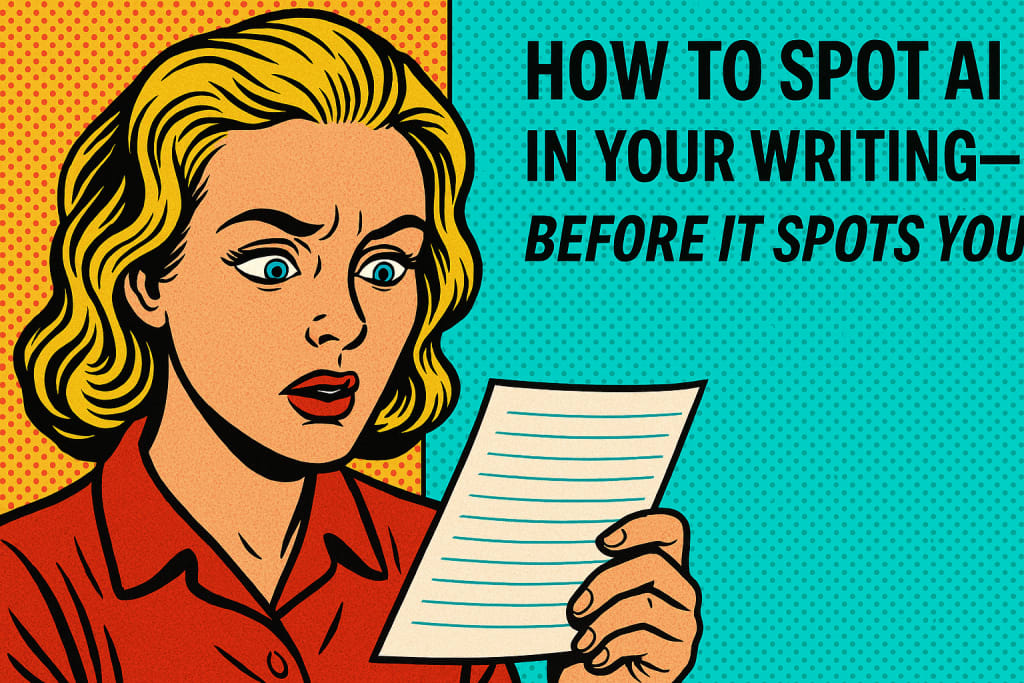
Long before a text gets flagged by an AI detector, there's usually a gut feeling. A paragraph that feels a little too clean. A phrase that somehow says exactly what it should, but leaves behind nothing. It happens even to seasoned writers. The strange moment when a draft, crafted with care (and maybe a bit of machine help), suddenly feels like it belongs to no one.
Spotting AI in your own writing isn’t just about passing detection software. It’s about recognizing where your voice starts to disappear. And sometimes, it’s already fading before you realize.
Not every sign is obvious. But a few patterns tend to show up, over and over.
There’s the rhythm, for one. Writing shaped by AI tools often settles into a hypnotic flow—every sentence the same length, every idea presented with robotic politeness. No stumbles, no stutters, no real tension. The writing behaves too well. That might sound ideal, until it starts sounding like everyone else.
Some writers catch it when they re-read and wonder: Did I really say that? They didn’t. Not exactly. The structure’s familiar, but the voice feels like a version of them that’s been auto-corrected into blandness. Like a clone trying to pass as the original.
Another sign: transitions that feel strangely obvious. Phrases like “Furthermore,” “In conclusion,” or “It is important to note that…” flood the text. They’re not wrong, just... tired. AI tools love these markers. They make paragraphs connect in a way that’s technically sound but creatively dull. Human writing often takes more crooked paths between thoughts. It’s less linear. More curious.
Even the emotional temperature matters. AI writing tends to hover at a constant, neutral tone. There’s a kind of eerie balance in the voice. Nothing is too bold. Nothing is too weird. No phrases that punch, no words that linger. It’s safe. Too safe. Human writers, when left alone with the page, eventually let something awkward or raw slip through. A sentence that spirals. A metaphor that overshoots. That’s what makes the writing alive.
It’s tempting to think that paraphrasing AI text—or translating it—erases the fingerprints. But that’s rarely true. Underneath new vocabulary or syntax, the core remains: symmetry, predictability, a soft but unmistakable flatness. Even after several edits, some AI-generated texts keep a mechanical soul unless they’re fully rewritten by hand.
There’s also the issue of length. AI tools often generate responses that sit comfortably within middle ground—neither too short to feel unfinished, nor long enough to meander. They aim for the statistical sweet spot. But readers notice when a paragraph ends just when they expect it to. Human writing, in contrast, sometimes rambles, sometimes cuts short, sometimes shifts gears without warning. It doesn’t always respect the formula.
Writers working under deadlines—or in second languages—may find these AI tendencies creeping in even when they’re doing most of the work themselves. A borrowed sentence here, a rewritten suggestion there. Slowly, their draft becomes a hybrid. Not quite AI, not quite personal. This is what many call “mixed writing.” And it’s the gray zone that detectors still struggle with.
Unfortunately, mixed writing gets flagged more often than people realize. Not because it’s inherently dishonest, but because the patterns confuse the algorithm. A detector doesn’t read intent. It only sees the mathematical consistency of the text. So a genuinely thoughtful essay, crafted with the occasional AI prompt or phrase, might be labeled “suspicious”—while a completely synthetic blog post slips by unchallenged, thanks to a few random typos and contractions.
Writers can fight this in two ways. First, by becoming their own detectors. Reading their text not as themselves, but as someone encountering it for the first time. Does it sound too… neutral? Are the turns of phrase too polished, too centered? Does every sentence end like a well-tuned chord? If so, the writing might be suffering from machine fatigue.
The second defense is editing—not as cleanup, but as restoration. Writers can go back into their drafts and look for places where things feel too smooth. They can add friction, unpredictability, even minor quirks. A long sentence that swerves off-track. A blunt statement. A question that never gets answered. These are the things that AI still doesn’t fake well.
Interestingly, some people are now using AI tools to help fix AI-leaning drafts. A strange irony. Tools designed to write are now being asked to rewrite, not to generate more content, but to shift the balance back toward human. The goal isn’t to outsmart detectors. It’s to sound like someone who actually had something to say.
In the end, the best way to spot AI in your writing is to listen for what’s missing. Not facts. Not logic. But rhythm. Mood. Hesitation. That sharp moment when a sentence snaps, or sighs, or slams the door. If your draft never does any of that—if it coasts too calmly—you might have let too much of the machine in.
Voice isn’t a technical detail. It’s the one part of writing that doesn’t scale well. And maybe that’s the point.
So no, AI probably didn’t “spot you.” But it may have started writing for you in places you didn’t notice. The trick is learning to notice again.
About the Creator
Keep reading
More stories from Karen Covey and writers in Lifehack and other communities.
Can Smodin Text Pass Other AI Detectors? I Tried It
I hear this question more often than students admit out loud. They do not ask whether AI tools exist anymore. They ask whether different systems talk to each other, whether one detector agrees with another, and whether rewriting tools leave a recognizable trace. As a teacher who reads hundreds of pages every term, I decided to test the concern instead of speculating.
By Karen Covey3 months ago in Lifehack
Who is your "Person"?
It's important to recognize that you cannot go through life as easily on your own. My name is Elizabeth and I'm a survivor of child abuse and horrific trauma. Healing from trauma is not a quick fix and recognizing that it will take time, is part of the struggle.
By Elizabeth Woods5 days ago in Psyche




Comments
There are no comments for this story
Be the first to respond and start the conversation.