
Forget Thumb Drives, Forget Dongles: China's SIM-Sized SSDs Are About to Change Your Tech Life
(and Your Pockets)

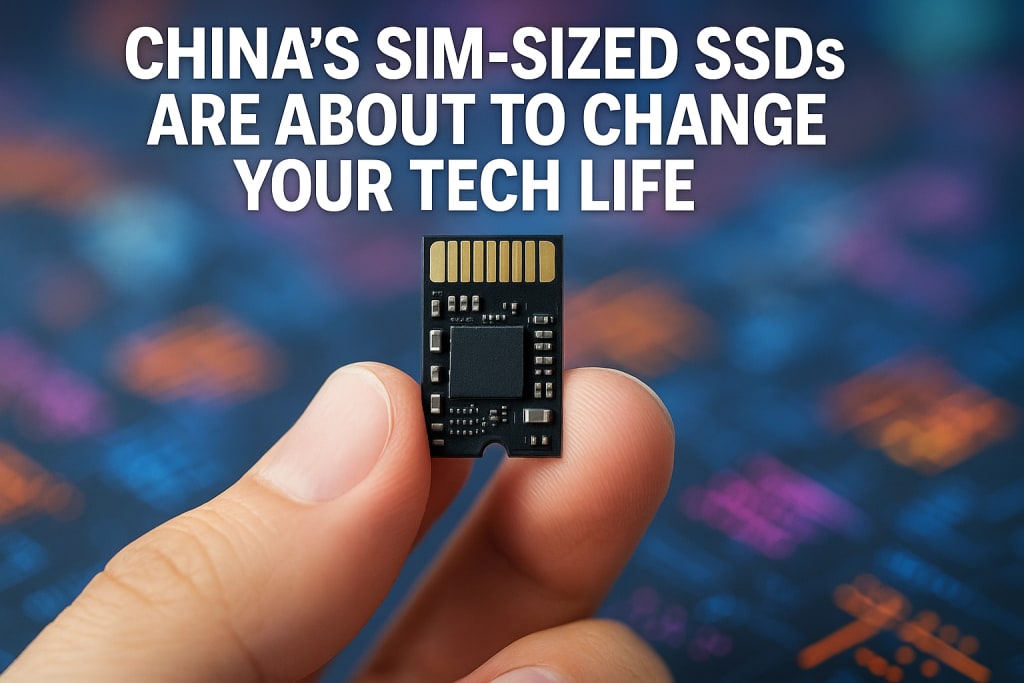
You know that sinking feeling. You’re about to capture the perfect sunset, your kid’s first goal, or that hilarious street performer. You raise your phone… and bam. The dreaded notification: "Storage Full." Suddenly, you’re frantically deleting old memes, uninstalling apps you barely use, sacrificing digital memories just to make room for the new. It’s a modern-day tech tragedy we all know too well.
What if I told you that a tiny revolution, literally the size of your SIM card, is brewing in China? And it’s poised to make those storage panic attacks a relic of the past? Get ready, because China is about to launch SSDs so small you insert them like a SIM card. This isn't science fiction; it's a tangible, standardized leap forward with the potential to fundamentally reshape how we interact with storage across all our devices.
The "TMEX" Card: Your Pocket-Sized Digital Vault
Let’s break it down without the jargon. Imagine your phone’s SIM card tray. Now, imagine popping in another card just like it, but this one isn’t for your phone number – it’s a powerhouse of storage. That’s the essence of the TMEX card (short for "Tinymicro Express").
Developed under the guidance of the China Electronics Standardization Association (CESA), the TMEX standard defines a storage module measuring a minuscule 14mm x 18mm. That’s roughly the footprint of a nano-SIM card. Despite its tiny stature, early versions promise capacities reaching up to a very respectable 256GB. Think about that: 256GB – enough for thousands of photos, hours of HD video, or a hefty chunk of your music library – tucked into a slot you already have in your phone.
The real magic isn't just the size, though. It's the standardization. CESA isn't just proposing this; they're establishing a unified specification. This means manufacturers across China (and potentially globally) can build devices – phones, tablets, laptops, cameras, drones, even smart home gadgets – with dedicated TMEX slots. And crucially, any TMEX card from any brand should work seamlessly in any compatible device. Remember the frustration of incompatible memory cards or proprietary dongles? TMEX aims to obliterate that.
Why China? Why Now? It's About Solving Real Problems
This isn't happening in a vacuum. China's tech ecosystem moves fast, driven by massive user bases and unique market pressures:
The Storage Squeeze is Real: Flagship phones are ditching microSD slots to chase slimmer designs and push pricier high-capacity internal storage tiers. Budget phones often skimp on internal storage. Consumers are stuck between a rock (expensive upgrades) and a hard place (constant storage management). TMEX offers an elegant, affordable escape hatch.
The Ecosystem Play: Imagine a world where your phone, your drone, your action camera, your laptop, and even your gaming handheld all speak the same tiny storage language. Seamlessly swapping a card between them isn't just convenient; it’s transformative for workflows. Chinese manufacturers excel at building integrated ecosystems – TMEX could be the glue.
Beyond Phones - The "Everything" Storage: Think bigger. A smart security camera needing local event storage? Pop in a TMEX card. A drone capturing 4K footage? TMEX. A portable music player? TMEX. Even industrial sensors or medical devices could leverage this tiny, standardized storage. The potential applications are vast.
Indigenous Innovation: China has a strong drive to develop and control core technologies. Establishing a successful, widely adopted storage standard like TMEX is a significant step in that direction, reducing reliance on foreign formats.
Your Life, Upgraded: The TMEX Effect in Action
Let’s ditch the abstract and picture how this SIM-sized SSD could genuinely change your daily tech experience:
The Traveler: You're backpacking through Southeast Asia. Your phone is your camera, map, translator, and entertainment hub. Instead of one phone with limited storage or juggling multiple bulky drives and cables, you carry a few TMEX cards. Fill one up with photos and videos? Simply pop it out, slot in a fresh one, and keep shooting. Later, pop the full card into your compact travel laptop (which also has a TMEX slot) to back up or edit. No dongles, no cloud uploads over dodgy hostel Wi-Fi, just instant, physical transfer. China is about to launch SSDs so small you insert them like a SIM card, turning storage management into a simple card swap.
The Content Creator (on a budget): You're filming a short documentary with your smartphone and a mirrorless camera. Traditionally, you’d need specific SD cards for the camera, then a dongle or card reader to get footage onto your phone or laptop for quick edits. With TMEX? Your phone and camera both have TMEX slots. Film on the camera, pop the TMEX card out, slot it directly into your phone, and start editing immediately on a powerful mobile app. Or vice-versa – record B-roll on your phone, slot the card into the camera for the main shoot. Seamless. Effortless. SSDs so small you insert them like a SIM card become the universal media shuttle.
The Parent: Your kid’s tablet is perpetually full of games and videos. Instead of wrestling with cloud storage subscriptions they don't understand or buying a whole new tablet, you buy them a couple of larger TMEX cards. "Game Card A" and "Cartoon Card B." When they want to switch, they learn to swap the cards themselves (it’s as easy as changing a SIM!). It teaches responsibility, avoids meltdowns over deleted saves, and is far cheaper than device upgrades. The simplicity is revolutionary.
The Privacy Conscious: Need to share sensitive documents or family photos? Instead of emailing, using potentially insecure cloud links, or handing over an entire USB drive, copy the files onto a TMEX card. Hand the card to the person. When they’re done, they hand it back. Physical control. Simple. Secure. No internet required. The tiny size makes it discreet and easy to carry securely.
Beyond Convenience: The Ripple Effects of Tiny Storage
The implications of widespread TMEX adoption go far beyond just easier photo storage:
Device Design Revolution: Without needing bulky internal storage bays or ports for larger cards, manufacturers can make devices thinner, lighter, or use the saved space for bigger batteries or other components. Imagine ultra-slim laptops where storage expansion is handled via a discreet slot, not a chunky drive bay.
Democratizing High-Speed Storage: SSDs are fast. Bringing that SSD speed in such a tiny, standardized, and likely affordable form factor could significantly boost performance on budget devices that traditionally rely on slower eMMC storage or limited internal SSD space. Boot times, app loading, file transfers – all get a potential speed bump.
Repairability & Longevity: If your phone's internal storage fails, it often means a costly repair or replacement. With TMEX, your precious data could live primarily on the removable card. If the device fails, your data is safe on the card. Similarly, upgrading storage capacity becomes trivial – just buy a bigger TMEX card, no need to replace the whole device.
A New Lease on Life for Older Devices: Got a perfectly good phone or tablet whose only flaw is paltry 64GB storage? Instead of relegating it to a drawer, popping in a 256GB TMEX card could breathe new life into it for years to come, reducing e-waste.
Challenges on the Horizon: Not All Sunshine and Tiny Cards
Of course, no revolution is without its hurdles:
Adoption is Key: For TMEX to truly succeed, major device manufacturers need to embrace it. They need to add the slot. While Chinese brands like Huawei, Xiaomi, Oppo, Vivo are likely early adopters, global giants like Apple and Samsung need to get on board for it to become ubiquitous. Will they see the value, or stick to their proprietary ecosystems?
Speed Matters: The initial specs focus on capacity and form factor. The speed of these tiny SSDs will be crucial. Will they match the performance of internal NVMe storage, or be more akin to slower microSD cards? Real-world performance will dictate their usefulness for demanding tasks like high-res video editing or gaming.
Durability Concerns: SIM card slots are designed for cards inserted infrequently. TMEX cards might be swapped much more often. Can the slots withstand daily wear and tear? Are the cards themselves robust enough for frequent handling?
The Cloud Factor: Cloud storage is deeply entrenched. For many, the convenience of auto-syncing photos and files across devices outweighs the need for physical swaps. TMEX offers offline speed and control, but it has to compete with the "set it and forget it" cloud model.
The Future is Tiny: What This Means for You
The announcement that China is about to launch SSDs so small you insert them like a SIM card isn't just a neat tech trick. It's a potential paradigm shift. It’s about giving power back to the user – power over storage, power over data, power over device longevity.
Imagine walking into a store and picking up storage like you pick up a prepaid SIM card. Need 128GB today? Grab one. Planning a big project and need 1TB next month? Grab a bigger one. All compatible with the devices you already own (or will soon buy). No compatibility charts, no hunting for the right adapter, just pure, simple storage expansion.
This is the promise of TMEX: Storage that finally disappears into the background, as small and effortless as the SIM card that connects you.
Actionable Thoughts & Your Next Move
So, what now? Keep your eyes peeled. As TMEX devices and cards start hitting the market later this year or early next:
Vote with Your Wallet: If this idea excites you as much as it excites me, support the manufacturers who embrace TMEX. Show there's demand for open, standardized, user-friendly storage expansion.
Re-evaluate Your Next Purchase: When considering a new phone, tablet, or laptop, ask: "Does it have a TMEX slot?" Let manufacturers know this feature matters. It could be the deciding factor that extends the usable life of your device.
Imagine the Possibilities: Seriously, take a moment. What would you do with effortless, instant, pocketable terabytes? Would you shoot more video? Carry entire libraries of music or movies? Never worry about backing up your phone again? How would it change your work, your hobbies, your digital freedom?
Demand Global Standards: While TMEX starts in China, the need for tiny, universal storage is global. Encourage international standards bodies and manufacturers worldwide to pay attention and collaborate. The best tech solutions transcend borders.
The battle against the "Storage Full" monster might finally have a victor, and it’s smaller than your fingernail. The era of cumbersome drives and frustrating dongles might be winding down. Get ready for a world where SSDs so small you insert them like a SIM card become as commonplace as the SIM card itself. The future of storage isn't bigger; it's brilliantly, beautifully smaller. And it’s almost here.
About the Creator
John Arthor
seasoned researcher and AI specialist with a proven track record of success in natural language processing & machine learning. With a deep understanding of cutting-edge AI technologies.
Keep reading
More stories from John Arthor and writers in Lifehack and other communities.
The iPhone 17 Wait Just Got Longer: Why That October Date Actually Matters to You
Remember that electric buzz in the air every September? The crisp hint of autumn, the flurry of tech headlines, the collective holding of breath as Tim Cook stepped onto that stage? For years, the rhythm of the iPhone launch felt as predictable as the turning leaves. You’d start saving in June, maybe casually browse cases in August, knowing that by mid-September, that shiny new device would be nestled in your palm. Well, friends, grab a comfy chair and maybe a calming tea – the beat just changed. The Apple iPhone 17, iPhone 17 Pro Release Date: New Date Enters The Schedule, and it’s humming a different tune: October.
By John Arthor5 months ago in Lifehack
The Quiet Advantage of Early Hustle Jobs and Why They Shape Long-Term Success
Early hustle jobs often look small on the surface. They may involve delivering food, selling items online, tutoring, washing cars, or helping in a local shop. Many people see them as temporary or unimportant. Yet the truth is different. These jobs build habits, skills, and mindsets that last a lifetime. The hidden power of early hustle jobs lies in how they prepare people for real challenges before adulthood fully begins. At a young age, time feels endless. Energy is high, and risk is low. This makes early work experiences very valuable. They teach lessons that schools often miss. They also shape how a person sees money, effort, and responsibility. These lessons quietly influence future success in careers, business, and personal growth.
By David Lipan4 days ago in Lifehack
Why Smartphones in 2026 Will Feel Very Different From the Ones You Use Today
The top phones from 2024 and 2025 don't appear that different when you put them next to each other. The displays are a little brighter. The cameras are a bit clearer. The CPUs are a little speedier. But in real life, things haven't altered much. You still swipe. You still tap. You still plug in your phone every night. You still care about battery life.
By abualyaanart5 days ago in Lifehack



Comments
There are no comments for this story
Be the first to respond and start the conversation.