
Coping with Social Isolation
Social isolation is not loneliness.


If you have an injury that limits your mobility or staying safe by quarantining during this pandemic, this prolonged isolation can bring some side effects.
Here's an important thing to remember: social isolation is not loneliness.
People must have social contact to be happy; without it, we become depressed.
The roots
It is not social isolation per se that causes depression, but rather the inability to meet one's emotional needs through certain social interactions.
Social isolation is very bad for humans. It affects their physical and mental health negatively, including depression and other related psychosomatic conditions.
It's well known that prolonged social isolation can have a harmful effect on a person's mental health. This has been highlighted by the famous study done by John Cacioppo and Louise Hawkley, which demonstrated that people who are socially isolated for long periods of time run an increased risk of mortality and contracting numerous diseases, including depression and cardiovascular disease.
An evolutionary standpoint
Humans appear to be social animals. This means we have evolved to seek others' companionship and will generally not cope well with prolonged isolation from other humans.
Therefore, it would seem that the best way to cope with social isolation is to avoid becoming isolated in the first place. However, this is easier said than done as humans are not naturally inclined towards forming friendships and communities.
Here's an interesting thing...
Humans get along best in groups of about 150 people. There is evidence that the human brain evolved to remember and track about 150 other humans at any time because this was what constituted a large enough group for survival purposes.
Alexa: what is Dunbar's number?
A fascinating sidenote
The concept of Dunbar's number has been described in the last few decades, which points to a human cognitive limit to the number of individuals with whom any one person can maintain stable relationships. This is typically given as 150 for adults.
It was first proposed in 1992 by British anthropologist Robin Dunbar.
In evolutionary terms, the human brain has only experienced growth over a relatively short time period compared to other species. One would likely expect that our cognitive capacities would be more limited than most.
The number 150 is probably the average size of a hunter-gatherer human group. When humans lived in small groups, natural selection favored individuals who were good at forming relationships with other tribe members and family members.
We may be on our phones too much.
Others may be suffering from social isolation because we are so attached to our phones, checking for messages and notifications every few minutes or even seconds. The result of this obsession is the rather obvious fact that it makes us less social.
Rather than talking to our friends and family in person, we are now more comfortable typing a status update on Facebook or sending them a text message. This has resulted in many of us being less social because it is easier for us to communicate with people through technology rather than spending time face-to-face.
Les IRL time
Social media, and technology in general, have fragmented our attention spans. We now have shorter attention spans than goldfish because we are constantly scrolling through social media feeds or on the internet.
We now have shorter attention spans than goldfish.
This can be harmful to our relationships because we are no longer able to give them the attention and time they need. The result is that many friendships and family ties have been broken, mainly due to a lack of communication.
For those not in the know, IRL means "in real life."
Some Solutions
One of the biggest reasons for coping with social isolation is less about the actual isolation itself, but more to do with a person's reaction to it. For example, many people would struggle in an isolated environment without others around them, but they could be alright if they just accepted their situation and tried their best to enjoy themselves.
One thin that comes to mind is to have people over to your home. Again, this is not easy or possible during this Covid19 crisis. Use your best judgement.
Being outdoors can have tremendous benefits for our psyche. Even something as simple as going out for a walk.
Another great way to cope, is to keep our minds busy. Got a skill? You may be able to do some volunteer or pro-bono work. Learn a new skill, pick up a hobby. Think of all the things you wanted to do, perhaps you have a list. Time to take it out.
About the Creator
Eduardo Siu
Sharing ways to live life maximizing for happiness.
Keep reading
More stories from Eduardo Siu and writers in Lifehack and other communities.
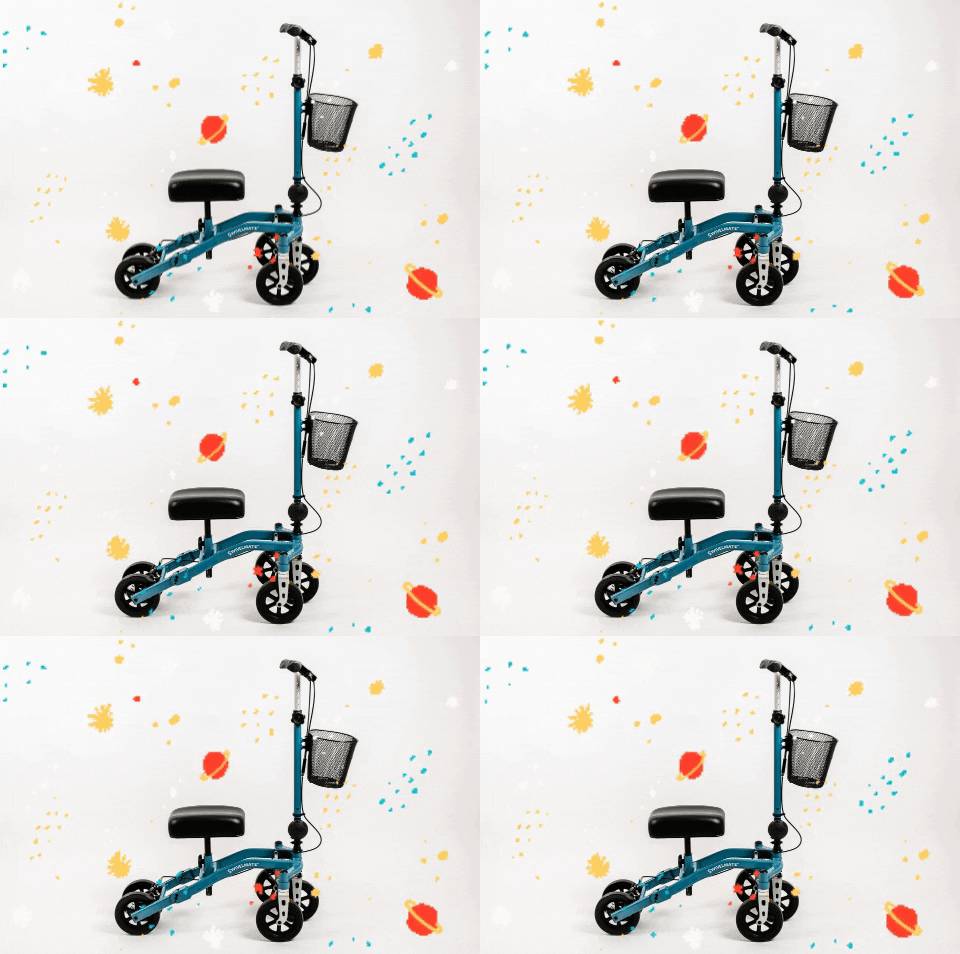
What Stuff Can You do on a Knee Scooter?
Knee scooters help folks to get around without the difficulty and discomfort of using crutches. It makes it easier for people to move around their homes, outdoors, and at the office. Knee scooters can help keep users safe with their stability, thus reducing the risk of further injuries.
By Eduardo Siu5 years ago in Lifehack
Why Engagement Matters More Than Reach
Reach looks impressive on a dashboard. A post appears on thousands of screens and the number feels like progress. Many creators celebrate that spike, especially when they are building Instagram side income. Yet income rarely follows reach alone. What actually drives earnings on small niche accounts is engagement.
By Nina Rafferty7 days ago in Lifehack
REEEEEEEEE!
I'm on a low road right now. There are a literal million things to do and not one of them worth my time. I would rather sit in place and burn but the orbit takes me on its inevitable route 'round the center; and I a center in my own right, around which others orbit, and so on and so forth, ad infinitum, ad nauseum.
By C. Rommial Butler2 days ago in Poets


Comments
There are no comments for this story
Be the first to respond and start the conversation.