
Cobblestones in the Kitchen
Arthur felt a persistent ache, a nostalgia for rain-slicked Parisian streets he'd only ever walked in his mind.
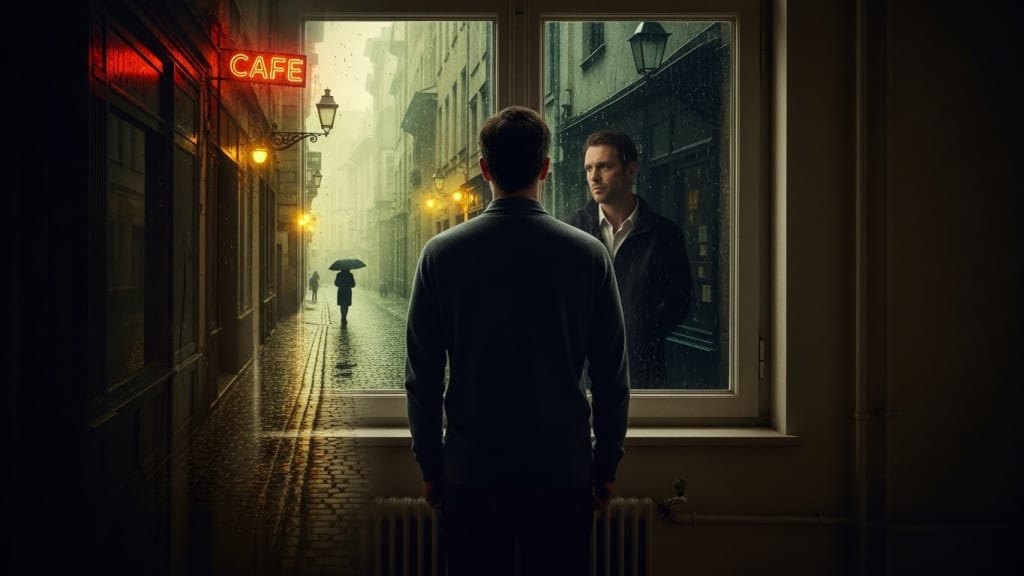
Arthur’s days unfolded in a predictable grey. Coffee, commute, cube, commute, dinner, television, sleep. Repeat. His apartment, a third-floor box in a sprawling suburb, smelled faintly of stale toast and the cleaning products the landlord insisted upon. The window overlooked a precise grid of other beige buildings, a parking lot, and a patch of manicured lawn that served no discernible purpose. He worked in data entry. Numbers, endless, indifferent numbers, marching across a screen. His fingers flew over the keyboard, but his mind, a restless, half-tamed thing, was always somewhere else.
And that 'somewhere else' wasn't a holiday brochure fantasy, not exactly. It was a feeling, deep in his gut, a yearning so specific it was almost painful. A nostalgia for a place he’d never once set foot in. Paris, maybe. Or Rome. Some ancient, rain-washed city where history clung to the stone like moss. He saw it in flashes: the glint of wet cobblestones under the glow of a streetlamp, the steam curling from a tiny café window, the muted rumble of distant chatter, the sharp, sweet smell of damp earth and baking bread.
It wasn’t a desire to 'see the sights.' No Eiffel Tower postcards in his brain. It was the grit of the alleyways, the peeling paint on an ancient wooden door, the way light fell across a cluttered storefront. The clatter of ceramic cups, the murmur of a language he didn't understand but felt, somehow, in his bones. He knew the weight of that silence after a sudden downpour, the chill of the air, the way the sound of his own footsteps would echo, singular, meaningful, down a narrow street. He imagined the ache in his calves from climbing endless stairs, the surprise of finding a small, hidden garden, bursting with defiant green in an unexpected courtyard.
This was his secret life, played out in the dark corners of his imagination, fueled by black-and-white films he streamed late at night, by the crackle of old Edith Piaf records, by dog-eared novels describing lives so utterly different from his own. He’d trace the lines on ancient maps online, losing hours to the labyrinthine details of quartiers, feeling a ghost of recognition, a familiar pull towards squares he’d only ever seen pixilated on a screen. Sometimes, he’d catch himself, sitting at his kitchen table, cup of instant coffee cooling, a pang of something akin to homesickness hitting him. For a home that wasn’t even real. Not for him, anyway.
It felt a little mad, this preoccupation. What kind of person pines for a memory that isn’t theirs? He didn't talk about it. His friends, mostly from work, would ask about his weekend, expecting tales of lawn mowing or grocery runs. He couldn’t tell them he’d spent Saturday afternoon re-reading a passage about a lone flâneur wandering the Île Saint-Louis, feeling the exact chill of the wind off the Seine. They’d stare. They’d probably suggest he needed a vacation. And he did, maybe, but a vacation felt too transactional, too neat for the deep, unsettling longing that lived inside him.
One particularly grey Tuesday, the kind where the clouds hung low and bruised, and the office fluorescent lights hummed with an extra dose of misery, Arthur found himself staring at his desktop background: a stock photo of a tranquil forest. Bland. Safe. And suddenly, he hated it. He hated the blandness. He hated the safeness. He closed his eyes and saw the flickering lamplight on wet stone, the shadow of a gargoyle against a darkening sky. He opened them and saw the endless grid of his spreadsheet. A tiny, desperate spark ignited.
That evening, instead of the usual frozen meal, he bought fresh bread, good cheese, and a bottle of cheap but decent red wine. He put on a compilation of French jazz, music he’d always associated with those imagined evenings. He didn't just listen; he *felt* it, the brassy melancholy, the insistent rhythm. He ate slowly, savoring each bite, the rich, complex flavors a stark contrast to the microwaved chicken he usually choked down. The familiar furniture of his apartment seemed to soften around him, the edges blurring. The hum of the refrigerator faded.
It wasn't Paris. Of course, it wasn't. But as he wiped a stray crumb from his chin, a thought, clear and sharp, pierced through the fog of his longings: this feeling, this profound, almost aching nostalgia, wasn't a curse. It wasn't some weird aberration. It was a compass. It was telling him what his soul craved. It wasn't about the physical place, not entirely. It was about what that place *represented*: beauty, history, passion, quiet observation, a life lived with a different cadence, a deeper texture. These were the things missing from his beige, numbered days.
The next morning, he skipped the instant coffee. He found an old French press tucked away in the back of a cupboard, something a well-meaning relative had given him years ago. He bought proper ground coffee, dark and rich. The process of making it, the slow pour, the waiting, the press, felt almost ceremonial. He added a phrase a day from an old French phrasebook he’d found online to his daily routine, mouthing the guttural sounds as he drove to work. He started taking a different route, a longer one, through the older parts of town, noticing the intricate brickwork on forgotten buildings, the shape of the trees, the subtle shifts in light.
The longing didn’t disappear. It was still there, a soft thrum beneath his skin, but it had changed. It was no longer a wistful ache for something unattainable, but a quiet guide. It pointed him towards the things that nourished him, the details that held beauty, the moments of pause and appreciation he could carve out of his own life. He might never walk those rain-slicked cobblestones, might never hear the clatter of ceramic in a genuine Parisian café. But the spirit of that place, what it meant to him, he could carry. He could cultivate it, right here, in his own square box apartment.
He stood at his window now, a steaming mug of strong coffee in his hands, watching the morning light begin its slow ascent over the beige buildings. It was still the same view. Still the same grey. But somewhere, deep inside, a tiny, imagined violin played a soulful, slightly off-key tune, and Arthur felt, for the first time in a long time, a quiet, almost imperceptible shift. A loosening. A breath. And then he took a long, slow sip of his coffee, the bitter warmth a small rebellion against the morning chill.
About the Creator
HAADI
Dark Side Of Our Society
Between Places and Possibilities: The Human Experience of Moving in Rockville, Maryland
Moving often begins quietly. It starts with small decisions — sorting belongings, noticing how spaces feel different, imagining life somewhere new. Gradually, what once seemed distant becomes immediate. Rooms empty, routines shift, and the familiar begins to transform into memory.
By House Doctor6 days ago in Lifehack
Why Cold Exposure Is Gaining Popularity
From elite athletes to busy professionals, more people are stepping into tubs filled with icy water—and loving it. Ice baths, also known as cold plunges, have surged in popularity over the past decade. What was once a recovery tool reserved for professional sports teams is now a mainstream wellness practice.
By AnthonyBTV6 days ago in Lifehack



Comments
There are no comments for this story
Be the first to respond and start the conversation.