
Braised Pork With Eggs
The dish "thịt kho tàu" turns out to be completely authentic Vietnamese (according to Professor Trần Văn Khê), always present on the traditional Tet feast and in daily meals. The meat dish I'm cooking today does not use coconut water but still has a beautiful color, with the sweet taste of rock sugar, and because it doesn't use coconut water, it can be preserved longer for use during Tet. This Tet, let's go into the kitchen and make this famous traditional "thịt kho tàu" dish that we are proud of in Vietnam! Wishing you success!
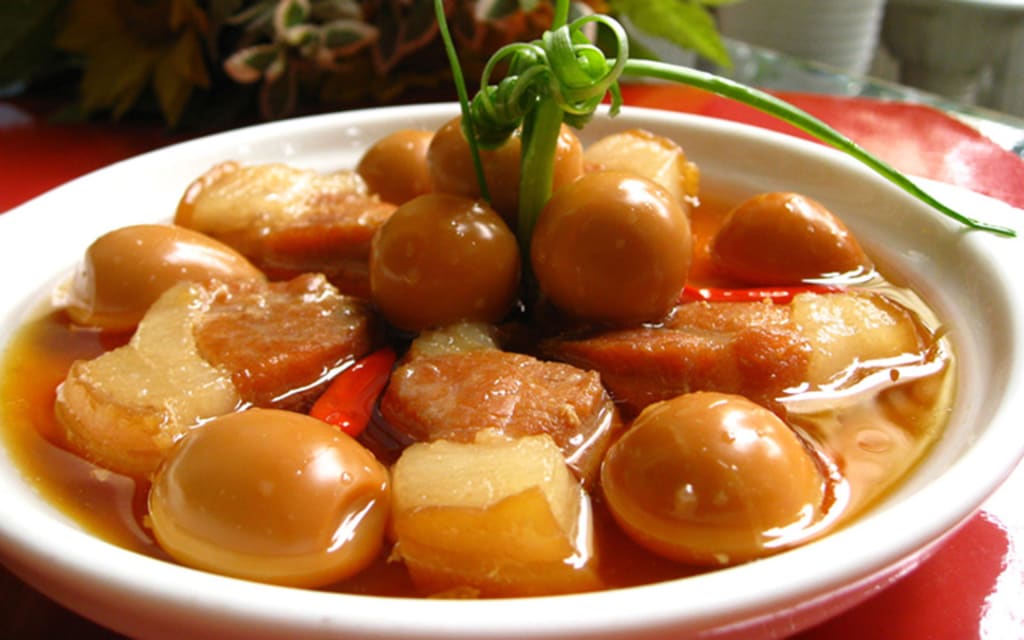
The name "Caramelized Pork - Thit Kho Tau" often leads people to believe that this dish originates from China, but that is actually incorrect. The term 'Tau' translates to bland, indicating a milder version of stewed pork. Professor Tran Van Khe notes that Caramelized Pork is entirely Vietnamese in origin. While making it isn't overly complicated, achieving the perfect dish is a real challenge. The pork should be tender, showcasing the bright red of the lean meat, the transparency of the fat, the brown skin from cooking, and the shiny yellow of caramelized sugar syrup, all balanced with the savory flavor of fish sauce and the sweetness of rock sugar. This combination creates the delightful taste of Caramelized Pork, which is now a staple in Vietnamese meals and especially significant during the Lunar New Year, known as Tet.
To prepare this dish, you will need pork and some spices such as green onion, garlic, chili, and onion. When marinating the pork, it's crucial to select the right cut for optimal flavor and presentation. Fresh pork with a natural pink hue is ideal; it should not be dry or have overly thick skin. Pork belly is usually preferred as it has layers of fat that enhance flavor and tenderness during cooking. When using pork belly, choose a cut where the fat and meat are well integrated so that it holds together during stewing. Other cuts like ham or pork shoulder can also work well. For this recipe, I have about 2.87 lbs. of pork, which I’ll prepare entirely.
To prep the pork, I’ll quickly explain the steps to save time. First, I’ll soak it in warm water with salt and lemon juice for 15 minutes, then rinse it clean and carefully scrape the skin. If using frozen pork, boiling water can help remove any unwanted odors. Next, I'll cut the pork into cubes for better presentation. To make slicing easier, poaching the meat in boiling water or briefly freezing it can help. The pieces should be around 4 to 5 centimeters on each side. If you prefer faster cooking, smaller pieces work too, but for traditional ceremonies, larger portions are ideal, usually serving six from one piece. When tasting, you’ll appreciate the tenderness of the pork.
Having sliced the pork, I’ll set it aside for marinating. I’ll prepare green onion, garlic, and chili, opting to pound them for better absorption into the meat. The vibrant red peppers will enhance the dish's color. Once that’s done, I’ll start the marination process. The quantities I’ll use include 4 spoons of sugar (rock sugar is preferred), 1/2 spoon of MSG (optional), 1 spoon of broth mix, 1/2 spoon of salt, 2 spoons of fish sauce, and 2/3 spoon of lemon juice to help tenderize the meat. For the syrup, I’ll use 1 to 1.5 spoons, depending on its consistency, ensuring it's homemade and brown, avoiding bitterness. I have a video link on making caramelized syrup that I’ll share separately. Be cautious not to add too much syrup, as it darkens when heated.
As for the spices, I’ll set aside half of the pounded mixture to extract the juice, while adding the other half directly into the marinate. This approach keeps the final texture clear. Lastly, I'll add a pinch of pepper, about 1/2 teaspoon, and mix everything by hand so the pork absorbs all the flavors. Remember to wear gloves while doing this and let it rest.
About the Creator
Keep reading
More stories from writers in Lifehack and other communities.
Moving in Canton: How Preparation Shapes the Relocation Experience
Relocating within or to Canton is often seen as a straightforward process, but many residents quickly discover that even local moves come with unexpected challenges. While the town offers a calm residential atmosphere and accessible neighborhoods, the success of a move depends largely on preparation rather than distance alone. Understanding how moving companies operate within Canton’s specific context can make the difference between a stressful day and a smooth transition.
By House Doctor5 days ago in Lifehack
Our Song
Evening has given way to night. Gently, I settle next to you on the comfortable, old love seat and reach for your hand. You snatch it away, again. It cuts me to the quick, but I hide the pain, understanding that the reaction is but part of your demented state. Since the accident, your presence here in our cozy home has been clouded by a haze I can't see. Nevertheless, I feel the frigidity of your expressions and it serves as an excruciating reminder of the immeasurable distance between us.
By Dana Crandell4 days ago in Fiction
The Angry Man in Your House
"If you grow up with an angry man in your house, there will always be an angry man in your house" This statement has caused plenty of controversy online, people say its a statement that blames victims while also undermining those who break traumatic cycles to form health relationships... but if I'm honest now that I'm in my 30s it makes more sense to me than ever, and I'd argue that its not just about fathers and uncles.
By S. A. Crawforda day ago in Humans



Comments
There are no comments for this story
Be the first to respond and start the conversation.