
A Travel to the World
Have you ever thought about this?

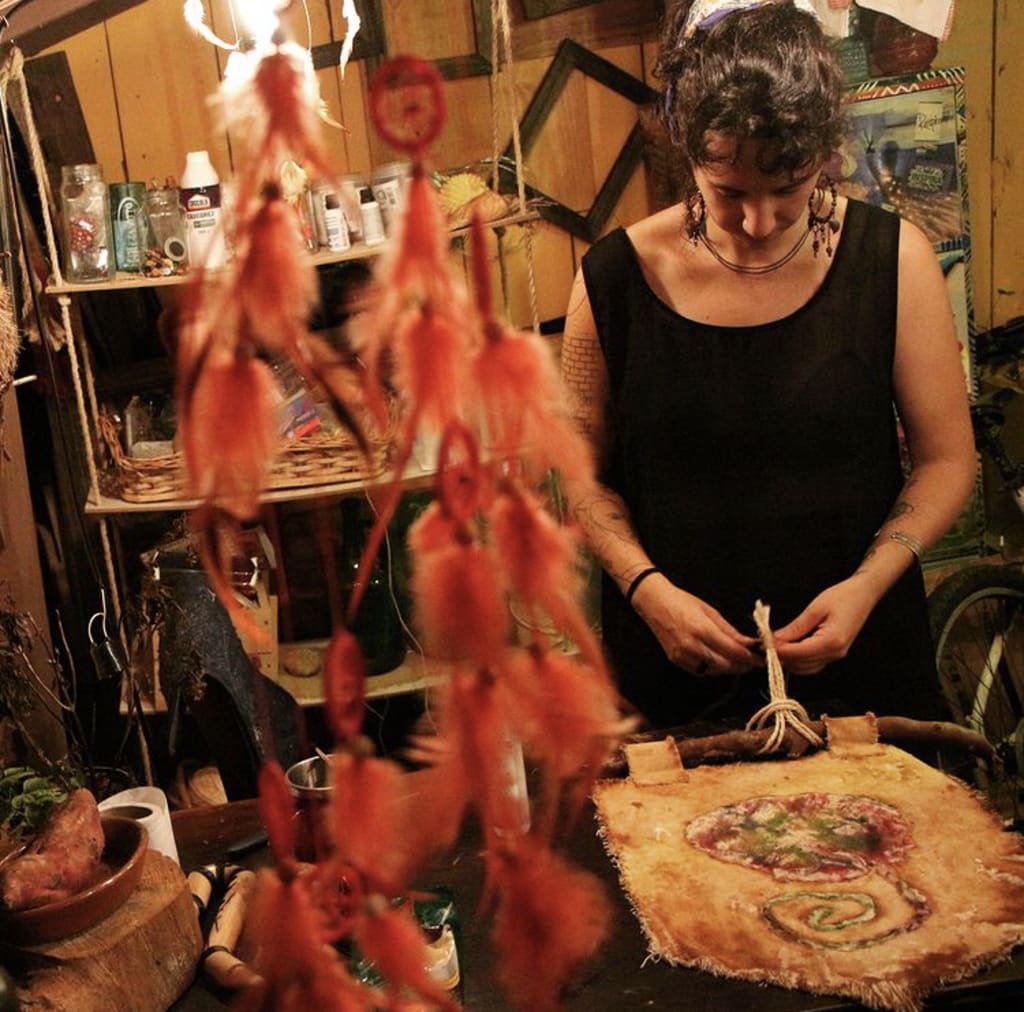
Not everybody understands my art. And I know it is quite peculiar. But I also know that those who wanted it, have used it to heal deep wounds or to preserve intact a sweet memory.
My craft is to eternalize the placentas, the guardians of life, the seal of mammals.
In our occidental world, the placentas have quite a silent destiny that lives in oblivion, coming out of the womb still pulsing essentials, being cut off before its job is done, and going straight to a plastic bag in hospital trash.
I wanted to offer the possibility of a different end. And believe me, amazing things have happened by that.

Before I get to tell you my experiences with placentas, there are some curious facts I would like to share with you. I don't intend to inculcate beliefs that are so personal, but I do want to show you different perspectives from some native cultures.
Mostly for ancient cultures, the placenta contains its own soul. That soul is responsible not only for connecting the baby to a source of nutrition and oxygen, as well as protection, but it is also the baby's sister who looks after them the whole life. They believe the placenta spirit is the one we usually call ''guardian angel''. Since nobody in the world can come to life without a placenta, there is no one as well who is not destined to a guardian angel. For the same reason, honoring the placenta, giving it a thought is a way of recognizing that angel and consciously giving them a place in our life. Some of the rituals with the placenta in those cultures are, for example, burying it right by the house's main door. That way, the placenta spirit would always make sure every time the child goes out of the house, also gets back safe and sound. After the baby is born, they do not get rid of the placenta right away, they keep it around resting in some piece of fabric with salt and herbs for one or two days. If during that time the baby has some complications, they would deep the placenta in warm water, calling its spirit to energize the baby and keep they alive.

There are many ancient rituals with placentas, having to do with a deep belief of it being totally connected with the baby's welfare. And what about science?. Some observations have been made in the animal world itself to better understand the full role of this organ in our lives. We are the only mammal who gets rid of the placenta right away, who ignores it completely. If we observe the animal world, we will see the placenta as being a mainstay of the birth process. After a baby animal is born, the placenta remains attached for a while until all the blood ended passing through the umbilical cord to the baby. Only then, the mother chews the cord, separates them, and eats the placenta, since seems like it has all the nutrients she needs to get over the birth process. A curious fact is that scientists have found a kind of placentophagy gene in mice, which is also present in women's DNA. That could suggest that if we don't handle the placenta like the animals, it could be for cultural reasons. Yes, I know it sounds crazy.
I always give this all a thought. The placenta is still being researched and is not deeply understood yet. But I just wanted to share with you those curious facts in order to make you get a little closer to your own placenta, to think about it, and ask yourself questions that can bring your own and unique answers.
Now, I want to tell you how I got into the placentas world and what means to do craft with it.

I worked for years supporting women in labor. Each time I saw a placenta, I would think to myself ''Such an amazing little thing'', well not always that little. The red color vibrating, the perfect, smooth, and shiny membranes, the cord still bumping like a heart all the way into the baby tummy, who was stretching and breathing for the first time thanks to it. Those were such beautiful scenes. One day, I asked a family if I could take the placenta home. Of course a huge why came from a shocked face, and, completely honest, I told them I was really curious and wanted to check it closer. And so I did.
I left and passed by a hospital equipment store. I got some gloves, masks, alcohol, and an appropriate bowl. Already home, I put some smooth music on and opened the world in front of my eyes. The labor smell was there, the placenta was still warm, and, for a moment, I felt bad for being me and not them who was looking at it with those full of love and admiration eyes. I didn't do anything special that day, I had read a lot about the placenta anatomy as well so I remained there for a while, exploring that interesting piece of life, that complex intelligence hiding inside. By exploring it, I found the exact tiny hole in the amnios where the water bag had broken and life started to arrive. That was exciting. After a while, I put it in a piece of fabric with some lavender from the garden, dug a deep hole for my dogs not to find it, and gave her a different end from the rest of the placentas I had ever seen.

I wanted to keep in some way in contact with that possibility of bringing the placenta on the scene. Researching, I got to know about a traditional midwife in the south of Chile who was developing a special work with placentas. I reached her, booked a flight, and went on my journey of discovering more about it. Her approach was very ritualistic, although clearly based on a strong western and ancestral knowledge. We spent days in her house, a cabin in the Andean forest during rainy weather with the chimney at full steam. She told me many stories about how the placenta had had a huge impact on many family's bosoms, especially after traumatic deliveries. It was a lot for me to process and I didn't want to have my mind shaped by anyone's beliefs all of a sudden. Of course, I was there to learn from her and I was definitely admired for everything, but I wanted to get back home and put into practice some of that information and see how I would feel, how families from such a different culture than hers would feel.
When I came back from Chile I took a course about safe blood handling and sanitary measures to get ready to jump into the placentas world more seriously. In Chile, I have been taught to handle the placenta in different ways, also how to prepare medicines for ingestion. But I was feeling that my dealing with placentas was going to be making art of it. To simply eternalize the placenta on the family bosom seemed like medicine enough. And it was.
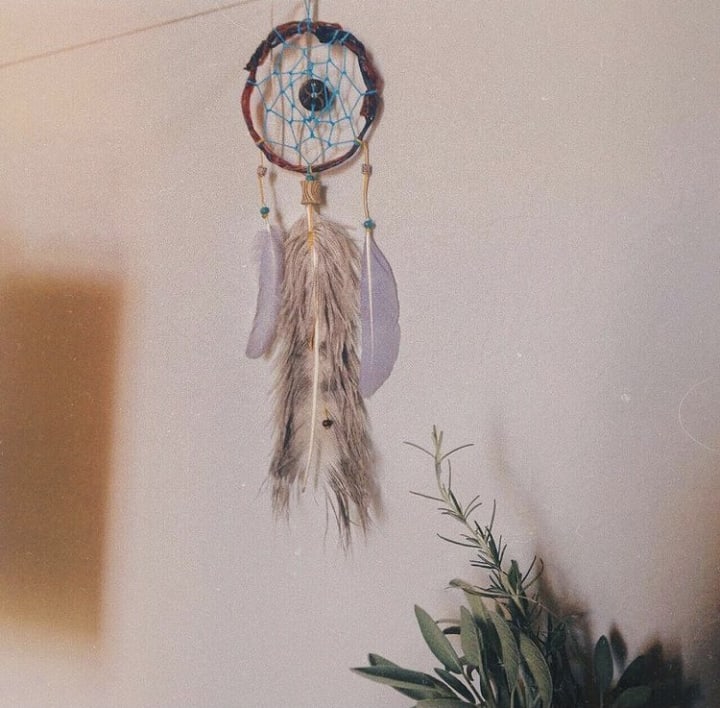
Returning home
The world is an amazing place to live in, full of love, opportunities, beauty, and happiness. But the world can be harmful as well and that is not a mystery. To arrive here is not always easy. Sometimes it requires a disturbing passage, a lot of strength from who is coming and from who is waiting. Is hard nowadays to ensure a safe environment for life to come because we live in a reality of painful obstetric care, so I found there a place for placenta crafts to heal.
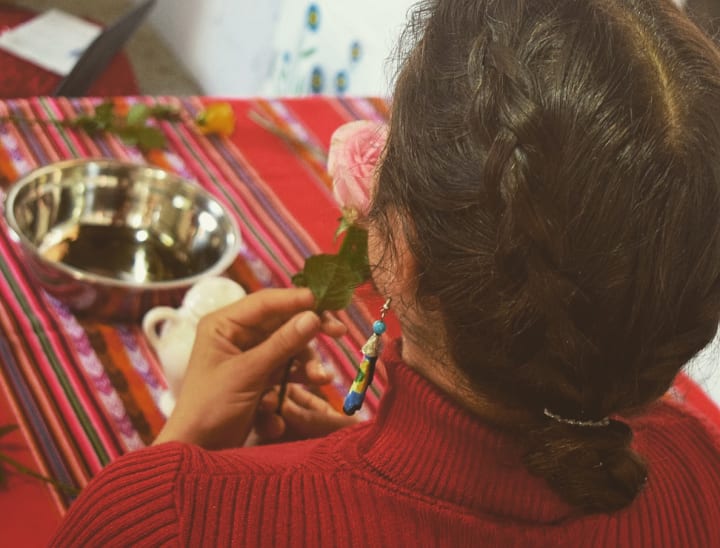
Art is known for being able to reach every corner of our spirit and resignify memories or scars. Even though I found it fantastic to see families wanting the placenta crafts to celebrate the baby's arrival and hold on to sweet labor memories, I also saw over and over how powerful healing tool this was for families who suffered traumatic labors or even losses. I can't tell you exactly what makes the placenta art touch so deeply, offering so much comfort. Maybe it has something to do with what the other cultures think as mentioned before, about the placenta having a soul and a mission. Maybe not. But when the placenta returns to a family bosom with colors, printed in fabric, as a dream catcher, as a jewel or any of the many possible crafts with it, it feel in the air like a great reunion taking place, where tears fall and love is felt in the air, offering the family the chance of holding on to something inexplicable that the placenta brings when goes back home.
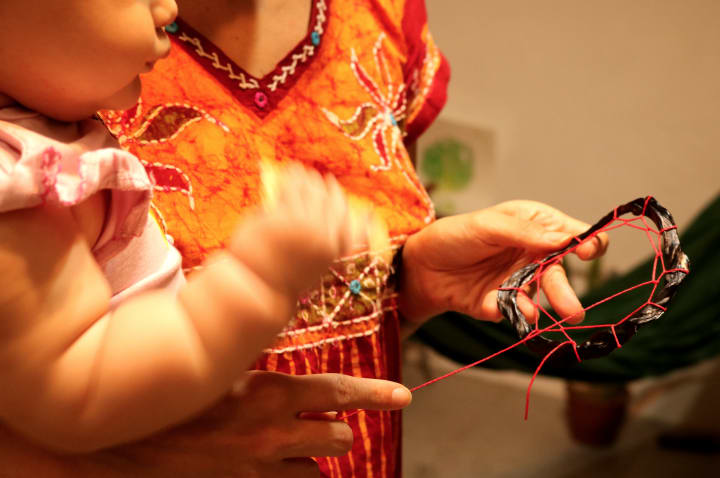
A couple of months ago the kid I did my first placenta craft was celebrating his third birthday. When I arrived, the mom took me to the boy's bedroom and showed me the dreams catcher over his bed that we have made from his umbilical cord when he was born. With the boy with us in the room, the mom said looking at me but talking with him, ''Sometimes when we go to bed, he points at the dreams catcher and asks for stories about his travel to the world, as we call it. Right Lian?''. At that moment, another understanding of the dimension of all that, entered my heart. The story was alive.
I have seen my craft taking an effect that never thought it will, being a balm that reaches places where deep fealing are. We usually limit our possibilities of expressing ourselves and using it as a tool for happiness and healing, but after this world was opened in front of my eyes, I could see beyond. I can see no limits on crafting love.
Summarizing a bit my journey: one day I looked at that piece of life and thought '' how to make its pulse eternal? '', Well, this is the way I found.
It was a pleasure to share something so special with you,
With love!
Melisa
About the Creator
Melisa Zabala
I have lots of scars. I mean, poems.
Keep reading
More stories from Melisa Zabala and writers in Lifehack and other communities.
Pikaia
I was Pikaia...I'm born from the ocean. I still swim and feel at home. Who got me out here? I'm just a remote accident, a survivor of extinction waves, those waves where many didn't. It just happened to be me. I could very well right now have to be hiding behind rocks to escape from dinosaur's teeth, or having to keep watching my back on the savannas. But just by luck, things took another way. Whose luck?. We conquered our greatness, but we compromised a whole planet on the way. It sounds a little like those promos, pay one and take five, but the opposite and in a biggest scale of numbers. In order to make this planet perfectly comfy, easy, and luxurious for us, and just for some of us, we sacrifice a brilliant creation of who knows who, and this part doesn't matter. What we can't deny, is that we all see a world made of Biodiversity, colors, incredible species hiding in the smallest places, intelligences expressed in the most astonish ways and far from being simply linked to brain size. Cognitively complex means of life that science tries to understand even today, and probably never will, including us. We watch a planet standing on its feet year after year of less care, fighting with the tools that this amazing ecological system has. And we live, day after day, without realizing we are in a war. We wake up, we look at the sky, and we say ''Look this beautiful morning'' and breathe a deep and fresh air being grateful for a new day. Just one second after, naively or not, we turn our backs and walk away starting the automatic environmentally harmful actions of our days, being on the wrong side of a war against ourselves.
By Melisa Zabala5 years ago in Earth
The Most Common Home Gym Equipment Mistakes — and How to Avoid Them
Buying home gym equipment should feel like a step toward better health and freedom. Instead, many people end up with expensive machines collecting dust, cluttering their space, or breaking far sooner than expected. Most of these problems aren’t caused by bad intentions — they come from a handful of very common mistakes.
By Enrique Navarro5 days ago in Lifehack


Comments
There are no comments for this story
Be the first to respond and start the conversation.