
Why the Palestine Issue Is So Complex
Untangling a Century of Conflict
The Palestine-Israel conflict is one of the most enduring and emotionally charged struggles in modern history. For over a century, this small strip of land has been the center of political, religious, and humanitarian tension. Countless peace talks have failed, violence has erupted again and again, and global powers remain deeply divided. But why is this issue so difficult to resolve?
To understand the complexity, we must look beyond headlines and hashtags. The roots of the Palestine issue lie deep in history, religion, land disputes, colonial decisions, geopolitics, and human suffering—all entangled in a way that makes simple solutions nearly impossible.
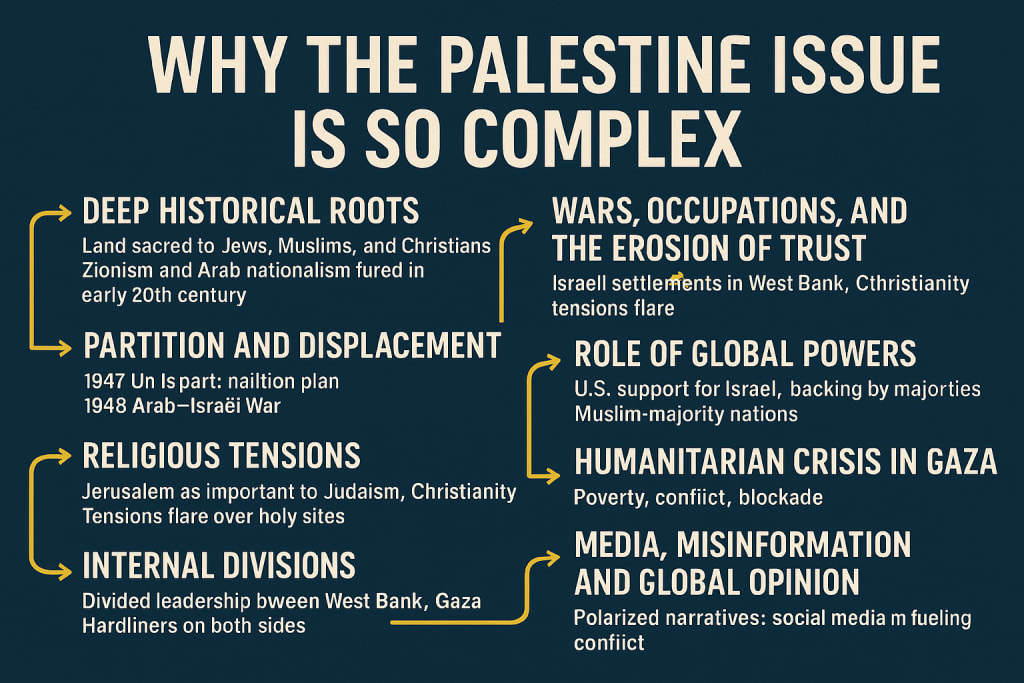
1. A Conflict with Deep Historical Roots
The land known today as Israel and Palestine has immense historical significance. It is sacred to Jews, Muslims, and Christians alike. For centuries, it was home to diverse communities living under different empires. But the real turning point came in the early 20th century.
In the late 1800s, the Zionist movement began, calling for the establishment of a Jewish homeland in response to rising anti-Semitism in Europe. At the same time, Palestinian Arabs, who had lived on the land for generations, also began to develop a strong sense of national identity.
During British colonial rule (1917–1948), conflicting promises were made to both Jews and Arabs, further fueling tension. The Balfour Declaration (1917) supported a Jewish homeland, while Arabs were also promised independence after World War I. These overlapping claims planted the seeds of long-term conflict.
2. Partition and Displacement: The Birth of a Bitter Divide
In 1947, the United Nations proposed a partition plan to divide Palestine into separate Jewish and Arab states, with Jerusalem under international control. The Jewish leadership accepted the plan, but Arab leaders rejected it, arguing it was unjust to give more than half the land to a minority population.
In 1948, Israel declared independence, leading to the first Arab-Israeli war. As a result, over 750,000 Palestinians were displaced from their homes in what they call the Nakba ("catastrophe"). Israel won the war and took even more territory than the UN plan had allocated.
Palestinian refugees were never allowed to return, and their descendants remain stateless in refugee camps across Lebanon, Syria, Jordan, and Gaza. The trauma of displacement became a central part of Palestinian identity, while Israelis celebrated their survival and sovereignty.
3. Wars, Occupations, and the Erosion of Trust
Several wars followed—in 1956, 1967, and 1973—each shifting borders and deepening resentment. The Six-Day War in 1967 was a turning point: Israel captured the West Bank, Gaza Strip, East Jerusalem, and other territories. These areas became occupied lands, and their status remains one of the most disputed issues today.
Over the years, Israeli settlements were built in the West Bank and East Jerusalem, which Palestinians and much of the international community consider illegal under international law. These settlements have fragmented Palestinian land, making the dream of a future Palestinian state increasingly difficult to achieve.
4. Religious Tensions: More Than Just Politics
Jerusalem is at the heart of the conflict—not only geographically, but spiritually. It is home to the Al-Aqsa Mosque (the third holiest site in Islam), the Western Wall (sacred in Judaism), and the Church of the Holy Sepulchre (central to Christianity).
This religious overlap adds fuel to the fire. Any change in control, access, or security around these holy sites can instantly spark outrage, protests, and violence. For many, the conflict is not just about land—it's about divine destiny, faith, and sacred identity.
5. The Role of Global Powers: Biased Peacemaking
Another layer of complexity is the involvement of powerful nations. The U.S. is widely seen as Israel’s closest ally, providing billions in military aid and often shielding it from international criticism at the United Nations. Meanwhile, many Muslim-majority countries and global south nations support the Palestinian cause.
This divide has made it nearly impossible for global institutions to mediate effectively. Peace talks, such as the Oslo Accords (1993) and the Camp David Summit (2000), have repeatedly failed—often collapsing under pressure from political hardliners on both sides or due to unmet promises.
6. Internal Divisions: Fragmented Leadership
Both Israelis and Palestinians suffer from internal divisions. In Israel, politics swing between left-wing peace advocates and right-wing nationalists who oppose any territorial compromise.
In Palestine, leadership is split between the Palestinian Authority (PA) in the West Bank and Hamas in Gaza. The PA supports a two-state solution, while Hamas refuses to recognize Israel and has used armed resistance, leading to multiple wars in Gaza since 2008.
This lack of unified leadership on both sides weakens peace efforts and allows extremist elements to hijack the narrative.
7. Humanitarian Crisis in Gaza
The Gaza Strip is one of the most densely populated places on Earth and has been under a blockade by Israel and Egypt since 2007. The region suffers from limited electricity, clean water, medical supplies, and basic infrastructure.
Frequent conflicts, airstrikes, and restrictions have made life in Gaza unbearable for many. Over half the population are children, growing up in poverty, trauma, and fear. This humanitarian tragedy fuels global outrage but also deepens feelings of hopelessness and anger within Palestinian society.
8. Media, Misinformation, and Global Opinion
Social media has made the conflict more visible than ever—but also more polarized. One person’s “self-defense” is another’s “occupation.” Graphic images, out-of-context clips, and biased reporting make it hard for people to understand the full picture.
This media war shapes global opinion, divides communities, and often oversimplifies a deeply complex issue into black-and-white narratives.
Conclusion: A Conflict That Defies Easy Answers
The Palestine issue is not just a local dispute—it’s a global symbol of injustice, identity, survival, and resistance. It’s about who belongs where, what land means, and how history is remembered.
Solving it requires more than political negotiations. It requires courageous leadership, mutual recognition of pain, accountability, justice, and empathy. Until both Palestinians and Israelis feel secure, respected, and free, peace will remain a distant dream.
In the end, what makes the Palestine issue so complex is not just the past—it’s the unwillingness of the present to fully confront it.
About the Creator
Fawad Khan
I’m Fawad Khan a passionate speaker and researcher sharing journals, fiction, history, education, current affairs, and English literature. With deep research and clear voice, I bring knowledge to life. Learn,grow, and stay informed with me.
Keep reading
More stories from Fawad Khan and writers in Journal and other communities.
How America Controls the World Economy
In the grand theater of global economics, there is one dominant force that shapes, stirs, and steers the world’s financial future—the United States of America. From the corridors of Wall Street to the data centers of Silicon Valley, America's reach stretches across continents, currencies, and corporations. But how exactly does this single nation hold such a firm grip on the global economy?
By Fawad Khan11 months ago in Journal


Comments
There are no comments for this story
Be the first to respond and start the conversation.