
Why Smart Money is Flowing Into Container Ships in 2025 (Data Analysis)
While mainstream media reports declining freight rates and industry volatility, institutional shipowners are quietly accumulating container ship assets. The data reveals why.

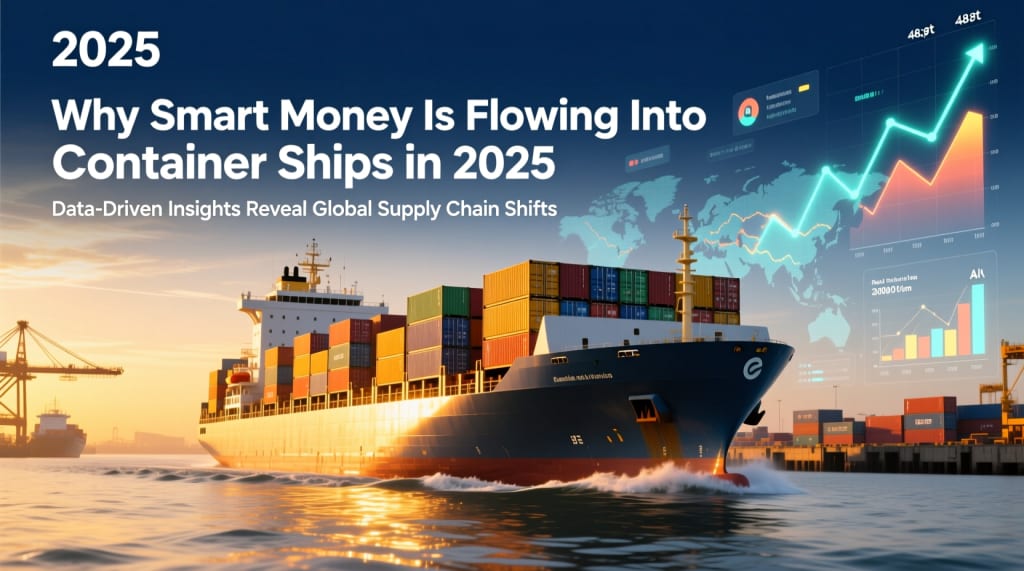
While mainstream media reports declining freight rates and industry volatility, institutional owners are quietly accumulating container ship assets. The container ship market is projected to grow from $15.37 billion in 2025 to $21.40 billion by 2032, representing a compound annual growth rate of 4.8%. The paradox is striking: freight rates have normalized from pandemic peaks, yet sophisticated capital continues flowing into maritime assets. Five data-driven factors reveal why 2025 represents a strategic entry point for ship owners seeking stable, defensible returns in an uncertain macroeconomic environment.
Record-Low Idle Capacity Signals Market Resilience
The most compelling indicator of container shipping's underlying strength lies beneath surface-level rate volatility. As of mid-2025, only 0.5% of the global container fleet sits commercially idle, a mere 65 ships representing 161,295 TEU capacity. This represents one of the tightest supply markets in maritime history, with zero 18,000+ TEU mega ships sitting unused and only eight ships in the critical 5,000-18,000 TEU range inactive.
Compare this to traditional downturns when idle capacity routinely exceeded 10-12% of the global fleet. Container trade volumes grew 4.3% in the first five months of 2025 compared to the prior year, while demolitions hit two-decade lows with less than 4,000 TEU scrapped in the first half of 2025. The average age of scrapped ships reached 28 years, above the 26-year historical average, indicating owners are extending ship lifespans rather than retiring capacity.
For shipowners, ultra-tight supply fundamentals eliminate the primary risk in maritime investment: asset values collapsing during periods of excess capacity. When inventory remains this constrained, charter rates maintain floors that protect downside risk while preserving upside participation when demand accelerates.
Long-Term Charters Deliver Stable, Visible Returns
While spot market rates capture headlines, sophisticated shipowners focus on contracted earnings that extend years into the future. MPC Container Ships exemplifies this strategy with a $1.2 billion charter backlog providing 100% contract coverage for 2025, 89% for 2026, and 34% for 2027. Average time charter equivalent rates range from $23,852 to $26,455 per day, rates that have enabled the company to distribute over $1 billion in earnings since February 2022.
Global Ship Lease demonstrated similar execution by adding 22 new charters in 2025, contributing nearly $400 million in additional contracted revenues. This secured 80% charter coverage through 2026, with a breakeven rate of under $9,400 per day, well below current market levels. Current spot rates as of October 2025 remain robust: Far East to US West Coast routes command $2,010 per FEU, while Far East to Mediterranean routes fetch $2,983 per FEU.
The investment thesis is straightforward: revenue visibility through multi-year charters eliminates speculation. Shipwoners aren't betting on rate volatility, they're purchasing predictable cash flows backed by creditworthy charterers and essential trade infrastructure. As MPC Container Ships CEO Constantin Baack noted, "The small to mid-sized segments are underinvested, and we see a lot of potential going forward".
How Blockchain Is Unlocking $3 Trillion in Maritime Assets
The most transformative development in maritime investment isn't technical—it's structural. Maritime asset tokenization is democratizing access to a $3 trillion industry that previously required millions in capital for single-vessel ownership. Blockchain technology creates verified, transparent ownership records enabling fractional investment through digital tokens representing proportional vessel shares.
Platforms like Shipfinex pioneer this transformation by placing each vessel in a regulated Special Purpose Vehicle (SPV) that isolates the ship from parent company operations. This structure allows aspiring owners to acquire fractional interests through Marine Asset Tokens in ships with strong, long-term charter contracts—the same 2-5 year agreements securing $20,000+ daily rates for established operators. Investors gain direct access to predictable, contracted cash flows rather than speculative spot market freight rates.
The mechanics revolutionize accessibility: investors purchase tokens starting from $100, receiving automated distributions of charter earnings proportional to holdings. Unlike traditional ownership involving decade-long lock-ups, tokenized assets offer 24/7 secondary market liquidity—solving maritime's primary illiquidity challenge while maintaining exposure to stable, contracted revenue streams.
Institutional players recognize tokenization attracts entirely new capital pools. Retail investors, family offices, and wealth managers previously excluded from shipping can now allocate to maritime infrastructure backed by multi-year charter agreements, creating structural demand for quality assets before mainstream awareness peaks.Why Alternative-Fuel ships Command Investment Premiums
Regulatory tailwinds are creating a bifurcated market, where modern, eco-compliant ships command premium rates, while conventional ships face a risk of obsolescence. Current conventional-fuel ships represent 50% of global TEU capacity, a percentage in permanent decline. The order book reveals the transformation: 347 LNG-powered ships, totaling 5.2 million TEU, and 194 methanol-powered ships, adding 2.5 million TEU, represent alternative propulsion overtaking conventional capacity for the first time in maritime history.
Major operators are positioning for this transition. MSC's LNG fleet approaches 60 ships, representing 33% of the global LNG container fleet by ship count. CMA CGM surpassed 4 million TEU operated capacity with over 40 LNG-powered newbuilds on order, including twelve 24,000-TEU mega ships. These investments aren't speculative, they're responding to FuelEU Maritime and EU ETS regulations, making non-compliant ships economically unviable on key trade lanes.
Charter markets reflect this premium, with modern alternative-fuel ships securing contracts of 2-5 years, while older conventional tonnage faces spot market exposure and rate volatility. Smart money isn't simply buying ships, it's acquiring future-proofed assets meeting 2030+ environmental standards today, capturing both regulatory compliance premiums and preferential access to long-term charter relationships.
Red Sea Crisis Reveals Container Shipping's Economic Moat
Geopolitical disruptions paradoxically validate the investment thesis of container shipping. The Red Sea crisis led to a 67% reduction in Suez Canal transits, with shipping costs from Shanghai to Europe more than tripling between December 2023 and May 2024. Rather than destroying asset values, extended voyage times absorbed new ship deliveries and created effective capacity shortages despite physical fleet growth.
This phenomenon reveals the inelastic demand characteristics of container shipping, trade routes adapt, ships reroute, costs adjust, but cargo continues to move. Extended voyages require more ships to maintain service frequencies, effectively tightening supply despite orderbook deliveries. India's $20 billion maritime infrastructure investment, including three Green Hydrogen Hub Ports and alternative corridor development (IMEEC, EMC, INSTC), demonstrates how governments respond to supply chain vulnerability with increased infrastructure spending, benefiting ship owners positioned on emerging trade lanes.
For defensive portfolios, container shipping offers rare characteristics: essential infrastructure status, government-backed trade facilitation, and proven demand resilience in crises. Every major disruption since COVID, such as port congestion, the Suez blockages, and the Red Sea attacks, has validated that global trade remains non-negotiable, regardless of geopolitical volatility.
The Smart Money Playbook
Institutional capital is flowing into container ships because five structural factors converge in 2025:
Supply discipline: 0.5% idle capacity protects downside with no excess tonnage threatening rate collapse.
Earnings visibility: Multi-year charters averaging $20,000+ daily rates lock in predictable cash flows through 2027.
Access innovation: Tokenization democratizes a $3 trillion asset class, creating structural demand from previously excluded shipowners.
Regulatory positioning: Alternative-fuel ships command premiums as environmental compliance becomes table stakes.
Crisis resilience: Geopolitical shocks reveal inelastic demand characteristics and the essentiality of infrastructure.
While speculative capital chases volatile growth stocks, institutional shipowners are building positions in an asset class offering stable cash flows, technological transformation through blockchain innovation, and unprecedented accessibility. Industry-wide net income is projected to be $11.6 billion in 2025, normalized from pandemic peaks but representing solid profitability, with operating margins averaging 18%.
The container shipping opportunity of 2025 isn't about timing perfect market entries, it's about recognizing structural shifts before they become consensus. With the global container ship market projected to reach $21.40 billion by 2032 and tokenization enabling fractional ownership on an unprecedented scale, early movers are well-positioned as asset values and accessibility converge. Is your portfolio positioned for the maritime industry's tokenization revolution?
Few Important Sources:
https://www.shipuniverse.com/top-10-container-shipping-investments-to-watch-in-2025/
https://market-insights.upply.com/en/shipping-company-profitability-in-2025
https://www.fortunebusinessinsights.com/container-ship-market-112874
https://public.axsmarine.com/blog/key-container-shipping-data-trends-july-2025
https://public.axsmarine.com/blog/key-container-shipping-data-trends-august-2025
https://www.shipfinex.com/post/tokenization-maritime-industry-3-trillion
About the Creator
Keep reading
More stories from Johnny Cash and writers in Journal and other communities.
Women in Ship Finance: The Power Players You Should Know
In a glass-walled conference room overlooking Singapore's harbor, a $300 million ship financing deal is being finalized. The lead banker structuring this complex transaction? A woman navigating an industry where female executives hold less than 8% of leadership positions.
By Johnny Cash5 months ago in Journal



Comments
There are no comments for this story
Be the first to respond and start the conversation.