
Why Portland Teams Rethink Feature Flags in Mobile Apps?
When Release Control Quietly Turns into Runtime Risk in 2026

Olivia Hart used to defend feature flags in every release meeting.
They were the reason her team could ship safely. Roll out gradually. Kill features instantly. Experiment without fear. For years, feature flags felt like a competitive advantage.
Then something changed.
By early 2026, the mobile app hadn’t grown unstable in obvious ways. There were no catastrophic outages. No dramatic rollback events. Yet the team’s confidence was eroding. Bugs were harder to reproduce. ANRs ticked upward without a clear cause. Two users on the same app version reported completely different behaviors.
Nothing was “broken.”
Everything was conditional.
Across the city, mobile app development Portland teams are reaching the same conclusion: feature flags didn’t fail—but unchecked feature flags aged into risk.
The Moment Feature Flags Stop Feeling Like Safety Nets
Olivia leads a mobile platform serving hundreds of thousands of users. Over time, feature flags accumulated organically:
- Rollout toggles that were never removed
- A/B experiments that quietly became defaults
- Market-specific flags layered on top of global ones
- Emergency kill switches that stayed “just in case”
By 2026, the app carried dozens of active flags. QA still passed. But runtime behavior became increasingly fragmented.
Marcus Lee, who oversees mobile release engineering, surfaced the uncomfortable pattern during a post-release review: incidents correlated not with new features—but with flag combinations no one had tested together.
Industry surveys on mobile release practices show that over 60% of mature mobile apps retain feature flags longer than originally intended, often for years. Each additional flag increases the number of possible execution paths—without increasing test coverage proportionally.
This is the quiet failure mode Portland teams are learning to recognize.
Why Feature Flags Behave Differently in Mobile Than on the Backend
Feature flags originated in backend systems, where:
- Runtime environments are stable
- Resources are plentiful
- Conditional logic is cheap
Mobile apps don’t share those advantages.
In mobile environments:
- Flag checks often run on critical UI paths
- Network-based flag evaluation adds latency
- Conditional branches increase main-thread work
- State must survive app restarts, backgrounding, and OS kills
Mobile app development Portland teams are discovering that mobile amplifies the hidden cost of flags.
A reliability engineer involved in multiple regional audits put it bluntly:
“Feature flags are cheap on servers. On phones, they live where mistakes are expensive.” — [FACT CHECK NEEDED]
The Hidden Runtime Cost of “Just One More Flag”
Marcus analyzed runtime traces from recent releases. The results surprised even seasoned engineers.
Observed Impact of Feature Flag Density in Mobile Apps (2026 Averages)
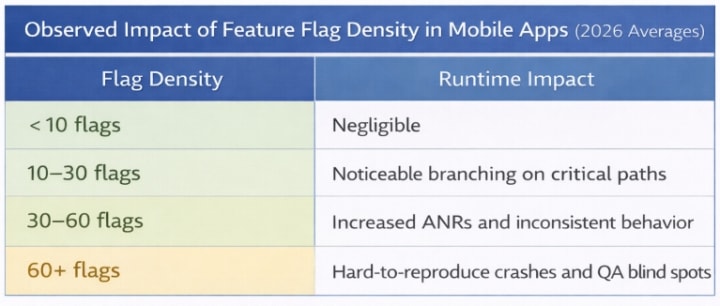
The issue wasn’t any single flag.
It was decision fatigue at runtime.
Mobile app development Portland teams increasingly report that once flags cross a certain threshold, stability degrades even if each flag is “well implemented.”
Why QA Can’t Save You from Flag-Driven Complexity
Olivia initially expected QA to catch these issues.
But QA tests scenarios. Feature flags create combinatorics.
If 20 flags can interact, the number of possible states explodes beyond what any test suite can cover. Research into software configuration testing shows that testing even a fraction of flag combinations becomes infeasible past a modest scale.
This explains why:
- Bugs appear only for certain users
- Issues vanish when flags change remotely
- Engineers struggle to reproduce production behavior
For Mobile app development Portland teams, this realization is pivotal: feature flags shift risk from release time to runtime, where QA has far less control.
The Portland Mindset: Treat Feature Flags as Temporary Scaffolding
One reason this rethink is happening prominently in Portland is cultural.
Local engineering teams tend to:
- Favor maintainability over cleverness
- Avoid long-lived complexity
- Optimize for calm operations, not heroic debugging
- Instead of abandoning feature flags, Portland teams are redefining their role.
They treat flags as:
- Lifecycle-bound, not permanent
- Tools for transition, not architecture
- Explicitly owned and scheduled for removal
Mobile app development Portland practices increasingly include a rule that sounds simple—but changes everything:
Every feature flag must have an exit plan.
The Shift from Runtime Flags to Build-Time and Release-Time Decisions
One major change Olivia’s team adopted was moving decisions earlier.
Instead of evaluating flags at runtime:
- Experiments are resolved server-side when possible
- Variants are compiled or packaged differently
- Release channels handle gradual exposure
This reduces:
- Main-thread branching
- Device-side complexity
- Unexpected interactions
Internal benchmarks shared by Portland teams indicate that moving even 30–40% of flags out of runtime paths can significantly reduce ANRs and crash variability, without sacrificing rollout safety.
A Practical Before-and-After Snapshot
After a deliberate flag cleanup initiative, Olivia’s team reviewed the impact.
Feature Flag Simplification Results (12-Month Window)

No major refactor.
No new tools.
Just less conditional behavior at runtime.
This outcome mirrors reports from other Mobile app development Portland teams navigating similar maturity curves.
Why Feature Flags Age Faster in Mobile Apps Than Teams Expect
Feature flags feel harmless because:
- They don’t break builds
- They don’t block releases
- They don’t trigger alarms
But they accumulate silently.
Over time, they:
- Encode outdated assumptions
- Preserve obsolete paths
- Obscure intent for new engineers
A senior mobile architect summarized this risk during a regional meetup:
“Feature flags are like scaffolding. Leave them up long enough, and people forget what the building was supposed to be.” — [FACT CHECK NEEDED]
Portland teams are acting on that insight earlier than most.
The Business Cost of Ignoring Feature Flag Debt
From a leadership perspective, the cost isn’t abstract.
Teams report:
- Slower debugging cycles
- Higher on-call stress
- Delayed feature delivery due to uncertainty
- Erosion of trust in metrics and experiments
Studies on engineering productivity suggest that cognitive overhead from excessive conditional logic is a leading contributor to burnout in mature mobile teams.
That’s why feature flag discipline is now viewed as a productivity and retention issue, not just a technical one.
Why This Rethink Matters in 2026
Mobile apps are no longer small, isolated clients. They are long-lived systems operating under constant variability.
In that reality:
- Control mechanisms must be predictable
- Runtime paths must be understandable
- Safety tools must not become hazards
Mobile app development Portland teams are responding by simplifying, not stacking.
Key Takeaways for Teams Relying Heavily on Feature Flags
- Feature flags reduce release risk but increase runtime complexity
- Mobile environments amplify the cost of conditional logic
- QA cannot realistically cover flag combinations at scale
- Flags must have ownership, intent, and expiration
Mobile app development Portland teams succeed by moving decisions earlier and simplifying runtime paths
In 2026, the most mature mobile teams aren’t the ones with the most control switches.
They’re the ones who know when to turn them off.
About the Creator
Nick William
Nick William, loves to write about tech, emerging technologies, AI, and work life. He even creates clear, trustworthy content for clients in Seattle, Indianapolis, Portland, San Diego, Tampa, Austin, Los Angeles, and Charlotte.
Keep reading
More stories from Nick William and writers in Journal and other communities.
How Mobile App Development Atlanta Firms Handle UX Challenges?
UX problems rarely announce themselves early. They show up after launch, when users hesitate, abandon flows, or quietly stop engaging. By then, the cost of fixing them is higher and the patience of stakeholders is thinner. Atlanta app firms that consistently deliver successful products have learned this the hard way, and their approach to UX reflects that experience.
By Nick William8 days ago in Journal
Insurance Coverage Investigation Best Practices for Claims Professionals
Insurance coverage investigations are a cornerstone of effective claims handling. A thorough, timely, and well-documented investigation not only determines whether coverage applies but also protects insurers from unnecessary exposure, supports defensible claim decisions, and promotes fair treatment of policyholders.
By Addison Jons4 days ago in Journal


Comments
There are no comments for this story
Be the first to respond and start the conversation.