
Why Lionel Messi wouldn't have been great by Now
Bad times in Lionel Messi life

Lionel Messi's sickness at a younger age is a well-known event in the football world. He suffered a growth hormone deficiency, a condition that stunted his growth significantly. Messi was diagnosed with this condition when he was 11 years old. As a result of this illness, he underwent medical treatment to rectify the condition, which was a harrowing ordeal. Messi's determination to overcome the illness is evident in the way he has dominated soccer, becoming one of the greatest players of all time.
Messi's medical treatment included injecting human growth hormones every night for three years. The medication was expensive, and the treatment was emotionally challenging for the young boy. Even though the treatment was meant to improve his health, it was anything but pleasant. Every night Messi had to go through the ordeal of taking injections. Most people would find this distressing, especially for a young person whose childhood revolves around fun, games, and carefree living. But Messi was different. He was determined to get better and would go through anything to achieve his goals.
Despite his condition, Messi did not let it get in the way of his soccer career. From a young age, he was passionate about playing football, and his parents supported him in his quest to become a professional player. Messi's background is one that is well-known in the football world. Messi came from a humble family, and his parents worked hard to provide him with the necessities of life. Messi's father worked at a steel factory in Rosario, while his mother worked as a cleaner and took care of the family. Messi was the third child in a family of four.
Messi's determination to play football was evident from the age of four when he joined the local team, Grandoli, where his father served as the coach. Messi learned how to play football from his father, who had a passion for the sport. At the age of six, Messi joined Newell's Old Boys, a club that was renowned for producing great football players. By age eight, Messi had dominated the local leagues and was invited to play for the Barcelona football club's youth team. However, Messi's condition meant that he could not move to Spain immediately. He had to undergo medical treatment in his native Argentina before he could leave.
Once Messi started playing for Barcelona's youth team, it didn't take long for the coaches to see his talent. Messi's diminutive size and lightning-fast speed made him a formidable opponent on the field. Despite his condition, Messi could out-dribble and outmaneuver any player on the field. In 2004, at the age of 17, Messi made his debut as a professional player for Barcelona. Messi's debut season was a success, and he helped Barcelona win the Spanish title. Messi's meteoric rise continued, and he went on to become one of the best football players in history.
Messi's success as a soccer player is a testament to his determination, hard work, and perseverance. Despite his condition and the difficulties he faced with medical treatment, Messi never gave up on his dream of becoming a professional soccer player. Messi's success shows that with hard work and determination, anything is possible. Messi's life story is an inspiration to many young people who aspire to be professional athletes or achieve their goals in life.
In conclusion, Lionel Messi's growth hormone deficiency was a significant obstacle in his life, but he refused to let it define him as a person. His determination to overcome this illness and achieve his dreams is a testament to his character. Messi is one of the greatest football players of all time, and his story serves as an inspiration to many young people around the world. Messi's success shows that with hard work and determination, anything is possible in life.
About the Creator
Keep reading
More stories from Temi Cyder and writers in Journal and other communities.
CRISTIANO RONALDO
Cristiano Ronaldo is a professional Portuguese football player who has been a prominent figure in the world of football for over a decade. Ronaldo has played for several prestigious clubs throughout his career, including Sporting CP, Manchester United, Real Madrid, and most recently, Juventus.
By Temi Cyder 3 years ago in Journal
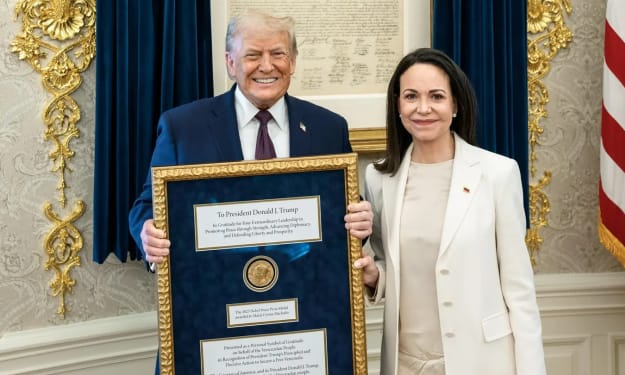
Machado Presented Her Nobel Peace Prize to Trump — But He Didn’t Actually Win It
In a stunning and symbolic moment at the White House, Venezuelan opposition leader María Corina Machado handed President Donald Trump her Nobel Peace Prize medal — a gesture that is now rocking world headlines and social media feeds.
By Omasanjuwa Ogharandukun6 days ago in Journal
Miss Persephone's Manual to a Seemingly Ordinary Life
Miss Persephone was found at the dining table, her blue eyes swollen, her tears arriving and retreating like the tides of the ocean. Earlier that day, her family had visited her in the retirement home where she had lived for eight years. It was her eightieth birthday.
By Imola Tóth7 days ago in Fiction


Comments
There are no comments for this story
Be the first to respond and start the conversation.