
Why E-commerce Sites Are Switching to Cloud Hosting
Cloud Hosting
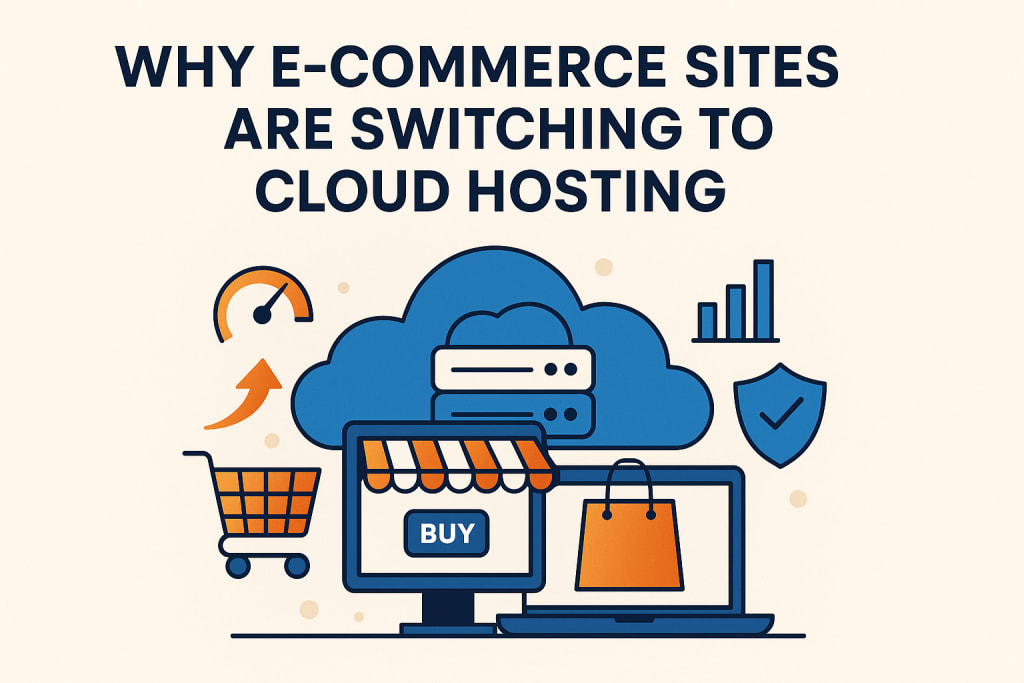
The online shopping market is expanding at an explosive pace along with this the technical demands that come with it. Fast page loads, secure transactions, real-time inventory & scalability to support traffic surges are now table stakes. To get there, more & more e-commerce businesses are leaving behind traditional hosting & turning to cloud hosting.
But why?
In this blog, we will explore the key reasons why cloud hosting has become the go-to solution for e-commerce websites, what benefits it offers, and how it stacks up against older hosting models like shared or dedicated servers.
1. Scalability to Handle Traffic Surges
One of the biggest challenges in e-commerce is handling traffic spikes during:
Flash sales
Holiday shopping seasons
Viral product promotions
With traditional hosting, your resource (RAM, CPU, bandwidth) is fixed. If you are hit with more traffic than you can handle, your site slows down—or in the worst-case scenario, shuts down.
Cloud hosting is scaled. You can scale up or down immediately based on current traffic. Hosts like AWS, Google Cloud, and Azure allow you to auto-allocate resources so you pay less for unused capacity without losing performance every time.
???? Example: A fashion retailer online can scale in Black Friday and demote after the holiday rush—only paying for what they use.
2. Enhanced Website Performance and Speed
Website speed directly affects sales. Google explains that 53% of mobile users abandon sites that take more than 3 seconds to load. That's huge.
Cloud hosting offers:
Enhanced load times with SSD-based storage
Global Content Delivery Networks (CDNs) for quicker access worldwide
Load balancing to distribute traffic evenly
These features help e-commerce sites deliver a responsive and seamless shopping experience, leading to higher engagement and conversion.
3. Enhanced Security and Compliance
Along with online commerce come the serious responsibilities—protection of customer data, fraud prevention, and compliance with regulations (like PCI DSS for credit card transactions).
Leading cloud providers offer enterprise-level security features, including:
Firewalls and DDoS protection
Data encryption at rest and in transit
Multi-factor authentication
Regular security patching
Compliance with global standards like: PCI DSS, GDPR & HIPAA.
Some cloud platforms also offer isolated environments, & even if one virtual server is compromised, then the rest of your infrastructure will not be affected.
4. High Availability and Uptime
Downtime is costly in e-commerce. Going offline for even a few minutes can lead to lost sales and destroyed customer trust.
Cloud hosting platforms are built on redundant infrastructure:
Data is usually replicated on multiple servers and regions
If a server goes down, traffic will be automatically routed around it
You can deploy applications to multiple availability zones
This equates to uptime promises of as much as 99.99%—a necessity for online stores that operate 24/7. Explore the Top eCommerce Hosting Providers of 2025.
5. Versatility and Adaptability
Cloud hosting offers unmatched versatility:
Choose from a vast number of operating systems, control panels, and tech stacks.
Use microservices or serverless models (like AWS Lambda) to optimize specific functions (e.g., payments, cart, inventory).
Roll out new apps, updates, and features with speed without affecting the rest of your system.
For growing e-commerce companies, this responsiveness allows for fast innovation and effortless integration with third-party tools (CRMs, analytics, ERPs, etc.).
6. Long-Term Cost-Efficiency
Even as the upfront costs may be greater than with shared hosting, cloud hosting is cost-efficient in the long term due to:
Pay-as-you-go pricing—only pay for what you use.
Lower need for internal IT personnel and hardware maintenance.
Integrated monitoring and optimization to control costs.
For businesses with varying traffic, scaling up or down prevents overpayment and underutilization.
7. Quick Deployment and Worldwide Presence
Opening a new e-commerce store or expanding into new regions? Cloud hosting simplifies it:
Deploy servers in worldwide locations in minutes.
Utilize CDNs and edge locations to cache locally and minimize latency.
Serve customers globally without requiring physical infrastructure.
This allows e-commerce companies to grow internationally rapidly, servicing regional demand without delay.
8. Seamless Backup and Disaster Recovery
Data loss can bring an online store to its knees. Cloud platforms offer automated backup, versioning, and disaster recovery capabilities so your data is never at risk.
Restore files and databases with a single click
Schedule backups hourly or daily
Store backups in various geographic locations for redundancy
This ensures business continuity even in the worst-case scenario.
9. Smooth Integration with E-commerce Platforms
Modern cloud hosting integrates well with popular platforms like:
Shopify Plus
WooCommerce
Magento
BigCommerce
Custom-built solutions on Node.js, Laravel, Django, etc.
Such integrations allow cloud-hosted websites to benefit from speed, flexibility, and rich features without being locked into a single ecosystem.
10. Facilitating Mobile Commerce and PWA
As mobile purchasing grows, more e-commerce sites are adopting Progressive Web Apps (PWAs) to enhance mobile performance.
Cloud hosting allows the resources and scalability needed to:
Host PWA backends
Serve cached content over CDNs
Handle API requests and mobile-specific interactions
This enhances the mobile shopping experience with reduced data consumption & load times.
Conclusion
Cloud hosting is no longer a "tech trend"—it is a strategic move for e-commerce businesses that want to stay competitive in a fast-changing market.
With benefits of scalability, speed, security, and affordability, it is little surprise that increasingly e-commerce stores are climbing on the bandwagon. Whether starting a new store or upgrading your existing configuration, cloud hosting offers you the adaptability and fault tolerance you need to thrive in the digital economy
About the Creator
Keep reading
More stories from Casper LAWRENCE and writers in Journal and other communities.
The Future of Game Server Hosting: Trends to Watch in 2025
Introduction Game server hosting has evolved significantly over the years, with advancements in cloud computing, AI, and network technologies shaping the industry. As gaming continues to grow, hosting providers are constantly innovating to meet the increasing demands of developers and players alike. In 2025, several key trends will define the future of game server hosting, making gaming experiences faster, more secure, and highly scalable. Let’s explore the major trends shaping the future of game server hosting.
By Casper LAWRENCE10 months ago in Journal
Rachel Reviews: The Spiral Archive by Pieter Hendrik
It's difficult for me to know where to start with a review of this book as it was, for me, an entirely unique experience and one that I'll probably never have again. I don't want that to be interpreted as unenjoyable but it has left me scratching my head a little and ruminating on its content, its themes and its characters.
By Rachel Deeming7 days ago in BookClub



Comments
There are no comments for this story
Be the first to respond and start the conversation.