
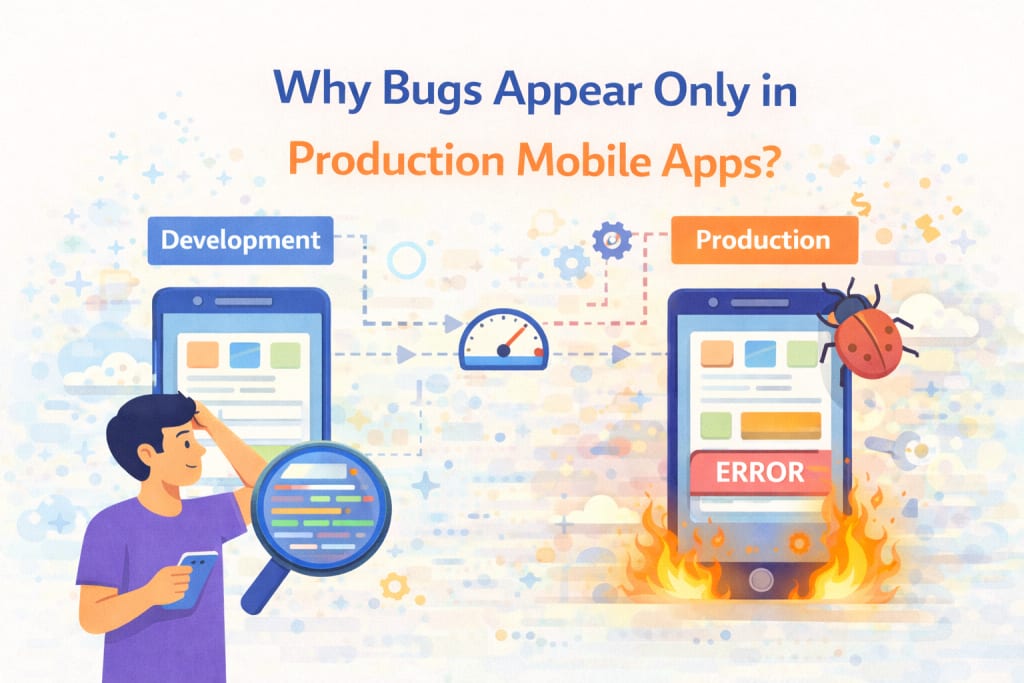
Why Bugs Appear Only in Production Mobile Apps?
A first-person reflection on why mobile apps behave differently once they leave controlled testing and begin living inside real, unpredictable days.

I noticed it on a Sunday evening when nothing else was happening. The app was open on my phone, resting on the arm of the couch, behaving in a way I had never seen during months of testing. A button responded late. A screen refreshed twice. Then everything went back to normal, like it hadn’t just revealed something it was trying to hide.
I sat there longer than I needed to, staring at the screen, thinking about how many times this had happened before. Always in production. Never when I was looking directly for it.
The App Changes the Moment It Leaves the Room
An app behaves differently the second it leaves the environment where it was built. In the office, conditions are polite. Networks are stable. Devices are predictable. People use the app with intention.
In the real world, none of that holds. Phones move between weak signals and strong ones. Storage fills up. Batteries drain. Users jump in and out without ceremony.
Production isn’t just a new stage. It’s a different personality entirely.
Real Users Don’t Follow the Script
During testing, we move with purpose. We follow flows. We retry politely when something fails. We give the app time to respond.
Users don’t do that. They tap twice. They rotate the phone mid action. They background the app without warning. They return hours later expecting continuity.
I’ve watched bugs appear simply because someone did something I never thought to try. Not maliciously. Casually.
That casualness is where production bugs find their space.
Timing Becomes Unpredictable
One of the hardest things to simulate is timing under pressure. In testing, things happen one at a time. In production, they overlap.
Notifications arrive while screens are loading. Background work wakes up while the user is interacting. Network responses return out of order.
I’ve learned that many production bugs are not logic errors. They’re timing disagreements that only surface when the app is busy living.
Data in Production Has a Memory
Test data is clean. It behaves. It resets.
Production data carries history. Old versions. Partial updates. Edge cases that nobody planned for.
I’ve seen apps fail because a single user carried a state forward from a version released years earlier. Nothing broke in testing because nothing like that data existed there.
Production remembers things we forget.
Scale Changes Everything Quietly
At small scale, rare events stay rare. At large scale, they become routine.
Something that happens once in a thousand sessions becomes daily noise when enough people use the app. Logs fill with patterns that never appeared before.
This is especially true in environments tied to mobile app development Milwaukee projects, where apps reach diverse users across devices, carriers, and habits that no test suite fully captures.
Bugs that only appear in production often aren’t new. They’re finally visible.
The Environment Fights Back
Devices throttle. Systems reclaim memory. Background limits kick in.
In testing, the app gets attention. In production, it competes.
I’ve watched features fail not because they were wrong, but because the environment refused to cooperate at the wrong moment. The system did what it needed to do. The app wasn’t ready for it.
That conflict rarely shows up in controlled conditions.
Logs Tell Stories Testing Never Heard
The first time I read production logs closely, I was surprised by how calm they looked. No crashes. No alarms. Just odd sequences.
Events happening twice. Actions happening without the expected setup. Requests arriving after the user had already moved on.
Production bugs often live in those quiet sequences. They don’t shout. They whisper.
Why Reproducing Production Bugs Feels Impossible
People ask why these bugs can’t be reproduced. The answer is simple and frustrating.
You can’t recreate a full day of someone’s life. You can’t recreate their network, their device temperature, their notification load, and their patience level all at once.
Production bugs are often the result of accumulation. Small things stacking until they tip.
Trying to isolate them removes the very conditions that caused them.
Testing Is Honest, Just Incomplete
This realization changed how I feel about testing. It isn’t failing when bugs escape. It’s doing exactly what it can within limits.
Testing checks intention. Production tests reality.
The gap between the two isn’t a mistake. It’s a space filled with human behavior and unpredictable environments.
Accepting that gap changes how teams respond when bugs appear.
Why Production Bugs Feel Personal
There’s a particular frustration that comes from production bugs. They feel like betrayal.
You trusted the app. You saw it work. Now it’s misbehaving in front of users.
I’ve felt that knot in my stomach more times than I can count. Over time, I learned that the feeling comes from attachment, not failure.
Production reveals what the app becomes, not what it was meant to be.
Learning to Design for Uncertainty
The teams I’ve seen grow healthiest are the ones that design for uncertainty early.
They assume things will arrive late. That users will leave mid flow. That data will be strange.
They don’t try to eliminate production bugs entirely. They try to make them softer. Recoverable. Less surprising.
That mindset turns production from a threat into a teacher.
When Monitoring Becomes Listening
Production monitoring isn’t just about alerts. It’s about listening for patterns.
I’ve learned to pay attention to what users don’t say. Drops in usage. Hesitation before actions. Quiet abandonment.
Those signals often appear before explicit bugs get reported.
Production speaks constantly. The question is whether we’re tuned to hear it.
The Moment I Stopped Being Surprised
There was a day when a production bug appeared and I didn’t feel panic. I felt curiosity.
I opened logs. I traced behavior. I learned something new about how the app lived in the world.
That shift didn’t make bugs disappear. It made them useful.
Ending With the Couch and the Quiet Screen
I think back to that Sunday evening often. The couch. The quiet room. The app misbehaving just enough to be noticed.
That moment reminded me that production isn’t where apps fail. It’s where they finally meet reality.
Bugs appear only in production because production is the only place where everything happens at once. When teams accept that truth, those bugs stop feeling mysterious. They become part of the conversation between code and the world it lives in.
About the Creator
~ Fired ~
— Ai Intrusion ~ Are you Next ~ Is Ai Evolution after your job? — Few workplaces haven't been affected. Ai is in supermarkets, at doctors' offices, and even monitoring farms. I just can't think of anything this machine is not getting into, can you? For instance: Education ~ Law and Tech jobs will one day have a major influence or be taken over by these inanimate machines, with accuracy and vigor. From mechanics' diagnoses to a wide variety of everyday jobs, including fast food workers, with this input having the ability to cut their unnecessary work hours. I'm certain all of us have been touched by this with our short stories and colorful headings, have you? Even comments are very questionable 'Non-Robot' insertions.
By Jay Kantor28 days ago in Journal
Advancing Compassionate and Equitable Women’s Healthcare
Women’s healthcare is most effective when it combines clinical expertise with empathy, prevention, and equitable access. Dr. Shamim Patel is a physician whose career reflects that integrated approach. Through her dedication to reproductive health, maternal care, and community engagement, she has worked to strengthen both patient trust and long-term health outcomes. Her broader professional background and areas of focus can be explored through her profile on LinkedIn, which reflects her ongoing commitment to women’s health advocacy.
By Shamim Patel MD 4 days ago in Journal



Comments
There are no comments for this story
Be the first to respond and start the conversation.