
Why Are Businesses Choosing Data Cleansing Services? Here’s The Answer
Data Cleansing Services are very crucial for business

“Data is a precious thing and will last longer than the systems themselves.”
Today, everything runs on data. It is one of the most critical organizational assets that frequently impacts business decisions, strategies, and growth.
Data operates on a simple rule: if you treat it well, it will treat you the best and vice versa. In cases where the data quality is poor, all the decisions and strategies emerging from it will automatically be ineffective or unsatisfactory. For that reason, a data store must be updated, accurate, and actionable at all times.
But what hampers the data quality?
Your database is prone to uncountable errors, inaccuracies, and/or inconsistencies. To keep such issues at bay, it is vital to implement data scrubbing and cleansing techniques.
In this guide, we will familiarize you with the concept of data cleaning, the exceptional benefits it can bring to your business, and how to get started with it.
What is Data Cleansing or Scrubbing?
Data cleansing (or Data scrubbing) is a process that enhances the quality of datasets by identifying the problem areas and fixing them in the best possible manner.
It operates on the fundamentals of correcting the incorrect values, de-duplicating the ambiguous data, completing the missing entries and fixing the obsolete data. This includes, but is not limited to, typographical errors, obsolete data, numerical issues, missing or blank fields, misspelled words, and many more. These might arise from:
- Faulty processing
- Incomplete information collected from varied sources
- Errors while inputting data
- Map projection issues
Data scrubbing detects all such errors and applies the best strategies to get rid of them. Take a look at the image below as an example:
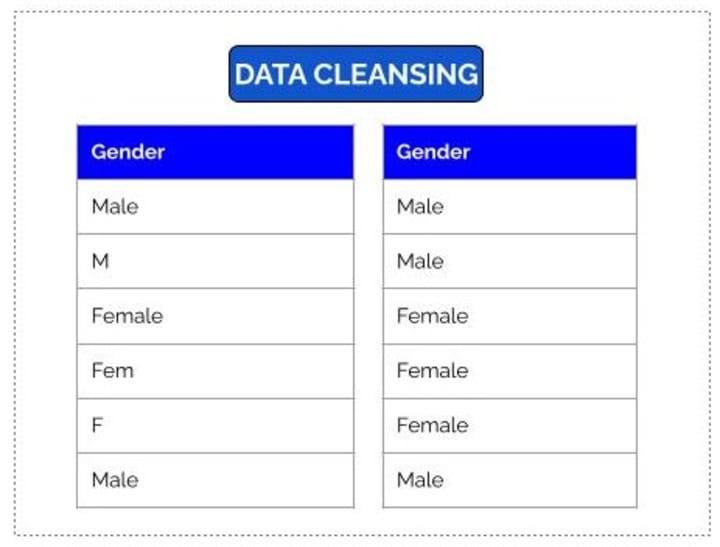
Here, you can see instances of incorrectly formatted data. Once it undergoes the process of data cleansing, all the incomplete entries (M, F, or Fem) get processed accurately.
Is It Important to Clean Your Data?
YES!
Data scrubbing is crucial, especially if your business belongs to a data-intensive industry (analytics, eCommerce, finance, healthcare, etc.) Here’s why!
1. Faster Customer Acquisition and Better Customer Relationship Management
What do businesses want except profits? Customers. In fact, it’s customers who bring them profits. Thus, acquiring new customers and providing them with a positive experience is essential to keep a business going.
How do you achieve this? Effective marketing, for one! CRM, for another!
With high-quality data at your disposal, you can create worthwhile strategies and target the right group of customers, at the right time, in the right way.
Moreover, organized data is the guiding principle behind CRM software and analytics; and nothing can do this better than CRM data cleansing services.
2. Reduced Compliance Risks
A business, no matter how big or small, must adhere to a set of industry-approved guidelines and policies. Not abiding by them can result in huge losses, both in terms of money and brand image.
When it comes to data, sticking to General Data Protection Regulation (GDPR) compliance is crucial, or rather, mandatory. However, badly kept and inaccurate data can disrupt your GDPR compliance efforts.
How? Let’s suppose one of your customers withdrew their consent to receive any marketing emails. Unfortunately, your team continued sending them the emails due to obsolete data and subsequent miscommunication. As per the laws of consent, this is a clear breach of data privacy and protection.
Information cleaning helps you avoid such violations by eliminating corrupt data. When your database is updated on a regular basis, your team will communicate with customers who want to stay connected with your business.
Additionally, you can avoid the massive penalty of GDPR breaching while saving your brand image.
3. Better Revenue, Marketing and Sales Efforts
According to a survey by Gartner, organizations believe that poor data quality can result in an average loss of $15 million per year. Another study by The State of CRM Data Health in 2022 claimed that low-data quality was the culprit behind inaccurate sales forecasts.
After going through the above stats, it wouldn’t be wrong to say that data quality plays a vital role in enhancing as well as diminishing an organization's revenue and marketing efforts. Sales and marketing strategies are based on data; imagine that data being duplicate and full of errors, inconsistencies, or inaccuracies. Your strategies are bound to fall in such cases. On the contrary, good quality or clean data can notably accelerate your marketing efforts and generate higher response rates.
4. Higher Productivity
Imagine a situation where your team is chasing customers with outdated or incomplete information. For example: wrong postal address or contact number. This will result in:
- Wastage of time and efforts
- Reduced productivity and efficiency
Data scrubbing saves you from this nightmare by updating the outdated data, completing the incomplete values, or correcting the incorrect information. Once the data is clean, your employees no longer have to spend time eradicating data errors or chasing customers with half/wrong information.
In addition to this, refined data enables effective, timely decision-making, reduces the risk of fraud (as payments/refunds are up-to-date,) streamlines business processes, and ultimately enhances overall productivity.
5. Organized Operational Workflow
Businesses run on data and information. From customers’ personal information, sales targets, payments, and refunds to inventory and the number of users, businesses have to manage tons of data. Mismanagement and disorganization in any form can lead to major setbacks in terms of revenue, reputation, productivity, and efficiency.
Data cleansing experts employ advanced cleaning techniques to keep your data clean, organized, and up-to-date at all times.
Additional Benefits of Data Cleansing and Scrubbing
- Improved mapping
- Effective decision-making process
- Minimal business risks
- Enhanced customer satisfaction
- Cost savings
Types of Errors Fixed by Data Cleansing
In layman’s language, data scrubbing is all about cleaning the dataset either by removing redundant data or fixing the errors. Whether the errors are a result of human negligence or varied data structures/formats, they can hamper data quality and cause heavy losses. Data cleansing rectifies and mends all types of errors, especially the ones that impact your bottom line.
Let’s take a look at some of the common errors resolved by data cleansing:
Typos and Missing Data
Datasets can have structural errors such as misspelled words, missing values, typing errors, incorrect numerical entries, wrong punctuations, blank/null fields, or syntax errors.
Data cleansing fixes such errors by:
- Filling the missing fields
- Removing the null fields (if too much data is missing)
- Correcting the misspelled words and incorrect numerical values
- Rectifying the punctuations and other similar mistakes
Formatting Inconsistencies
There are instances where attributes such as names, contact numbers, or addresses aren’t consistent across different systems. In other words, attributes might be formatted differently or might not match across different systems. For example, a customer’s pin code might be included in one dataset but missing in the other. This is termed data inconsistency.
Information cleansing techniques facilitate data uniformity by resolving such issues so that the dataset can yield accurate results.
Duplicate Data
When data is scraped or collected from different sources, it’s likely to have ambiguous entries. However, it is crucial to get rid of duplicate data as it can skew your results to a great extent. Data scrubbing identifies all the duplicate entries and either removes or merges them via de-duplication measures.
Irrelevant Data
Certain entries might be completely irrelevant or unnecessary. This can be lethal to data analysis as it can slow down or obstruct the entire process. Data cleansing targets such information and removes it from your database for effective business functioning.
Let’s take a look at an example: if your database is about customers’ email addresses but contains contact numbers in certain spaces, then those would be considered irrelevant and removed. Similarly, elements such as HTML tags, personally identifiable data, tracking codes, URLs, etc. are redundant and must be eliminated.
Data Cleansing Process: Steps Involved
1. Identification and Profiling
Before cleaning the data, it’s important to inspect the data and locate the issues that need to be eliminated or fixed.
In this step, a line is drawn between relevant and irrelevant data, and accurate and inaccurate data in order to figure out what to keep and what to discard.
2. Cleaning
This is one of the most crucial steps of the data scrubbing and cleansing process. Here the unwanted or redundant data is removed, errors are fixed, bugs are resolved, and duplicate data is taken off the databases.
3. Fixation of Structural Errors
Things like misspelled words, inappropriate naming conventions, wrong capitalization, incorrect word usage, etc. are counted as structural errors. While these may be obvious to humans, they can considerably hamper your data analysis since most machine learning applications won’t be able to recognize them.
Similarly, dates, addresses, phone numbers, etc. need to be standardized, so that computers can comprehend them easily.
4. Validation and Verification
Once all the data is cleansed and fixed, it must undergo some verification checks to ensure no inconsistencies or errors are left. To be precise, it involves analyzing data quality.
In addition to this, this step makes sure that the data adheres to all the quality standards and regulations.
Get Your Data Cleansed Today
By now, you know how crucial data is and why it is important to keep it error-free. Even the slightest inaccuracy can lead to long-term losses.
But, do you want your team to invest a major chunk of their time in organizing the data instead of focusing on other profit-generating tasks?
Leverage data scrubbing and cleansing services from reputed organizations and experience an updated, organized, and error-free dataset. The biggest advantage of outsourcing data cleansing services is that your in-house teams aren’t distracted while your business databases get cleaned cost-effectively.
One such company that converts rogue data into actionable data is SunTec Data. They have a team of highly skilled experts who employ state-of-the-art techniques to get you a database that contributes to your company’s growth and market share consolidation.
Want to know more about data cleansing? Drop an email to [email protected] and hear it from the experts.
About the Creator
Keep reading
More stories from christiehanes and writers in Journal and other communities.
Types & Importance Of Text Annotation in Machine Learning
Text annotation for machine learning is a sort of data annotation in which a computer learns to give meaning to chunks of text, whether they be brief phrases, longer sentences, or entire paragraphs. This is accomplished by supplementing the text with extra information such as definitions, meaning, and intent provided to AI models.
By christiehanes4 years ago in 01
What Is the Hanging Man Doji Pattern? Meaning, Strategy & Examples for 2025
Trading can feel confusing when market trends suddenly reverse. The hanging man doji is a critical candlestick pattern that traders rely on to identify possible reversals. For a deeper look at the hanging man doji, including its technical structure and real examples, traders often explore candlestick resources to refine their chart-reading skills. This guide will help you grasp its structure and how it indicates changes in market direction.
By Sanjeev Kumar6 days ago in Journal
A Historic Declaration
We the People of the Husbands of the United States of America, in Order to form a more perfect Union, and I mean you...with me...establish Justice, insure domestic Tranquility, provide for the common defence, promote the general Welfare, and secure the Blessings of Liberty to ourselves, after Puberty, do ordain and establish this Declaration of Co-Dependence.
By Gerard DiLeo5 days ago in Humans




Comments
There are no comments for this story
Be the first to respond and start the conversation.