
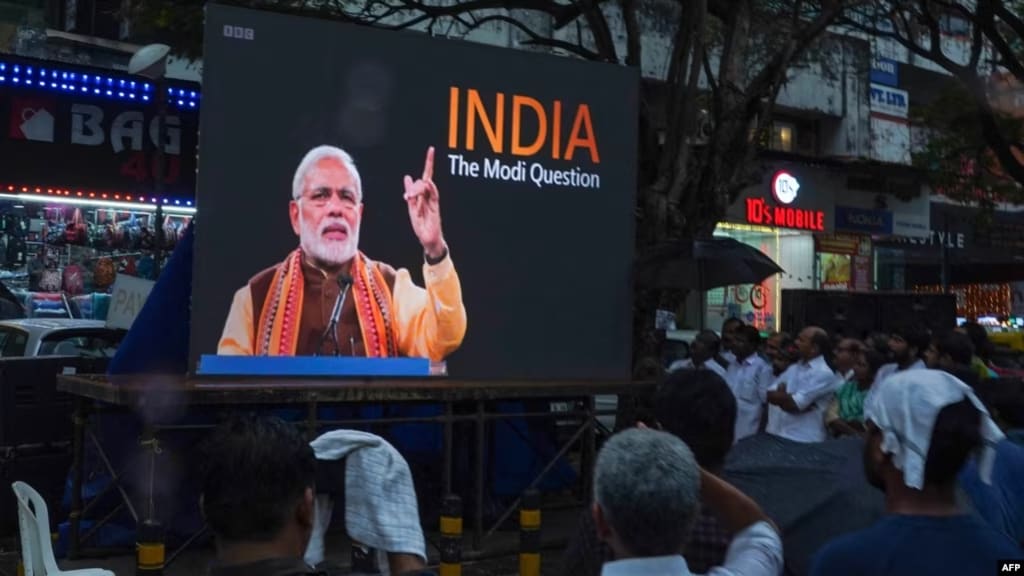
Indian Prime Minister Narendra Modi has been a controversial figure in Indian politics since he was elected in 2014. His Bharatiya Janata Party (BJP) has pushed for a number of policies that have been criticized for targeting the Muslim minority in India. The most notable of these is the Citizenship Amendment Act (CAA), which has been widely denounced for discriminating against Muslims. The CAA has sparked widespread protests and international condemnation. [1]
Modi has also been accused of failing to take action during the 2002 Gujarat riots, which resulted in over 1,000 deaths, the majority of whom were Muslim. [2] The Indian Supreme Court ruled in 2013 that there was insufficient evidence to prosecute him. [3]
Critics have also pointed to the BJP's Hindu-nationalist agenda, which has seen the government push for laws that restrict Muslims' rights and freedom of speech, such as the recent ban on sharing clips of the BBC documentary "India: The Modi Question" on social media. [2]
The Indian Muslims played a significant role in India's struggle for freedom from British rule. The Muslims of India were among the earliest participants in the Indian National Congress and, together with the Hindus, were instrumental in the formation of the Indian National Army.
Several prominent Muslim leaders, such as M.A. Ansari, Maulana Azad, Hakim Ajmal Khan, and Muhammad Ali Jinnah, actively participated in the Indian freedom movement. During the Khilafat Movement, the Indian Muslims united for a common cause – the restoration of the Islamic Caliphate in Turkey. This unity of Indian Muslims was further seen during the Quit India Movement in 1942, when the All-India Muslim League and the Indian National Congress issued joint statements, declaring their determination to win India's freedom.
Apart from the political arena, the Indian Muslims also played an important role in the economic and social development of India. Many Muslim industrialists, businessmen, and entrepreneurs contributed to the growth of the Indian economy. Also, the Indian Muslims set up several educational institutions across the country, contributing to the growth of education and literacy in India.
All in all, the Indian Muslims played a crucial role in India's struggle for freedom, and their immense contribution cannot be overlooked.
The present condition of Indian Muslims in the country is concerning, with a wide range of issues facing them. According to a survey by the Indian Council of Social Science Research, Muslims face numerous challenges, including poverty and lack of access to health care and education. In addition, they are often discriminated against when it comes to employment opportunities, with unemployment rates among Indian Muslims at least twice as high as the general population.
Discrimination against Muslims is often manifested in the form of social exclusion, with many feeling unable to participate in common activities and rituals. Crimes targeting Muslims have also been on the rise, with recent reports of mob attacks, lynchings, and hate speech. The situation of Indian Muslims has been further exacerbated by the recent Citizenship Amendment Act, which has been met with protests across the country.
The Indian government has taken some steps to address the situation, such as forming committees to study the issues and introducing affirmative action policies. However, more needs to be done in order to ensure that Indian Muslims are able to lead a life of dignity and equity. Political leaders must work towards inclusive policies that will ensure the safety and security of Indian Muslims and ensure that they are able to enjoy the same rights and freedoms as the rest of the population.
The Muslim community in India makes up around 14% of the population, and is mostly composed of Sunni Muslims. [3] Despite constitutional protections, Muslims have faced systemic discrimination, prejudice, and violence since India's independence. [3] It remains unclear why communities that had coexisted for hundreds of years attacked each other in 2002. [1]
The BBC documentary on the Modi question, titled "India's Most Controversial Prime Minister?", examines the rise of Indian Prime Minister Narendra Modi and the affects his rule has had on the nation. The documentary is produced by former BBC correspondents Nick Robinson and Justin Rowlatt and features interviews with political and human rights activists, scholars, and journalists. The documentary takes a deep dive into the controversies surrounding Modi and his government, including questions of communalism, foreign policy, and how his administration is handling the COVID-19 pandemic. It also examines Modi's supporters, including those in the business community, and how his rule has impacted the nation. The documentary paints a complex picture of a leader and a nation in transition.
About the Creator
sam
guiding purchasers on branding, patron retention and lead technology with #content, enterprise improvement and #social media, Public speaker and Author
Review of 'Man on the Run'
My wife and I saw Man on the Run, a nearly 2-hour documentary on Amazon Prime, about Wings, Paul McCartney's group that flew around the world from shortly after The Beatles broke up in early 1970 to shortly after John Lennon was murdered at the end of 1980, making a Beatles reunion forever impossible.
By Paul Levinson3 days ago in Beat


Comments