
When Harmony Strikes: Huawei’s Bold Move That Shook Windows in 2025
Inside the rise of Huawei’s HarmonyOS PCs and what it could mean for Microsoft’s dominance.
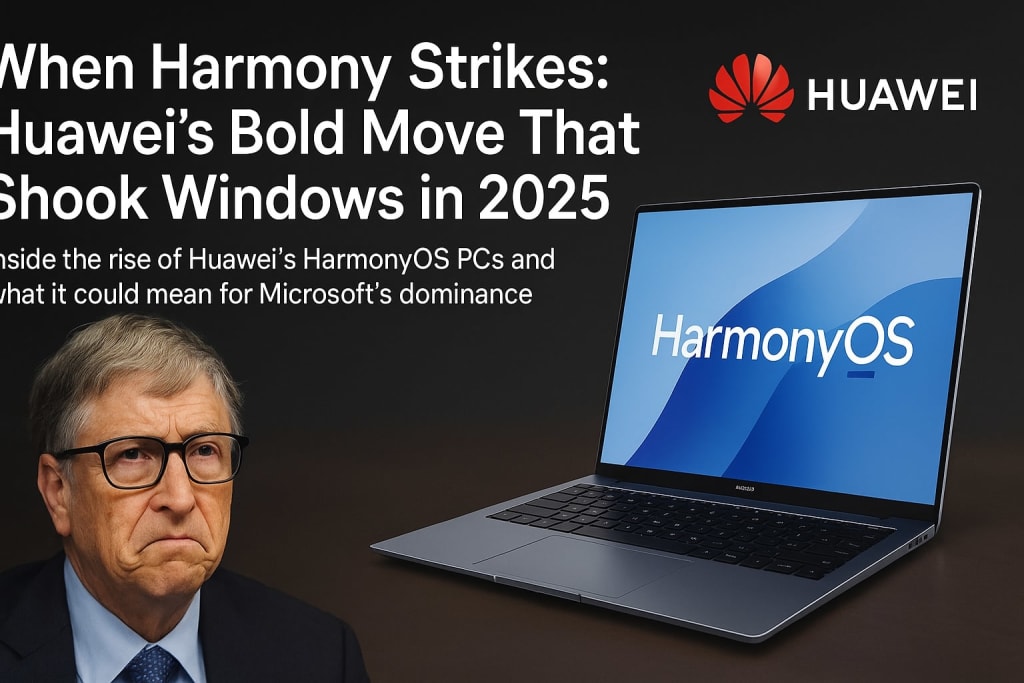
The Headline That Broke the Internet
"Bill Gates enraged by HUAWEI's 2025 Windows Killer."This phrase has probably been seen dominating news, video thumbnails, and trending posts if you have recently been surfing tech blogs or scrolling social media.It is spectacular, attention-getting, created to pique interest—and it really does.But the truth is considerably more nuanced, as is usually the case with headline-grabbing articles.
Under all the fanfare, the technological environment is really changing.Boldly entering the market for PCs without Windows, Huawei, the Chinese technological giant, is counting on its own HarmonyOS ecosystem to disrupt the established order.Though there is no evidence Bill Gates is genuinely "outraged," the language appeals to a tech community watching a longtime head under challenge from a newbie.
The Rise of HarmonyOS in PCs
Huawei released a selection of HarmonyOS 5-powered laptops in May 2025, including models such the dual OLED MateBook Fold and the high-end MateBook Pro.These devices are fully functional, high-performing notebooks meant to rival Windows-based goods, not just prototypes.
For laptops, the move to HarmonyOS is a calculated plan.Huawei has found challenges getting Windows licenses as a result of U.S. export restrictions, therefore raising the hazards of relying on Microsoft.Huawei seized the chance to develop and chart its own path rather than letting outside forces dictate its future.Their approach emphasizes hardware-software integration, AIdriven capabilities, and compatibility beyond laptops—including phones, tablets, and smart devices.
Separating Hype from Reality
Not quite furious, is Bill Gates truly "outraged"?These headlines demonstrate the clickbait culture, wherein the drama is used to draw attention even if it is not absolutely true.Microsoft has not formally responded to Huawei's move toward HarmonyOS in a manner suggesting rage.
The larger strategic implications take precedence over personal emotions.Huawei's HarmonyOS denotes a deliberate attempt to reduce dependence on foreign software; this choice has major technical and geopolitical implications.Rather than a personal conflict among corporate leaders, this is a story of inventiveness under duress.
Why This Shift Matters
Geopolitical Pressure Spurs Innovation
Driven by geopolitical tensions, Huawei's change comes from trade restrictions and U.S. sanctions.Faced with the future of Windows licenses in doubt, the corporation had a big decision: remain reliant on outside services or strike out on its own route.Choosing HarmonyOS signals a major stride toward self-reliance.
A Growing Ecosystem
Including smartphones, tablets, and televisions, more than one billion devices across the world currently run NetworkHarmonyOS.Huawei wants to provide a unified user experience across many devices—similar to the amicable interaction between Apple's macOS and iOS—by including laptops into this network.
Developer Momentum
More than 7.2 million developers are now involved in developing apps for HarmonyOS.The platform becomes a more appealing choice for both individual users and companies looking for Windows substitutes as the number of apps and services increases.
Flexibility and Choice
Huawei's laptops are not limited to HarmonyOS only; they offer variety.The brand also supports Linux systems, therefore giving consumers more options and guaranteeing business activities may continue without interruption.Tech aficionados and companies seeking viable substitutes will both find this dual approach appealing.
Challenges Ahead
Huawei faces noteworthy problems even with its remarkable development:
Software Compatibility: Windows still dominates the corporate and consumer markets for obvious reasons.Many well-known productivity programs, specialty applications, and games are made mostly for Windows.For greater acceptance, HarmonyOS has to close this gap.
User Transition: Many find it difficult to adjust to a new operating system.Unless HarmonyOS provides more evident benefits in performance, security, or distinctive features, Windows users might be hesitant to adopt it.
Global Perception and Trust: Geopolitical concerns, brand reputation, and legal obstacles might all impede Huawei's capacity to thrive outside of China.Developing trust with worldwide users for a somewhat new operating system presents a great difficulty.
What HarmonyOS Brings to the Table
Huawei is not just copying Windows; it is pushing boundaries in creativity.HarmonyOS laptops have:
AI-Enhanced Productivity: The system customizes itself to personal workflows, providing features like automatic task suggestions and intelligent window management.
Seamless Device Sync: Huawei's system lets smartphones, tablets, and computers effortlessly work together so that files, alerts, and apps may be easily shared.
Optimized Performance: Built for Huawei devices, HarmonyOS reduces latencies, maximizes battery life, and enables complex multitasking free of the extra load sometimes found with Windows PCs.
These benefits go beyond simple curiosity and give a compelling reason to think about the change.
The Bigger Picture: A Competitive Shift
Huawei's latest activities run counter to the long-held beliefs that have formed the PC business.Windows has long led personal computing; Linux and macOS make up increasingly small segments of the market.HarmonyOS introduces fresh competition, therefore stimulating creativity across the sector.
This growth could provide consumers:
- More device options fit various tastes.
- Options more cheap yet rich in features.
- Encouragement for developers to broaden their horizons beyond Windows.
This is a trend in the tech industry: variety in operating systems is fast becoming a requirement instead of an optionality.
The Human Angle
The main subject of this also centers on personal adaption to change rather than just corporate rivalry.Tech enthusiasts are looking at various possibilities, developers are working hard creating programs for HarmonyOS, and users are mastering a fresh operating system, all of which help to produce a vibrant atmosphere.Beyond Gates and Huawei, the conversation emphasizes how technology affects—and sometimes complicates—daily life.
Community Engagement
Important questions rise from Huawei's HarmonyOS project:
- Would you consider using a HarmonyOS notebook for either study or employment?
- Do you think Windows is actually under danger?
- Having several operating systems is quite important for the development of technology?
Express your ideas, exchange experiences, and project predictions by joining the Journal community.Your ideas add to a conversation beyond merely sensationalism or headlines.
Conclusion:
Though the real circumstances are far more complicated, strategic, and finally more compelling, the provocative headline "Bill Gates Furious By HUAWEI'S 2025 Windows Destroyer" tells a certain tale.Huawei's debut of HarmonyOS laptops shows more than only a reaction to geopolitical issues; it shows a drive for innovation, autonomy, and ecosystem cooperation.
Though Windows still dominates, Huawei's actions remind us that technology is always changing, monopolies don't last forever, and significant advances frequently emerge from pressing requirements.For users, developers, and tech geeks alike, this story is important to follow not just for the thrill but also for the big changes it brings in the field of computers.
About the Creator
Keep reading
More stories from Shahjahan Kabir Khan and writers in Journal and other communities.
China Draws the Digital Line: The New Sovereignty Law Challenging U.S. Data Rules
China says no to data rules placed on it by the United States. In a big move for the global tech scene, China has enacted a strict new Data Sovereignty Law meant at reducing foreign, especially American, influence on data gathering, storage, and distribution inside its boundaries.
By Shahjahan Kabir Khan7 months ago in Journal
Author’s Advice
If you would’ve asked me 20 years ago did I know I’d become a writer and an author, I would’ve said “nope, ain’t happening”. As fate would have it I did become an author and I can honestly say I’m loving it so far. It really does feel good to be a writer. I’ve learned a lot on this journey and I feel like with even me being as new to this world as I am, there’s some wisdom I need to share with every other aspiring author.
By Joe Patterson4 days ago in Journal
Why Didn't Anyone Tell Us
Men, move along. This is not for you. This is for the women. I was forty-five when I began menopause. It is pretty young for that to be going on in a woman’s life, but I had undiagnosed PCOS, my entire life. Thank you to all the gynecologists I had seen my entire life. That in itself should encourage women to keep seeking second opinions, especially when you are not getting correct answers or any at all.
By Alexandra Grant5 days ago in Humans



Comments
There are no comments for this story
Be the first to respond and start the conversation.