
What My Grandfather’s Toolbox Taught Me About Life
Using a physical object (toolbox, shoes, letters) as a metaphor to tell a story about family, legacy, or healing.

writer name : Nadeem shah
I was eleven years old the first time I opened my grandfather’s toolbox without his permission.
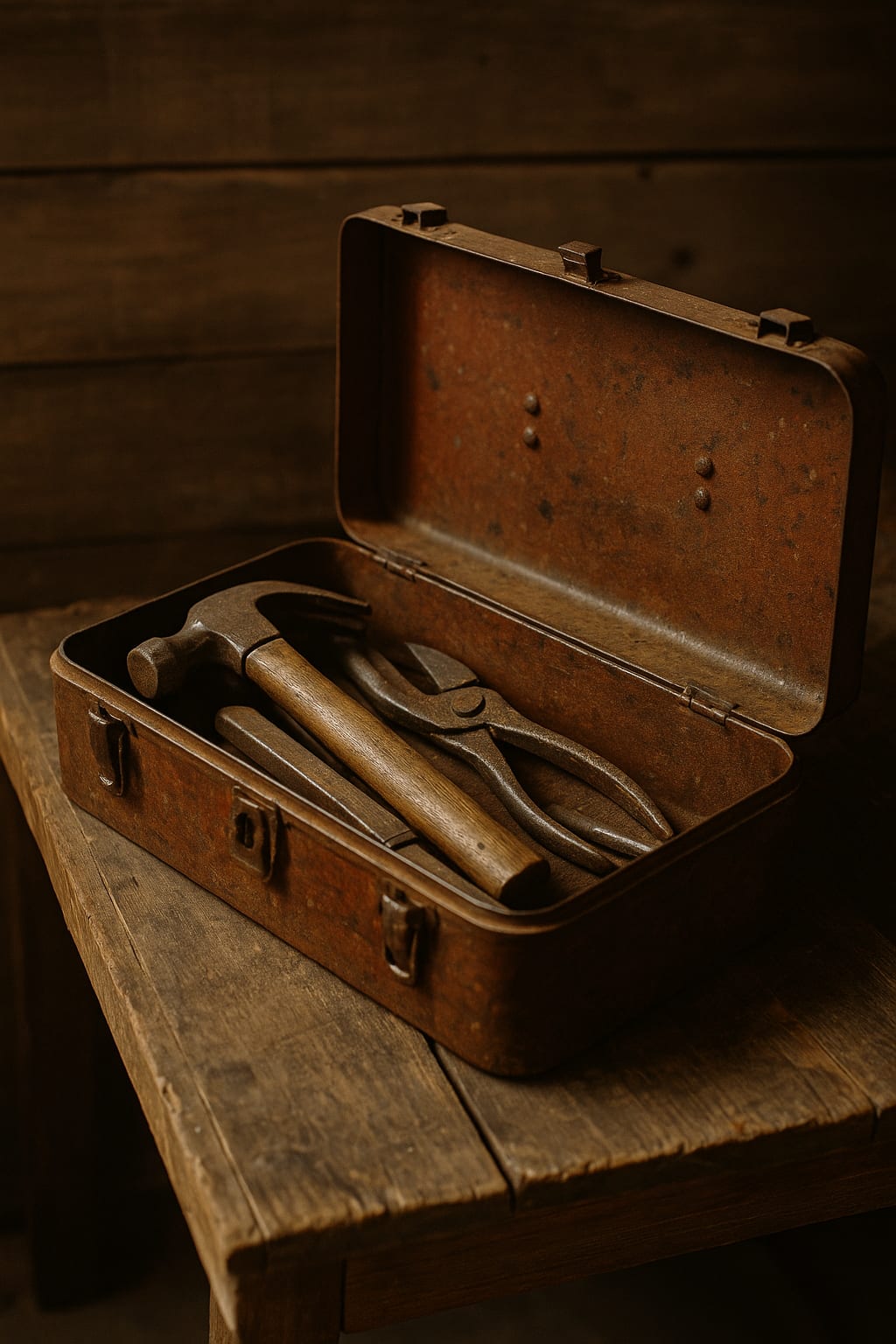
It sat beneath the wooden workbench in his shed like a sacred artifact—scratched, weather-beaten, and locked with a rusty clasp that only he seemed to open with ease. That morning, he had gone inside to answer a call, leaving me alone in the shed with a half-built birdhouse and a growing curiosity.
With the bravery only children possess, I knelt beside it, flipped the latch, and opened the box.
It was less a box and more a collection of memories. Inside were tools with worn handles, strange metal contraptions I couldn’t name, and a layer of sawdust that seemed to whisper stories from decades before I was born. What struck me most wasn’t what I found, but how the tools were organized—not by size, or type, or color—but by wear. The most used were placed on top, as if his hands always knew where to go.
Before I could reach in, I heard his footsteps behind me. I froze.
“You’re curious,” he said with a slight smile. “That’s good. But these tools—they’re not toys.”
I stammered an apology, but instead of scolding me, he sat beside me and pulled out a small wrench. “This one,” he said, turning it over in his hands, “helped fix the kitchen sink when your mom was twelve. Flooded the whole floor.” He chuckled. “She thought the house was sinking.”
That day, he didn’t just introduce me to tools—he introduced me to stories. From then on, every summer afternoon I spent with him, I wasn’t just learning how to hammer a nail or tighten a screw—I was learning about life.
The Hammer and the Art of Strength
The first tool he taught me to use was the hammer. I remember gripping it too tight, too eager to impress him. I smashed nails sideways, bent them like paperclips. But he never got angry.
“You’re trying too hard,” he said. “Let the hammer do the work. It has weight for a reason.”
Back then, I didn’t understand how that advice would carry me beyond the shed. Years later, when I was in college, struggling with depression, overwhelmed with expectations, I remembered those words. I had been fighting everything—myself, my studies, my future. I wanted to be perfect. Strong. Capable. But it was only when I loosened my grip—when I let myself feel tired, sad, broken—that I began to heal.
Sometimes, the strength isn’t in how hard you swing. It’s in knowing when to ease up.
The Tape Measure and Perspective
One afternoon, while helping him repair a sagging fence, I misjudged a measurement. The result? A crooked board and a scolding splinter.
“Measure twice, cut once,” he reminded me gently.
I heard that line a hundred times growing up, and each time, it felt more profound. In my twenties, when I rushed into a relationship that felt perfect on paper but hollow in my gut, I remembered that tape measure. I hadn’t paused. I hadn’t asked the right questions—of myself or her. I was cutting before I was sure. When it ended, painfully and suddenly, I didn’t just mourn the relationship—I mourned the version of myself that refused to wait and measure carefully.
Some mistakes aren’t just miscalculations. They’re lessons in patience and clarity.
The Screwdriver and the Long Game
Of all the tools in the box, the screwdriver was his favorite. “Simple, precise, and patient,” he used to say.
Once, we spent nearly an hour removing the back panel of an old radio he was trying to restore. I grew bored, wanting to pry it open with something faster.
“Rushing ruins things,” he told me, holding the screwdriver like it was sacred. “You’ve got to turn slowly. Feel the resistance. It’ll come loose when it’s ready.”
Years later, when my mother got sick, I remembered that screwdriver. Watching someone you love fade slowly is its own kind of torture. I wanted to fix her. I wanted her better. Now. But healing—and in some cases, saying goodbye—requires quiet endurance. You can’t yank open time or speed up nature. You just show up every day, patiently turning love into presence.
The Rusted Pliers and Acceptance
When I was seventeen, I found a pair of old pliers in the bottom of the toolbox. The grip was uneven, and the metal had rusted over. I asked him why he kept it.
He looked at it thoughtfully and said, “Because even broken things can be useful.”
That line gutted me the year I failed my first big job interview. I was fresh out of college, cocky, and convinced I had it all figured out. When I didn’t get the position, I spiraled into self-doubt. Maybe I wasn’t smart enough. Maybe I’d peaked already.
But then I remembered the pliers.
I wasn’t useless. I was just in a season of rust. Still capable. Still holding value. I just needed a little oil and time.
The Empty Compartment
When my grandfather passed away, I returned to the shed, now colder and quieter than I remembered. The toolbox was there, untouched, like he’d only stepped out for a moment.
Inside, everything was still in place—except for one compartment. Empty.
For weeks, I puzzled over it. Why was it left bare? Then it hit me.
That space wasn’t for a tool. It was for me.
A reminder that life is a work in progress. That the box isn’t complete. That every generation adds their own tools, their own stories, their own scars.
Legacy, in Wood and Metal
I still have his toolbox. It sits in my apartment now, under my own workbench. I don’t use it often, but I open it from time to time—when I feel lost, when I need to remember.
Each tool reminds me not just of tasks, but of truths:
Hammers remind me to trust the weight of my own presence.
Tape measures urge me to pause and reflect.
Screwdrivers whisper patience in the face of resistance.
Pliers teach me to value the worn, the flawed, the imperfect.
My grandfather never wrote books or gave grand speeches. He didn’t have a resume that would impress most. But through the quiet ritual of repair, through a box of simple tools, he left me a legacy more valuable than anything else.
Final Reflection
Now, when people ask what shaped me most, I don’t mention degrees or achievements. I tell them about the shed. About the rust and the dust. About the man who taught me that every nail bent wrong, every board measured off, every stripped screw was still a part of something beautiful.
Because life, like any good project, is messy. You won’t get everything right the first time. But if you keep showing up, tool in hand, heart open—you’ll build something that lasts.
And maybe, just maybe, you’ll pass it on too.
About the Creator
Nadeem Shah
Storyteller of real emotions. I write about love, heartbreak, healing, and everything in between. My words come from lived moments and quiet reflections. Welcome to the world behind my smile — where every line holds a truth.
— Nadeem Shah
Keep reading
More stories from Nadeem Shah and writers in Journal and other communities.
."Learning to Love My Imperfect Story"
For most of my life, I chased a version of myself that didn’t exist. The polished version. The perfect one. The one with no scars, no stumbles, no missteps. I believed that if I could just keep everything neat—grades, friendships, career, relationships—then I'd be enough. Then my story would be worth telling. But real life, as it turns out, is rarely neat. And for a long time, I mistook that mess for failure.
By Nadeem Shah 8 months ago in Journal
Author’s Advice
If you would’ve asked me 20 years ago did I know I’d become a writer and an author, I would’ve said “nope, ain’t happening”. As fate would have it I did become an author and I can honestly say I’m loving it so far. It really does feel good to be a writer. I’ve learned a lot on this journey and I feel like with even me being as new to this world as I am, there’s some wisdom I need to share with every other aspiring author.
By Joe Patterson2 days ago in Journal
Twitter founder Jack Dorsey fired 4,000 people over AI and issued a warning to the business world.
On Thursday, February 26, Jack Dorsey cofounder of Twitter and CEO of Block, one of the world's largest digital payments companies published an internal memo that went viral within hours. Block, the company that operates Square, Cash App, and its Bitcoin ecosystem, was laying off more than 4,000 people: almost half of its global workforce. The stated reason wasn't a crisis. It was artificial intelligence.
By Omar Rastelli5 days ago in Journal
Becca
"Everything is so... flat." Denille said stupidly as she looked around her new neighborhood. She looked around at the muted desert where even the smallest sign of life seemed to have given up. The plant life was shrubs that were half cooked by the heat and where there should have been a lawn, a mess of white rocks laid glistening in the sun. Even the sky looked stretched thin, like the sun had ironed it smooth. She’d moved from Riverside, where at least there were hills, but here in Barstow, everything felt baked and brittle.
By Sara Wilson8 days ago in Fiction




Comments (1)
amazing