
What are the PHP Security Tools That Protect Your Fintech Software
Given how quickly the fintech sector is evolving and how fiercely competitive it is becoming, it is crucial to take all the necessary precautions to maintain dominance.


Developing web applications for the fintech sector is not without its difficulties. And in this blog, we are going to discuss the biggest challenge the industry is facing and how to overcome it.
Data Security: The Biggest Challenge of Fintech Industry
Making products that are both user-friendly and secure is the biggest challenge in Fintech software development right now. Since financial institutions store large amounts of sensitive customer data, even a small weakness in the code can have serious repercussions.
If you want users to make your product the go-to place for their financial needs, then you must balance functionality and simplicity.
You may run the risk of losing customer data to hackers if it does not have sufficient data security measures in place. That will make your reputation suffer, and there could be significant financial losses.
How PHP Can Help With This?
There are many advantages of PHP, including the many ways to protect databases from unwanted cyberattacks. And with Fintech, the need to secure them is at an all-time high. Here, we will mention the top ways you can use the security features of PHP.
What are SQL Injections?
SQL injection is a kind of injection attack where an attacker submits a maliciously crafted input. These attacks force an application to take an unintended action. SQL injection is one of the most prevalent cyberattack types due to the widespread use of SQL databases.
How PHP Can Protect Your Fintech Software
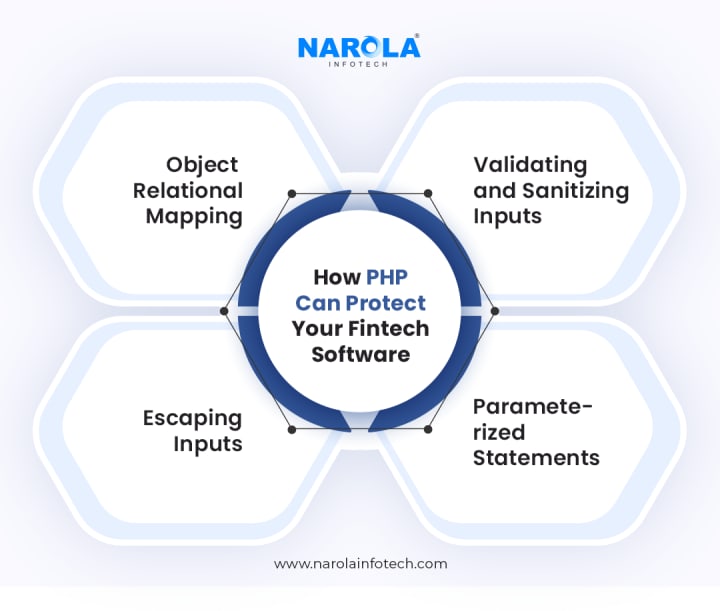
1. Parameterized Statements
An application can create and execute SQL statements against a database, retrieving and transforming data as necessary with the help of database drivers. These drivers also let programming languages communicate with SQL databases. Therefore, inputs (also known as parameters) passed into SQL statements are handled safely with parameterized statements.
2. Object Relational Mapping
When converting SQL result sets into code objects, many developers favor Object Relational Mapping (ORM) frameworks. Because of ORM tools, developers rarely need to write SQL statements in their code, as these tools internally use parameterized statements. So you can hire PHP developers who can use these tools effectively.
However, using an ORM does not make your software invulnerable to SQL injection. When performing more complex database operations, many ORM frameworks let you construct SQL statements or portions of SQL statements. So it is important to be prudent about the code your developers write in these situations.
3. Escaping Inputs
There will be situations where you won't be able to use parameterized statements or a library that generates SQL for you. In that case, the best alternative is to make sure that your developers properly escape special string characters in input parameters.
An escape character invokes a different interpretation for the characters that follow it in a character sequence.
The ability of the attacker to create an input that will close the argument string early in which it appears in the SQL statement is a common requirement for injection attacks.
There are common ways to describe strings with quotes in them in programming languages, and SQL is no exception. It prompts the programme to treat the quote as part of the string and not the end of the string. That happens when the quote character is doubled up and a single quote is replaced with double quotes.
The majority of SQL injection attacks can be easily thwarted by escaping symbol characters, and many languages have built-in functions to do this. The best PHP web development services will make sure of that.
4. Validating and Sanitizing Inputs
Input validation resembles running tests on the information a user is entering into a form.
If there is an email field, you should make sure it is not blank and that the email format is as specified. If the form has a name field, make sure it's not blank. Also, it must be a string, and be of the right length.
The user can use these tests to determine whether the data they have entered is correct or not. You can even send them a message if they are incorrect.
For a better user experience, user input values can be validated on the client side, but they should also be done on the back end.
Bypassing the client-side code allows users to send incorrectly formatted data to the back-end. So it is important to validate the code on the backend too.
For all applications, sanitizing inputs is a good practice. Always try to dismiss inputs that appear suspicious right away, but be careful not to unintentionally punish authentic users.
Client-side validation is useful for providing the user with immediate feedback when they fill a form. However, it is no match for a determined hacker. Instead of the browser itself, hackers use scripts in the majority of hacking attempts. Therefore, you must hire PHP developers who have the expertise of thwarting these attacks.
Why Narola?
We all understand how critical data security for Fintech apps is. So if you are building a financial app, you wouldn’t want just anyone to be handling that project, right?
Narola Infotech is a PHP development company with more than 17 years of experience. Our 350+ IT experts have worked with over 1500 clients around the world in every major industry. In fact, our clients have appreciated our efforts and results over the years.
Do you want to build a secure and functional fintech platform? Feel free to contact us at any time, and our experts will get back to you to discuss your dream project.
About the Creator
Narola Infotech
Narola Infotech is one of the leaders in IT outsourcing services. We are proficient in providing Web Application Development, Automation, Machine Learning, Mobile Apps Development, & Digital Marketing, etc.
Keep reading
More stories from Narola Infotech and writers in Journal and other communities.
How Can You Get High ROI for Low Investment by Making an Android App With Java?
Have you ever wondered why Java serves as the backbone for virtually all Android mobile application development? Additionally, Java is the primary language that coders choose to use when creating Android applications. What gives, though?
By Narola Infotech3 years ago in Journal



Comments
There are no comments for this story
Be the first to respond and start the conversation.