
Understanding the Basics of eChecks: What They Are and How They Work
Electronic Check for Business

What Is an eCheck?
An electronic check, commonly known as an eCheck, is a digital equivalent of a paper check. It allows for the electronic transfer of funds from the sender's checking account to the recipient's account through the Automated Clearing House (ACH) network. This eliminates the need for a physical check and streamlines the payment process.
In the United States, eChecks are processed via the Automated Clearing House (ACH) network, a system that links financial institutions like banks for electronic transactions. Customers can authorize ACH transactions through a contract or online, allowing for seamless transfer of funds between accounts.
How Do eChecks Work?
eCheck processing is like paper check processing, but quicker. A customer no longer has to manually fill out a paper check and send it to the business for payment, technology enables the process to occur electronically, reducing both time and paper usage.
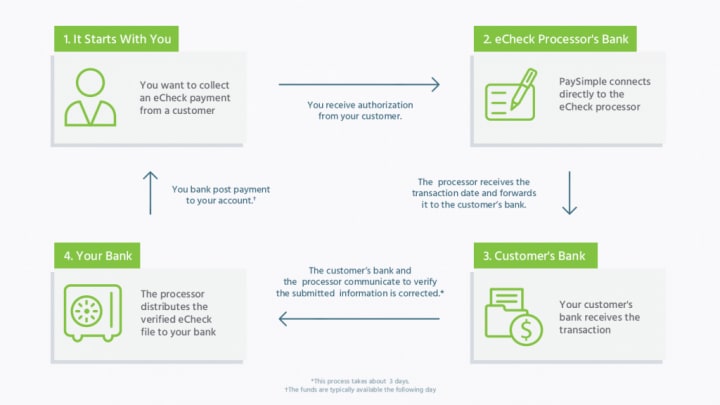
The following steps are involved in processing an eCheck:
Authorization request: The customer must authorize the deduction of the specified amount from their account for the payment to be made. This authorization can be obtained through a signed order form, verbal approval, or a web-based payment form
Payment setup: Upon obtaining authorization, the merchant enters the necessary financial information (such as the checking account and routing number) into the online payment gateway.
Transaction completion: The payment gateway confirms the financial information and forwards the payment to the merchant's bank. The eCheck transaction then begins as the payment is transmitted through the ACH network.
Fund deposit: The payment is automatically taken from the customer's bank account, the customer receives a payment receipt from the online system, and the payment is credited to the business's bank account. The funds are usually credited to the merchant's bank account three to five business days after the transaction starts.
These four steps make eChecks a more efficient payment option than traditional methods. The convenience and reduced processing fees are among the factors contributing to the increasing popularity of eChecks.
What is the processing time for an eCheck to clear?
eCheck clearing time may vary among providers, therefore the processing time may also differ. Typically, the funds are verified within 24 to 48 hours of initiating the transaction. If the customer has sufficient funds in their checking account, the transaction is usually cleared within three to five business days and the funds are transferred to the recipient's account.
Is using e-check for payment a secure option?
Paying and accepting e-checks is secure. They offer the same level of security as traditional paper checks, but with added convenience for online transactions. E-checks transfer funds electronically from one bank account to another through secure methods employed by banks for other transactions, ensuring the safety of your payment.
How do I cancel an eCheck?
As a business owner, you may need to cancel an eCheck for a customer. The method for cancelling depends on the payment system used and the stage of the transaction. If the payment has already been cleared into your account, it cannot be cancelled and a refund must be arranged. If the payment is still pending, contact your payment processor for the best way to proceed.
What is the cost of processing an eCheck?
The cost of processing an eCheck may vary among providers of eCheck merchant accounts. Some providers might charge a higher fee per transaction and a lower monthly fee, while others may charge the opposite. Typically, the fee for processing an eCheck is between $0.30 and $1.50 per transaction. By using OnlineCheckWriter to print checks from your office or home on blank check stock, you can significantly reduce your check printing costs by 80%.


Comments
There are no comments for this story
Be the first to respond and start the conversation.