
Understanding API integrations in trading applications.
Explore how API integrations enhance trading applications by enabling real-time data access, automation, and seamless platform connectivity.


Traders in today's financial markets need trading software that allows them to execute deals precisely and quickly. API (Application Programming Interface) connections have altered trading platforms by providing new features and functionality. API connections across systems enable traders to make automated transactions and access real-time data, leading in faster data-driven decisions. The seamless integration of systems via API allows traders to develop and implement high-level trading strategies while navigating volatile markets.
API integrations in trading software signaled a new era of trader-environment interface with markets, resulting in improved operational efficiency and optimal control features. Third-party tool integration enables traders to design bespoke solutions that meet their specific needs. APIs are becoming more important in trading software because they enable the automation of repetitive procedures, the execution of complicated strategies, and better decision-making capabilities in today's financial markets.
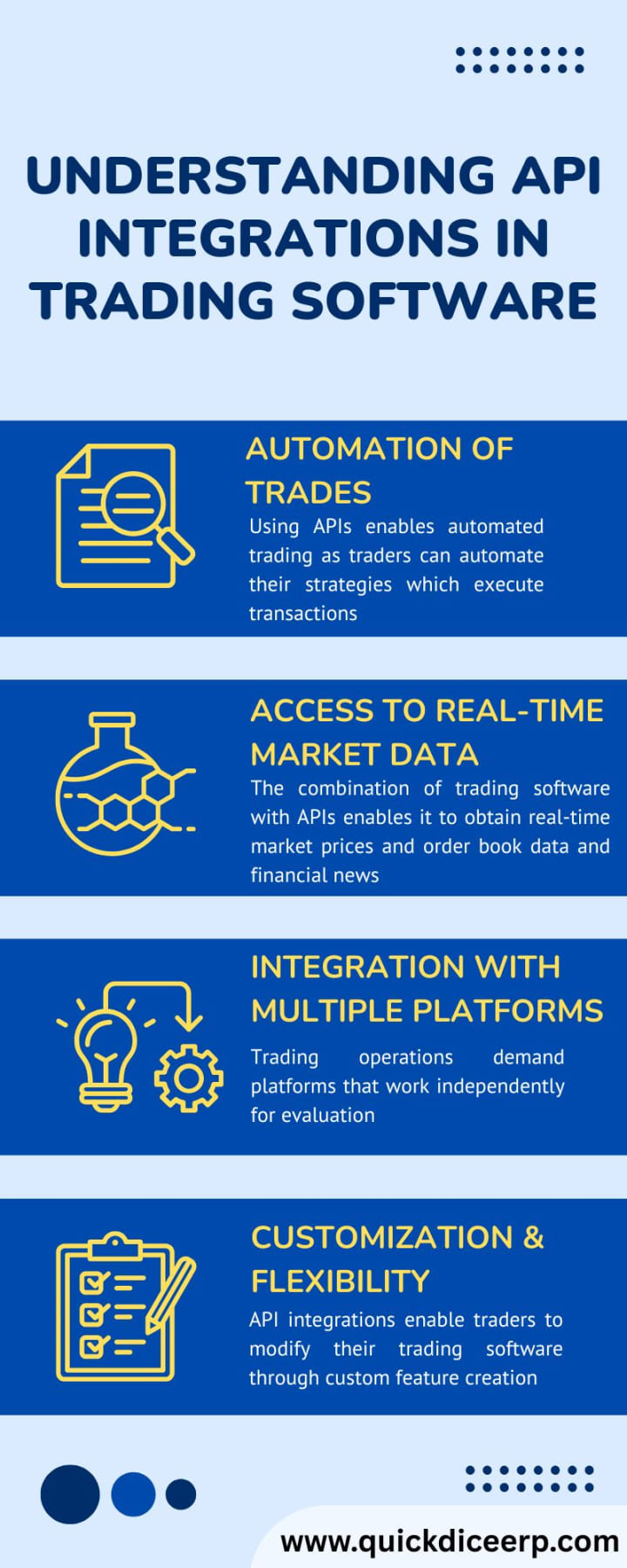
What is API Integration in Trading Software?
API integration technology offers shared communication protocols between trading platforms, partner systems, application providers, and data sources. APIs allow trading software to communicate with other software systems and brokers, transmitting and receiving vital information.
API connectors provide traders with advanced trading tools that automate their methods, access to a variety of markets, and the ability to develop bespoke indicators in addition to regular trading software capabilities.
Why is API integration so important in trading software?

API integration is a critical component of modern trading software systems since it allows traders to remain competitive in financial markets. Here's why.
1. Automation in Trades
Using APIs facilitates automated trading since traders may automate their processes, which execute transactions based on predefined criteria without requiring human intervention. This time-saving method enables faster execution times and increased market volatility response.
2. Obtain real-time market data.
The combination of trading software and APIs gives traders real-time market pricing, order book data, and financial news updates, allowing them to make quick judgments.
3. Integration across several platforms.
Trading operations necessitate systems that can work independently for evaluation, order placement, and position protection services. APIs enable trading software to integrate several tools into a single system, resulting in increased operational speed and efficiency.
4. Customization and versatility.
API connectors allow traders to customize their trading software by adding unique features and indications, as well as connecting to external systems, resulting in more flexible trading strategies.
What functions are executed when API integrations are utilized in trading software?

API integration works in trading software by utilizing core notions; nonetheless, users must have technical understanding. The software and an external server communicate in real time using an API. This is how it works.
The trader must first authenticate their access by requesting an API key from the API provider. The API key enables secure access to the trading platform.
User authentication enables trading software to communicate with external systems through data exchange capabilities. The software platform either transmits trading orders to brokers via its network or collects market feed provider data.
The trading software receives data and generates execution decisions based on its algorithm or trading strategy, which are then carried out automatically.
Advantages of API Integration in Trading Software

1. Increased speed and efficiency.
API integration increases trading software execution speed by completing transactions quickly based on trader-specified parameters, hence decreasing manual trading delays.
2. Minimized human mistake.
Trading methods enable error-free execution via automated API integrations, shielding traders from both incorrect order type and wrong trade execution. Because of the importance of this criterion, precision is essential in high-frequency trading.
3. Improved strategy execution.
The API functionality allows traders to evaluate their trading strategies against historical market data and run virtual market simulations before implementing them in live trading scenarios. The technology ensures that techniques are reliable before they are used in the actual world.
4. Cost-effective solutions.
Brokers and trading software providers provide their clients affordable API access, allowing traders to use advanced tools without incurring the fees associated with custom-built trading systems.
Top API Integrations for Trading Software.
Trading software developers can improve the utility of their solutions by integrating many APIs.
1. Broker APIs.
Trading software users receive direct access to broker systems via these APIs, allowing them to execute trades and examine current pricing data.
2. Market data APIs.
These APIs provide traders with both current and historical market data, enabling them to make strategic judgments.
3. Risk management APIs
Effective risk management is crucial for trading activities. These APIs enable trading programs to manage risk by computing margins, setting stop-loss limits, and other key risk features.
4. Charting and Technical Analysis APIs
Trading platforms that offer these APIs allow users to construct detailed charts for visualizing market trends, as well as technical analysis tools to assist them improve their trading strategy.
Issues With API Integration in Trading Software
Although API connectivity for trading software has numerous advantages, it also introduces a number of practical challenges. Here are some common issues:
Nonprogrammers will struggle to implement and configure APIs.
Data transmission delays caused by the API provider may impair the speed and accuracy of trade execution.
API security is dependent on strong secure access protocols, as financial data is still vulnerable to hacker efforts.
Conclusion
API integrations are crucial for traders seeking a competitive advantage in today's markets. Traders can improve their approach efficiency and reduce operational flaws by automating functions and delivering data promptly via API. When trading platforms collaborate to establish unified ecosystems, traders receive full access to the tools needed for efficient and adaptive trading.
As financial markets grow, API connections will become increasingly important. Incorporating these advanced capabilities into trading software gives traders a significant advantage by allowing them to make faster, more informed decisions, keeping them ahead of the competition. API technology is becoming increasingly vital in trading platforms as it creates critical elements for current trading success.
About the Creator
Aya Basha
"Hi, I'm Aya Basha, an accounting enthusiast who loves simplifying financial processes. I share insights and tips to help businesses streamline operations, stay compliant, and achieve financial success."
Author’s Advice
If you would’ve asked me 20 years ago did I know I’d become a writer and an author, I would’ve said “nope, ain’t happening”. As fate would have it I did become an author and I can honestly say I’m loving it so far. It really does feel good to be a writer. I’ve learned a lot on this journey and I feel like with even me being as new to this world as I am, there’s some wisdom I need to share with every other aspiring author.
By Joe Patterson3 days ago in Journal
7 Signals the wireless connectivity market Is Entering a New Era
The invisible threads holding the modern world together aren’t made of steel or fiber—they travel through the air. From the moment your alarm syncs with the cloud to the instant a self-driving car updates its navigation data, wireless signals quietly power the rhythm of modern life. What once began as simple radio communication has evolved into an ecosystem connecting billions of devices, satellites, sensors, and cities.
By Andrew Hamilton6 days ago in Journal




Comments
There are no comments for this story
Be the first to respond and start the conversation.