
Ukraine Using The Copperhead Laser-guided Artillery Shell With Great Success
How the shell works in the modern battlefield context with drone laser-painting of targets

A video compilation has recently emerged showing the very successful use of the M712 Copperhead laser-guided artillery shell in Ukraine. That led me to a deep dive into the technology of this interesting, supposedly obsolete, weapon and what it teaches us for the future.
The M712 Copperhead was a functional historical milestone in the development of precision-guided munitions. Developed by the United States during the 1970s and entering mass production in 1978, the copperhead was the first “smart” artillery round designed to allow standard 155mm howitzers to engage point targets with terminal accuracy.
While modern military discussions often focus on satellite-guided systems, the Copperhead relies on semi-active laser homing, a technology that was originally intended to neutralise Soviet armoured formations in central Europe. At that time it was expected that World War III would start on the plains of Germany with the engagement of massed NATO and Soviet armoured formations.
The assault breaker design initiative sought to provide conventional forces with the ability to strike high-value targets behind the front lines without resorting to nuclear options. The US developed the M712 Copperhead as one of the tank killers. The other was, of course, the famed A10 Thunderbolt aka ‘Warthog’ aircraft.
How times have changed. Massed cheap drones are now the tank killers.
But the Copperhead and its Ukrainian successor, the Barovnik-K, still have a place in the arsenal.
The M712 Copperhead
The shell is a 62.4 kg projectile, measuring 140 cm in length. It contains a 6.69 kg high-explosive anti-tank warhead designed to penetrate heavy armour and reinforced structures.
It is not a discarding sabot design. Instead it utilises a slipping driving band (also known as a slip-band obturator). This spins with the rifling of the barrel but slips around the projectile so that the Copperhead is stable and not itself spinning when it leaves the gun barrel.
The following 155mm artillery systems are capable of firing the M712 Copperhead:
• M777 (Towed)
• M109 (Self-propelled, including A3 through A7 variants)
• M198 (Towed)
• M114 / M114A2 (Towed)
• CAESAR (Wheeled self-propelled)
• PzH 2000 (Tracked self-propelled)
• AS-90 (Tracked self-propelled)
• FH-70 (Towed)
• AHS Krab (Tracked self-propelled)
• Archer (Wheeled self-propelled)
Although the United States ceased production of the Copperhead round in the 1990s and retired the system from its own active inventory in favour of the GPS-guided Excalibur, substantial stockpiles remained in storage.
These vintage munitions have now found a second life in Ukraine, where the requirement for precision often outweighs the age of the hardware. The reappearance of the Copperhead on the modern battlefield demonstrates that older technology, when applied to specific tactical problems, remains effective.
Here an M712 Copperhead approaches an old M47 Patton tank used as a target during testing. (Wikipedia)
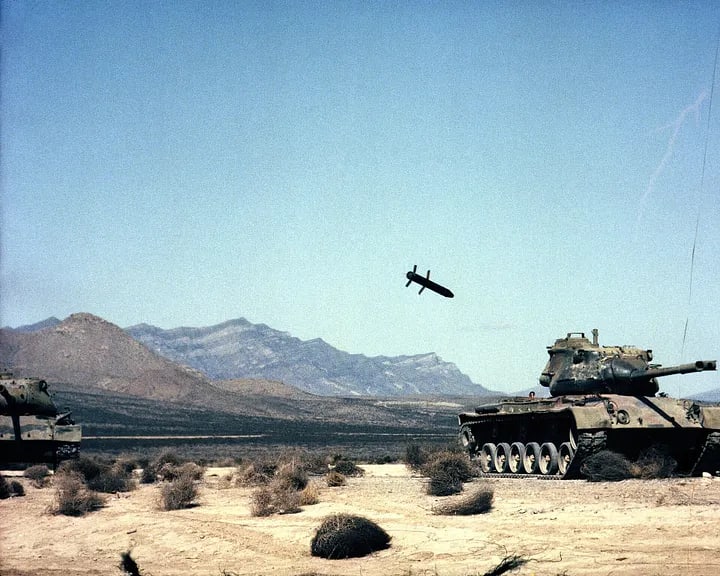
The integration of this 40-year-old munition into a 21st-century digital battlefield proves the durability of the original engineering concepts.
First confirmed uses: from Kursk incursion to Kherson fortifications
The deployment of M712 Copperhead shells by the Ukrainian armed forces was first documented in the autumn of 2024.
Reports from November 2024 indicated that special operations forces utilised these rounds during the Kursk incursion. In this operation, the primary objective was the destruction of a metal communication tower located east of Sudzha.
This tower served as a critical node for russian electronic surveillance and communication. Ground teams from the special forces utilised portable laser designators, specifically the Leonardo Type 163, to guide the shells fired from M777 towed howitzers. Target designation — painting — is a dangerous task and we’ll look at this later, in more depth.
This engagement demonstrated the ability of the Copperhead to hit narrow, vertical structures that would be difficult to destroy with conventional unguided fire, which often requires many rounds to achieve a single hit.
By early 2025, the use of the Copperhead expanded to the southern front, where the geography of the Dnipro river delta creates unique challenges for artillery. In January 2025, a strike was recorded in the Kherson region, specifically targeting a concrete fortification in the village of Hola Prystan. In this instance, the 47th Separate Mechanised Brigade utilised the munition to demolish a reinforced command bunker.
How laser guidance works — and why it beats GPS in jamming environments
The operational mechanism of the M712 Copperhead differs fundamentally from the GPS-guided M982 Excalibur.
When fired from a 155mm howitzer, the Copperhead follows a standard ballistic trajectory until after it reaches peak height in its parabolic arc. At a pre-programmed point, the on-board guidance and control systems activate, and internal winglets extend to provide manoeuvrability.
The seeker head, located in the nose of the shell, searches for a specific frequency of coded laser light reflected off the target. This coding uses pulse repetition frequency to ensure that the seeker only tracks the specific laser spot designated by the friendly operator, preventing interference from other light sources or enemy countermeasures.
This method of guidance is resistant to ECM in specific target contexts. Modern GPS-guided munitions are vulnerable to signal jamming and spoofing, which can cause them to miss their targets by hundreds of metres.
Because the Copperhead does not rely on satellite signals, it is immune to the intense electronic countermeasures deployed by Russian forces across the frontline. As long as the laser operator can maintain a line of sight with the target for the final fifteen to twenty seconds of the flight, the shell will hit the designated point regardless of the local electromagnetic environment.
This makes the Copperhead a necessary tool for high-precision strikes in areas where GPS is unreliable. The system provides a level of electronic resilience that modern, software-dependent weapons often struggle to match.
I should point out that Soviet tanks were equipped with systems which could counter laser guided weapons, but with doubtful efficiency. The most effective technique is rapid manouevre or ‘hiding’ to break the designator lock. That clearly does not work for static targets.
Painting the target
The use of the M712 Copperhead imposes a severe physical burden on the “painters,” the forward observers tasked with illuminating the target. Unlike modern “fire-and-forget” systems, the Copperhead requires the operator to maintain a continuous, steady laser beam on the target for the final fifteen to twenty seconds of the shell’s flight.
This requirement forces ground teams to remain in a fixed, exposed position within a few kilometres of the enemy, often under direct observation. The Leonardo Type 163 laser designator, while portable, is a bulky piece of hardware that necessitates a stable tripod for accuracy at range, making a rapid retreat difficult if the team is detected.
Unlike the Kursk engagement, which relied on ground-based operators, the Kherson strike reportedly involved the integration of laser designators on unmanned aerial vehicles, such as the ACS-3 Raybird.
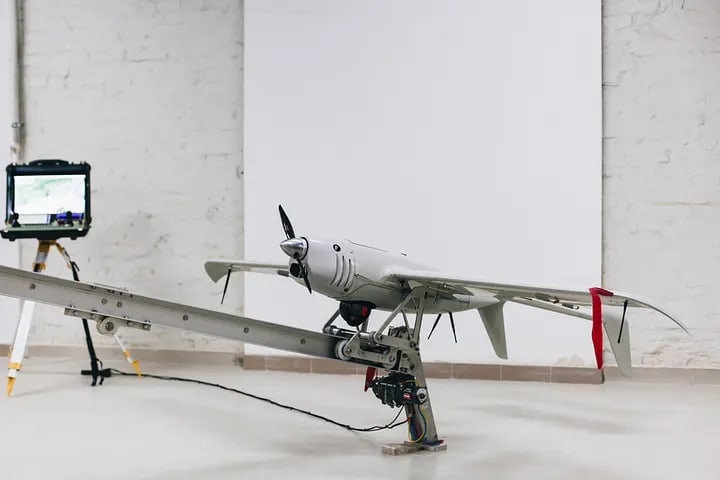
This evolution in tactics allows the Ukrainian military to designate targets from the air, reducing the risk to ground personnel while maintaining the precision of the laser-guided system.
This is why UAVs such as the Raybird are increasingly important. Rather than hovering, the Raybird utilizes a pylon turn or “orbiting” flight profile. The onboard autopilot executes a precise circular path around the target area.
The radius of this circle is calculated to keep the target within the camera’s field of regard while maintaining a safe distance from enemy air defences. This constant motion actually increases survivability, as a stationary hovering drone is much easier to detect and intercept.
The primary technical solution for the “non-hovering” challenge is the gyro-stabilised gimbal. The Raybird is equipped with a high-performance turret (often the Epsilon 140Z or the domestic “Tryzub” module) that features 4-axis stabilisation.
The ability to coordinate between drone operators and artillery batteries has maximised the benefit of the Copperhead in these static defensive environments.
Targeting high-value assets: bunkers, towers, and observation posts
The tactical benefit of the Copperhead lies in its ability to destroy “hard” point targets that conventional artillery would require a massive expenditure of ammunition to neutralise.
In the Ukrainian theatre, these targets typically include observation posts, command and control centres, and electronic surveillance towers. By using a single Copperhead shell, a battery can achieve the same effect as dozens of standard high-explosive rounds.
This reduces the logistical burden on the supply chain and limits the time the artillery pieces must remain stationary and vulnerable to counter-battery fire. The “one shot, one kill” capability is essential when operating in environments where enemy drones are constantly searching for firing positions. Shoot and scoot is a must.
The accuracy of the system is measured in centimetres, allowing for direct hits on reinforced apertures or structural supports.
For example, during the strikes on Russian observation posts, the copperhead was able to strike the small rooms housing sensitive optical and electronic equipment.
When targeting bunkers, the kinetic energy of the heavy shell combined with the shaped-charge warhead is directed at the most vulnerable points of the fortification.
The Copperhead can be fired in two distinct modes: ballistic for clear weather and glide for low-ceiling conditions. While the system is sensitive to environmental factors such as heavy cloud cover or thick smoke, which can obscure the laser beam, the ability to strike stationary high-value assets with such precision remains a vital capability for the Ukrainian military.
It allows for the surgical removal of assets without causing the widespread collateral damage associated with traditional artillery barrages.
Implications for the battlefield and future precision munitions
The successful reintroduction of the M712 copperhead has several implications for the future of artillery warfare.
Firstly, it proves that legacy systems can be revitalised through integration with modern technology, such as reconnaissance drones equipped with laser designators.
This hybrid approach allows for the efficient use of existing stockpiles while providing a level of accuracy that matches newer systems. Ukraine has already begun to realise this potential by developing its own domestic laser-guided shells, such as the Barvinok-K.
Barvinok-K
The Barvinok-K (previously known as the Kvitnyk) follows the same semi-active laser homing philosophy as the Cold War-era M712 Copperhead, it incorporates modern electronics and improved range to meet the demands of contemporary conflict. Produced using modern manufacturing techniques and improved seeker technology, it ensures a sustainable supply of precision munitions that do not rely solely on foreign aid.
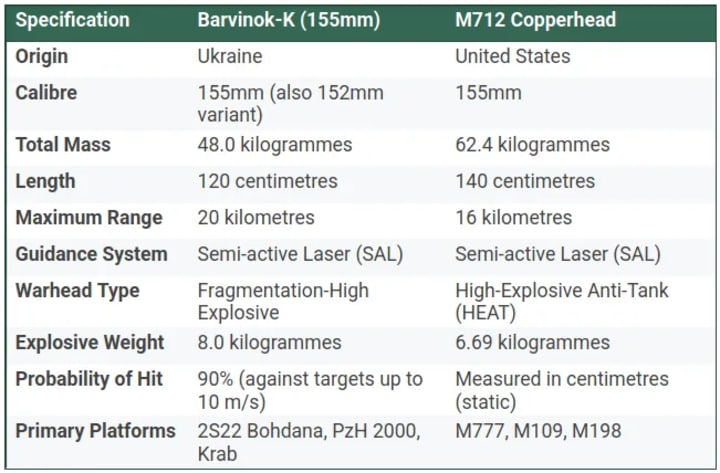
Comparison of specs of Copperhead and Barvinok-K laser guided artillery shells.
Re-evaluation for the future
The vulnerability of GPS-dependent munitions has forced a reconsideration of guidance philosophies. While satellite guidance is easier to implement for long-range strikes against fixed coordinates, the Copperhead demonstrates the enduring necessity of semi-active laser homing for operations in contested electronic environments.
The Barvinok-K builds on this experience. But beyond that, future precision munitions are likely to adopt multi-mode seekers that combine GPS, inertial navigation, and laser homing to ensure reliability across all battlefield conditions.
The Copperhead, once considered an obsolete relic of the Cold War, has instead provided a blueprint for the next generation of resilient, high-precision artillery. Its performance in Ukraine suggests that the era of the laser-guided projectile is far from over.
End
This story was originally published on Medium.
(c) James Marinero 2026. All rights reserved.
About the Creator
James Marinero
I live on a boat and write as I sail slowly around the world. Follow me for a story diet of Tech, AI, Geopolitics and more as the world is rapidly changing. I also write techno thrillers, with six to my name. More of my stories on Medium
Keep reading
More stories from James Marinero and writers in Journal and other communities.
Ukraine's New Weapon: Dropping Swedish Bonus Smart Shells On Hard Targets
There has been a technical and tactical shift in the Ukrainian conflict, where heavy-lift unmanned aerial vehicles (UAVs) have been adapted to deliver 155mm ordnance, including the sophisticated Swedish-designed 155 BONUS sub-munitions.
By James Marinero10 days ago in Journal
Why Ethical SEO Practices Are Essential for Long-Term Drug Rehab Marketing Success
Understanding Ethical SEO in the Context of Drug Rehab Marketing Ethical SEO, in the realm of drug rehab marketing, is the deliberate application of strategies that prioritize transparency, integrity, and compliance with search engine guidelines. Unlike manipulative tactics, ethical SEO seeks to enhance visibility without compromising credibility. For drug rehabilitation centers, where trust and reliability are paramount, employing ethical SEO ensures that prospective clients encounter accurate, supportive information rather than misleading promises. This approach fosters both immediate engagement and sustained growth, establishing a reputation grounded in authenticity. The use of ethically optimized meta descriptions, accurate schema markup, and precise keyword integration exemplifies how a methodical, principled approach can elevate search engine performance without courting risk.
By Fida Hassain3 days ago in Journal




Comments
There are no comments for this story
Be the first to respond and start the conversation.