
Top 9 Guangzhou Fabric Markets and 4 Sourcing Tips
Explore Guangzhou Zhongda and 8 Other Major Fabric Markets


Guangzhou is home to many clothing and fabric markets. In today’s blog, we’ll introduce the top 9 fabric markets and share 4 practical sourcing tips.
1. Zhongda Fabric Market (中大布匹批发市场)
Located in Haizhu District, Guangzhou, next to Sun Yat-sen University, Zhongda Fabric Market is one of the biggest fabric markets in China. Spanning approximately 5 square kilometers with over 23,000 shops, it offers nearly every fabric you can imagine.
Zhongda Fabric Market isn’t a single wholesale market but a massive cluster of over 50 markets, including Zhongda International Textile City. Known for its high efficiency, it’s common to see fabrics purchased in the morning, produced in the afternoon, and shipped the next day.
Beyond fabric wholesale, it also covers garment manufacturing, accessories, logistics, storage, and exhibitions, forming a complete textile and apparel supply chain. Industry insiders often say, “You can’t explore it all in three days and nights,” and some even call it China’s “Milan.”
Open time: 10:00 AM to 7:00 PM. By 6:30 PM, most shops focus on shipping and rarely accept visitors. This is also the busiest time in the market. Conveniently, it’s near Sun Yat-sen University Metro Station.

2. Guangzhou China Fabrics & Accessories Center (广州国际轻纺城)
Guangzhou China Fabrics & Accessories Center is the largest fabric market in Guangzhou and the largest modern textile wholesale market in Asia by single-building area. Covering an impressive 300,000 square meters, it houses over 4,000 shops and offers a wide range of fabrics and accessories.

This market features 9 floors, including 2 underground levels (B2 is for parking).
- B1 Level: Specializes in garment accessories like zippers, buttons, and ribbons, with eight streets. Streets 1-5 focus on zippers and hardware buttons. Streets 6-8 specialize in lace, sequins, and decorative trims.
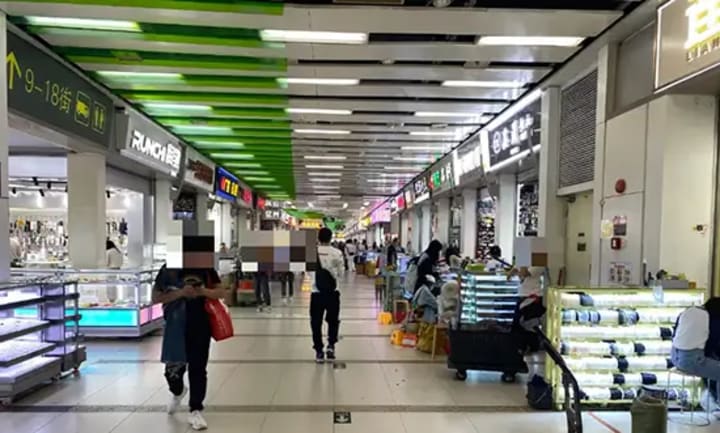
- 1F: Areas A & B: Primarily knitted fabrics, such as striped knits and materials for T-shirts. Areas C-F: Mostly women’s fashion fabrics, like printed stripes and sweatshirt materials.
- 2F-4F: Dedicated to fabric suppliers, with prices and quality increasing on higher floors.
- 5F-6F: Home to the brand fabric exhibition and trade area, showcasing premium materials year-round.
- 7F: Features restaurants and leisure spaces.
Each floor is divided into six zones: A, B, C, D, E, and F. Each zone is designed in a grid-like layout, allowing you to navigate systematically by walking aisle-by-aisle and looping back.
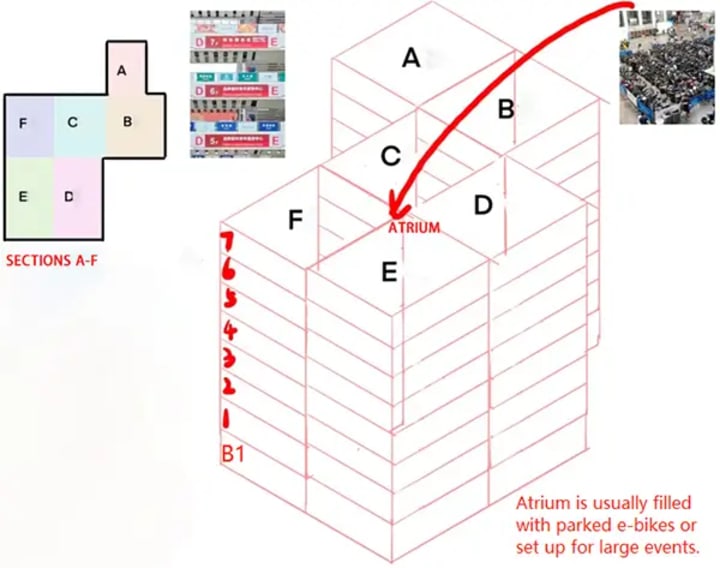
There is a wide variety of fabrics, many of which are relatively new and trendy. It’s a popular venue for major events such as the annual Guangzhou College Students Fashion Week and fabric launches by various brands.
Note that prices at Guangzhou China Fabrics & Accessories Center are relatively higher due to the expensive shop rental fees. For example, a prime ground-floor storefront facing the street can cost nearly 1 million RMB per year in rent. In contrast, nearby markets like Changjiang and Jiuzhou offer more affordable options.
3. Zhongda Jiu Zhou Textile Trade Plaza (中大九洲轻纺广场)
Unlike the high-end positioning of the Guangzhou China Fabrics & Accessories Center, Jiu Zhou Textile Trade Plaza focuses on “absolute value for money” with a style leaning toward export-oriented fabrics. The market houses over 2,000 shops across four floors.

- 1F: Specializes in women’s fashion fabrics, including woven, knitted, striped, plaid, and checked materials. The layout is divided into areas based on a grid system of “latitude and longitude” plus 22 alphabetical zones.
- 2F-3F: Focuses on decorative items like heat transfer prints, rhinestones, and beaded embellishments.
- 4F: Dedicated to lace, embroidery, and other accessories.
4. Guangzhou Changjiang International Textile Center (广州长江国际纺织城)
Located directly opposite Guangzhou China Fabrics & Accessories Center, Changjiang International Textile Center (commonly referred to as “老长江” in Chinese) is known for more affordable prices.
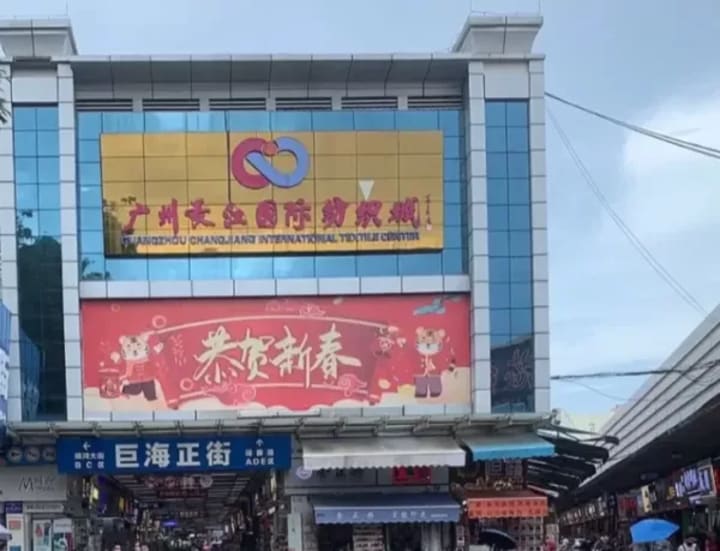
- 1F: Features a variety of woven fabrics, including cotton, linen, suit fabrics, floral prints, chiffon, digital prints, winter fleece, and woolen materials.
- 2F-3F: Specializes in all kinds of fur fabrics.
5. Changjiang (China) Fabircs and Accessories Center 广州长江(中国)中国轻纺城
Located opposite Guangzhou China Fabrics & Accessories Center, the Changjiang (China) Fabrics and Accessories Center, also known as “新长江轻纺城” in Chinese, is divided into 2 zones:
- South Zone: Comprises 10 streets with over 500 shops, focusing on fabrics like corduroy, faux suede, velvet, and various types of fur materials.
- North Zone: Includes 9 streets with 500+ shops, specializing in fashion knit fabrics for items such as T-shirts and sweatshirts. Many streets also offer quick-dry fabrics, ideal for yoga wear and sun-protective sports apparel.

Prices here are affordable, and it’s recommended to compare options across different streets to find the best deal.
6. Zhujiang International Textile Market(珠江国际轻纺城)
Zhujiang International Textile Market caters to various aspects of the textile and garment industry:
- 1F: Focuses on a wide range of knit and woven fabrics.
- 2F-3F: Primarily serves as the fabric storage and warehouse.
- 4F-6F: Houses fashion studios/apparel firms offering design and production services.

7. Zhongda 'Wufeng East' Cloth Market (中大五凤东场)
Located behind the Guangzhou China Fabrics & Accessories Center, Wufeng East Market specializes in various lining fabrics, leather, faux suede, and PU leather, plus some knit fabrics.

8. Guangzhou Ruikang Accessories Lace Market (瑞康花边世界)
Next to Zhongda ‘Wufeng East’ Cloth Market, Guangzhou Ruikang Accessories Lace Market offers a wide variety of accessories at prices more competitive than those on the basement level of the Guangzhou China Fabrics & Accessories Center.
- 1F: Specializes in trims and accessories, including lace, hat cords, and elastic bands.
- 2F: Focuses on lace, embroidered fabrics, and other decorative materials.

9. Hongmian Zhong Da Men (广州红棉中大门)
Hongmian Zhong Da Me or HMZDM is built upon the former “Guangzhou Textile Exchange Park” (广州轻纺交易园), whereby filled with old textile factories. This is an upgraded and modernized fabric wholesale market.
- 1F-3F: Home to fabric manufacturers offering a wide range of wholesale fabric options.
- 4F-7F: Provides one-stop services for design studios and apparel companies, including design, pattern-making, and more.
Four tips for sourcing fabrics in Guangzhou markets.
1. Know fabric measurement units and industry practices.
Knitted fabrics are sold by weight (kilograms/tons), while woven fabrics are sold by length (meters/yards).
Be aware of the common “short measure” practice in the industry. For example, you may order 100 meters but receive only 95 meters. Always ask about short measure upfront or request “net fabric pricing” to ensure accurate billing based on the actual delivered quantity.
2. Bring sample garments when sourcing.
Browsing fabric alone can be overwhelming, and it’s easy to lose track of what you’re looking for. Bringing a sample garment helps you find matching fabrics more efficiently. If you can’t locate an exact match, ask store by store and collect similar swatches (color cards), which are usually free, for comparison later.
3. Confirm details before cutting fabric samples.
Once you’ve identified a suitable fabric, confirm these details before cutting samples:
- Width, weight (GSM), and composition (usually noted on the store’s swatch card).
- Bulk price, availability, and production lead time.
If the fabric is in stock, sample cutting typically takes 30 minutes to 2 hours. For fabrics stored farther away, it may take several hours or until the next day. Usually, 2 meters are cut for sampling, and the price is slightly higher than bulk pricing.
4. Negotiate prices.
For large orders, it’s easy to negotiate a discount of 0.5 RMB per meter. If your order is small, many suppliers may reject you, let alone offer discounts.
Originally published on jingsourcing.com.
About the Creator
Jingsourcing.com
Finding a reliable supplier and ensuring smooth production is challenging. JingSourcing takes care of the entire process, from sourcing suppliers to shipping.
Keep reading
More stories from Jingsourcing.com and writers in Journal and other communities.
How Content Creators Can Save Time With Voice Automation Tools
Is recording, editing, re-recording, and fixing small voice mistakes in your content consuming too much of your time? Well, the creator economy is estimated to reach half a trillion by 2027. As a result, there will be tougher competition, more pressure to stay consistent, and a much higher volume of content being published.
By Dinesh Crest7 days ago in Journal
Is Trump considering a military draft? What Americans Should Know
For many Americans, the idea of a military draft feels like something from history textbooks—associated with World War II or the Vietnam War. But the system that would allow the United States to reinstate a draft still exists today. With rising global tensions and ongoing conflicts around the world, some people have begun asking an important question: Could the U.S. bring back the draft?
By Navigating the Worldabout 23 hours ago in Journal



Comments
There are no comments for this story
Be the first to respond and start the conversation.