
Top 10 Web Development Frameworks
Web application framework
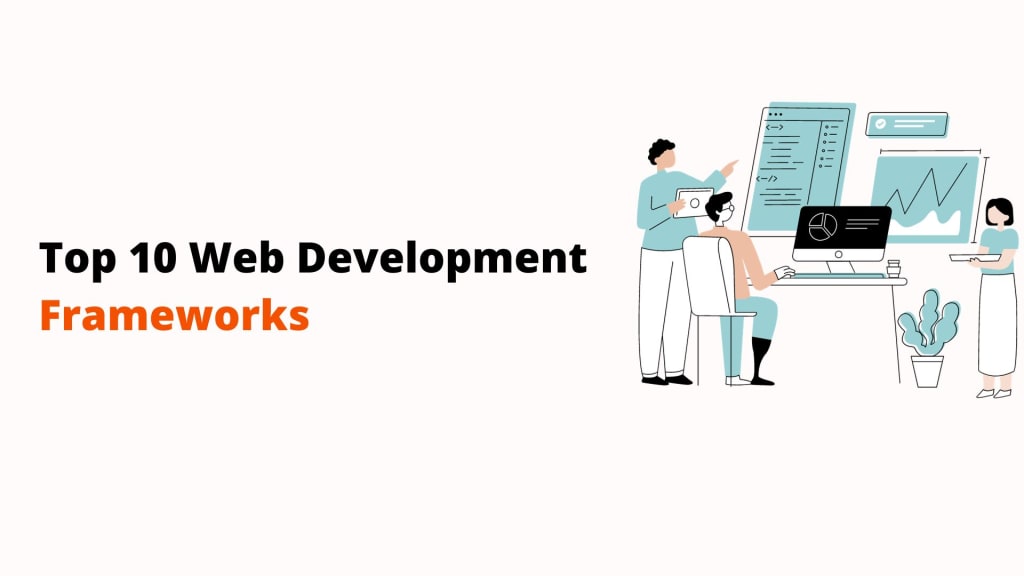
How does a web application framework work? What problems does a framework solve in website development? A framework gives a skeleton with pre-built tools, libraries, and standardized conventions to help developers create complex web applications in an effective way.
Frameworks can come with different features and functionalities for web development, and mobile app development. But once implemented, they make the process fast. Inherent stages of software development life cycle (SDLC) remain same. It starts with idea generation, planning, designing, development, testing, deployment, maintenance, along with implementing first hand feedback of the clients. Frameworks provide templates, libraries, API's, scaffolding to regularize common tasks and reduce the amount of code that you need to write.
Like programming languages for frontend and backend, frameworks for web development need to be chosen with great caution. It is specific to the language, platform, architecture, performance, scalability, compatibility, documentation, community, and the learning curve chosen by the web development companies and their clients.
Considering all of this there is no one size-fits-all solution and web development companies need to evaluate their specific requirements, customize their efforts, goals, and budget and choose a framework that best fits them.
Once you decide to put up with a framework, be on a lookout for their updates and changes. They are constantly evolving and brimming with new features. Every new feature or a functionality is an improvement above the previous one. But it could also indicate a requirement to update the code and dependencies accordingly, to save time and avoid risks.
A correct framework in place can help you save cost, as the same framework might be used across the platforms. Frameworks should be included right from the very beginning to avoid potential costs of breaking existing code or introducing new errors. Website Developers should constantly monitor release notes, change logs, and depreciation warnings of the frameworks and use them in a suitable way. Make use of tools like version control, automation and testing to ease the update process. See if you are able to enclose some compatibility and secure your framework dependencies, along with their licenses and documentation. And of course there should not be any dependencies, if you are looking forward to avoiding errors and code crashes.
Top Web Development Frameworks
Here's a brief overview of some of the top web development frameworks that are being used in 2023, and will be prevalent in 2024:
1. React: A JavaScript library for building user interfaces, known for its component-based architecture and high performance.
2. Vue.js: A progressive JavaScript framework for building user interfaces, emphasizing simplicity and flexibility.
3. Angular: A full-fledged Typescript framework for building dynamic web applications with a focus on modularity and dependency injection.
4. Express.js: A minimalistic Node.js framework for building robust and scalable web applications and APIs.
5. Ember.js: A JavaScript framework that provides a convention-over-configuration approach for building ambitious web applications.
6. ASP.NET: A Microsoft framework for building web applications using C# or VB.NET, often associated with Windows-based server environments.
7. ASP.NET Core: A cross-platform, open-source version of ASP.NET designed for building modern, high-performance web applications.
8. ASP.NET MVC: A part of ASP.NET for building web applications following the Model-View-Controller (MVC) architectural pattern.
9. Laravel: A PHP framework known for its elegant syntax and features like Eloquent ORM and Blade templating. Laravel developers have enjoyed top spot in frontend development since quite some time. It holds a special place in PHP Web frameworks owing to its expressive and elegant syntax. Plus, it has been a top choice of Warner Brothers, The New York Times, Disney, twitch, Bankrate, St. Jude Children's Research Hospital and more firms.
10. Ruby on Rails: A Ruby-based framework that follows the convention-over-configuration paradigm and emphasizes developer productivity.
11. Django: A Python framework for building web applications with a focus on simplicity, reusability, and rapid development. It is a favorite choice of any Django development company.
12. Node.js: A JavaScript runtime that allows server-side development and is often used with frameworks like Express.js.
13. Foundation: A responsive front-end framework for building mobile-first and highly customizable web designs.
14. CakePHP: A PHP framework that simplifies building web applications with features like scaffolding and ORM.
15. Semantic UI: A CSS framework that provides a set of responsive and customizable UI components with a semantic naming convention.
16. Spring Boot: A Java framework that simplifies building production-ready, stand-alone Spring-based applications.
17. AngularJS: The first version of Angular, a JavaScript framework for building dynamic web applications.
18. Spring Frameworks: A collection of Java frameworks within the Spring ecosystem, such as Spring Boot, Spring MVC, and Spring Security.
19. Bootstrap: A popular CSS framework that simplifies responsive web design and provides a set of pre-designed UI components.
20. JQuery: A JavaScript library that simplifies DOM manipulation and event handling in web development.
21. Flask: A lightweight Python web framework for building web applications with minimal overhead.
22. Symfony: A PHP framework known for its flexibility, modularity, and extensive developer tools.
23. Next.js: A React framework for building server-rendered React applications with features like routing and code splitting.
24. React Native: A framework for building mobile applications using React, allowing developers to write code for both iOS and Android platforms. It shares an equal preference alongside ReactJS in any ReactJS development company.
That’s a handful of wisdom!
The trick to implement any of these above frameworks for web app development is to keep it simple. Avoid over-engineering at all costs. Besides this, best web development companies follow best development practices, conventions of the frameworks, and languages, along with code quality tools like formatters, linters, analyzers to write a clean and consistent code.
To implement a new framework, you need to learn new skills and concepts specific to them. You should also learn other similar frameworks, study how will the application work if these two are used in conjunction, learn other technologies relevant or useful for the project, and embrace learning as a continuous and essential part of web development. Next, use collaboration tools like version control, issue tracking, code review, and project management to work effectively and efficiently with frameworks.
Each of these frameworks has its own strengths and use cases, making them suitable for different web development scenarios. Developers choose frameworks based on factors like language preference, project requirements, and development goals.
About the Creator
Keep reading
More stories from Ryan Miller and writers in Journal and other communities.
Best 6 Languages for iOS App Development in 2023
This article will help you get to grips with the basic building blocks of iOS App Development! As you analyze and research about top programming languages for iOS development, you should consider what you wish to achieve – a better return on investment, an application with comprehensive features and high performance, or a combination of all these. Pick one of these options – Building separate native apps for each platform – that allows using features of the platform to the fullest (expensive), or use a single code base and a cross platform integrated development environment that allows building an app with frameworks like React Native, .Net MAUI and can be deployed to multiple platforms (cost-effective). Both approaches are viable and the right choice depends on your priorities. Let's now take a look at the top iOS programming languages and frameworks for each strategy.
By Ryan Miller2 years ago in Journal



Comments
There are no comments for this story
Be the first to respond and start the conversation.