
The US Navy Sacked a Destroyer Captain After a Ship Collision: The Risks of Resupplies at Sea
How a routine replenishment maneuver led to a leadership shake-up and renewed scrutiny of the dangers behind naval logistics at sea.
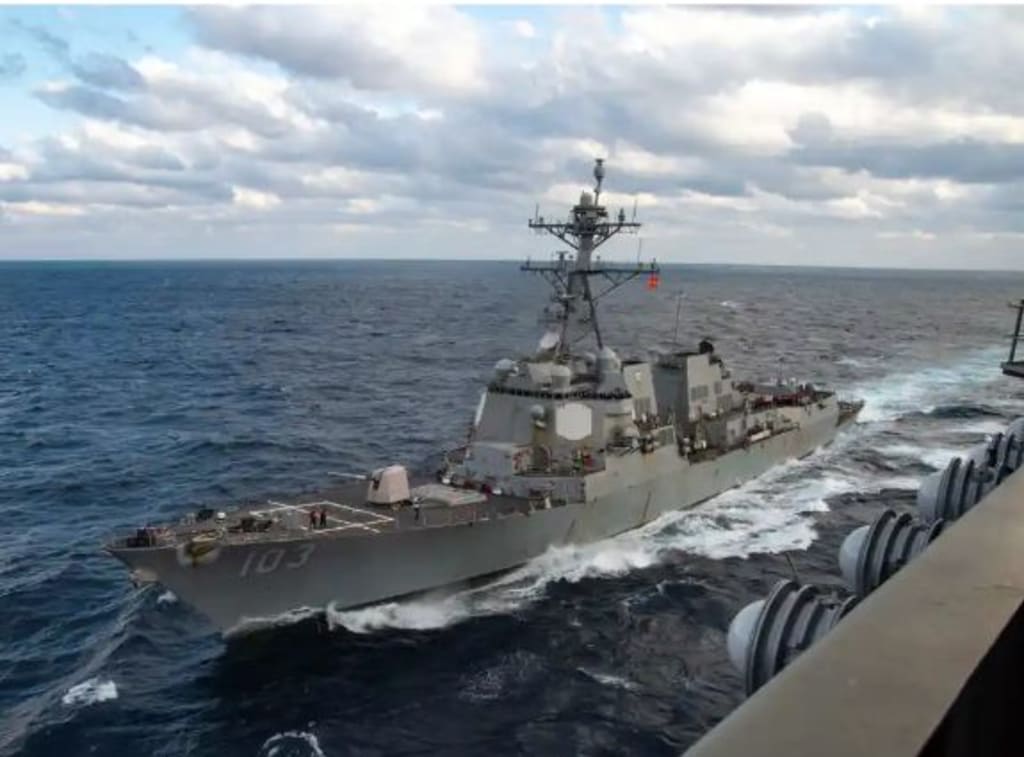
While collisions between naval vessels are relatively rare, they often highlight the hidden risks sailors face even during routine procedures. The event underscores how logistical tasks, not just combat scenarios, can become moments of high danger.
A Routine Operation Turns Critical
Replenishment at sea (RAS) allows warships to receive fuel, ammunition, food, and other supplies without returning to port. This capability is essential for maintaining a global naval presence, enabling fleets to remain operational for extended periods.
However, these operations require two large vessels to sail in extremely close proximity, sometimes just a few dozen meters apart, while maintaining steady speed and course. Even small errors — miscommunication, weather changes, mechanical issues, or human misjudgment — can quickly escalate into a collision.
In the recent case, the destroyer was reportedly conducting or preparing for a resupply maneuver when contact occurred with another vessel. Following a standard review process, Navy leadership removed the commanding officer, citing a loss of confidence in leadership — a phrase commonly used when accountability is assigned after operational failures.
Why Command Accountability Matters
Naval command carries enormous responsibility. A destroyer captain oversees hundreds of sailors, multi-billion-dollar equipment, and mission execution that can influence national security. When incidents happen, even if multiple factors are involved, the commanding officer is ultimately responsible for the ship’s safety.
Relieving a captain does not always imply misconduct or negligence. Instead, it reflects the Navy’s strict culture of accountability. The decision signals that operational standards must be upheld, particularly in situations involving navigational safety.
Historically, leadership changes after collisions are not unusual. Past incidents across various fleets have led to reviews of training, navigation procedures, and fatigue management. Each event becomes a learning opportunity aimed at preventing future accidents.
The Hidden Complexity of Resupply at Sea
To outside observers, resupply may appear straightforward — ships sailing side by side transferring cargo. In reality, it is one of the most technically demanding naval procedures.
Several factors make RAS inherently risky:
1. Tight Maneuvering Space
Warships must maintain precise spacing despite ocean swells, wind, and currents. Minor drift can create dangerous contact between hulls.
2. Continuous Motion
Unlike port transfers, everything happens while both ships are moving, often at speeds exceeding 10 knots.
3. Communication Dependence
Bridge teams, engineering crews, and supply personnel must coordinate perfectly. Misinterpreted commands can lead to sudden course deviations.
4. Mechanical and Environmental Variables
Equipment failures, changing sea states, or unexpected traffic can complicate operations instantly.
Because of these challenges, resupply drills are repeated constantly during deployments. Even experienced crews treat each evolution with caution.
Operational Pressure in a Global Navy
Today’s naval forces operate in a more demanding environment than ever. Warships are deployed across multiple regions simultaneously — from deterrence patrols to humanitarian missions. Sustaining that presence requires frequent at-sea replenishment.
This operational tempo increases fatigue risks. Long deployments, irregular sleep cycles, and high workload can affect decision-making on the bridge. Analysts often point out that collisions are rarely caused by a single mistake; instead, they emerge from layers of small issues aligning at the wrong moment.
The recent destroyer collision has reignited discussion about workload management, training intensity, and the balance between readiness and crew wellbeing.
Technology Helps — But Doesn’t Remove Risk
Modern warships rely on advanced radar, automated navigation systems, and precision positioning tools designed to reduce human error. Some replenishment ships even use computerized systems to maintain steady course and distance.
Yet technology cannot fully replace seamanship. Officers must interpret data, anticipate vessel movement, and react to unpredictable ocean conditions. When two ships operate close together, human judgment remains the most critical safety factor.
This is why the Navy continues emphasizing traditional navigation skills alongside technological upgrades.
Lessons for Naval Strategy
Beyond the immediate personnel change, the incident highlights broader strategic realities. Logistics is the backbone of naval power. A fleet that cannot resupply efficiently cannot remain forward-deployed.
Military planners increasingly recognize that supply operations themselves are strategic targets in potential conflicts. This adds another layer of pressure to perform replenishment safely while maintaining readiness.
The collision serves as a reminder that sustaining operations is just as complex — and risky — as combat missions.
Safety Reviews and Training Adjustments
Following incidents like this, the Navy typically conducts detailed investigations examining navigation logs, crew actions, equipment performance, and environmental conditions. The findings often lead to procedural updates or additional training.
Possible areas of focus include:
Bridge resource management practices
Fatigue mitigation policies
Simulator-based replenishment training
Communication protocols between ships
Equipment reliability assessments
These reviews aim not to assign blame alone but to strengthen systemic safety.
The Human Element at Sea
Behind every naval headline are sailors performing demanding tasks far from home. Replenishment operations require trust — between ships, between departments, and between leaders and crews.
When a collision occurs, it affects morale as well as operational planning. Removing a commanding officer can be disruptive, yet it also reinforces a culture where safety is non-negotiable.
For crews, the message is clear: routine does not mean risk-free.
A Reminder of Maritime Realities
The destroyer collision and subsequent leadership change illustrate a fundamental truth about naval operations: even everyday procedures carry significant danger. Maintaining global presence depends not only on powerful ships and advanced weapons but also on flawless execution of logistical tasks.
Resupply at sea remains one of the defining capabilities of modern navies — and one of the most challenging. As investigations continue and lessons are absorbed, the incident will likely influence training, leadership expectations, and operational planning.
Ultimately, the event is less about a single captain and more about the delicate balance between speed, readiness, and safety on the world’s oceans.
About the Creator
~ Fired ~
— Ai Intrusion ~ Are you Next ~ Is Ai Evolution after your job? — Few workplaces haven't been affected. Ai is in supermarkets, at doctors' offices, and even monitoring farms. I just can't think of anything this machine is not getting into, can you? For instance: Education ~ Law and Tech jobs will one day have a major influence or be taken over by these inanimate machines, with accuracy and vigor. From mechanics' diagnoses to a wide variety of everyday jobs, including fast food workers, with this input having the ability to cut their unnecessary work hours. I'm certain all of us have been touched by this with our short stories and colorful headings, have you? Even comments are very questionable 'Non-Robot' insertions.
By Jay Kantor24 days ago in Journal
The Invisible Government
By any conventional definition, governments rule nations. They levy taxes, pass laws, regulate markets, and enforce environmental protections. Yet in the 21st century, multinational corporations often exert influence that rivals—and sometimes eclipses—that of elected officials. Through lobbying networks, aggressive tax strategies, global labor arbitrage, and environmental maneuvering, the world's largest companies have become powerful architects of the global order.
By Rachid Zidine5 days ago in Journal
At My Wits’ End
Life is about taking out the trash and calling it trash because you have every reason to. It wasn't meant to be linear, they say. But the times you tried to make it straight led to problems, and you didn’t have the tools to put any of it to use. You don't put your right shoes on the right feet; you put the left shoes on the left feet. The grey hardened slab will trip you up anyway.
By Caitlin Charlton6 days ago in Humans




Comments
There are no comments for this story
Be the first to respond and start the conversation.