
The Story of Us: Evolution of Humans!
From Our Ancestral Roots to Modern Society
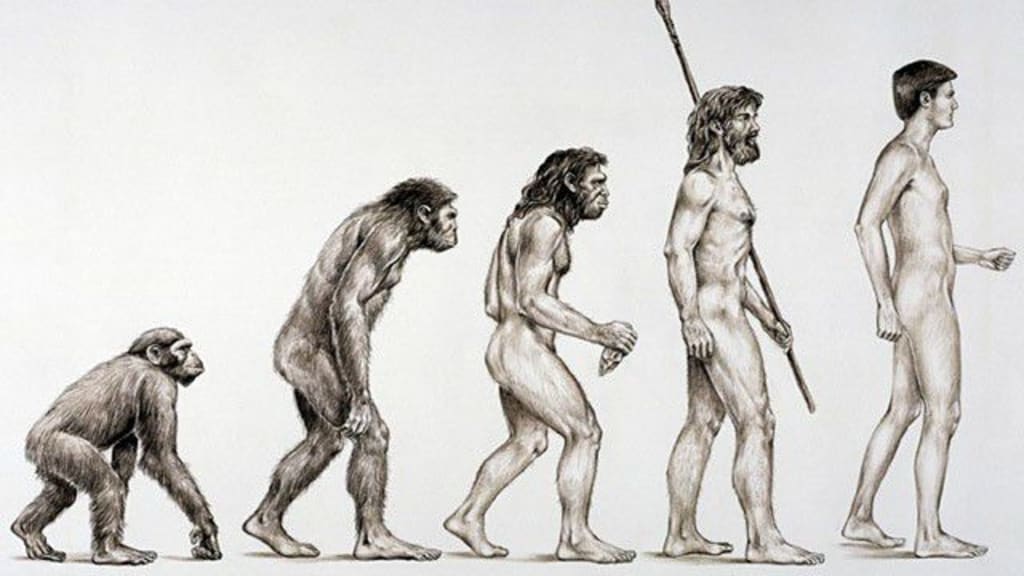
The story of human evolution is a long and complex one, spanning millions of years and countless generations of our ancestors. From the earliest primates to the modern humans we know today, the evolution of our species is a fascinating and awe-inspiring journey through time.
The earliest primates, known as prosimians, first appeared in the fossil record over 60 million years ago. These small, tree-dwelling creatures were the first mammals to develop features such as forward-facing eyes and opposable thumbs, which would later prove crucial to the evolution of primates and ultimately humans.
Over the course of millions of years, primates continued to evolve and diversify. By around 20 million years ago, the first true monkeys had emerged, with a more complex brain and a greater capacity for problem-solving and tool use. These early primates were still far removed from the modern humans we know today, but they laid the foundation for the evolutionary path that would eventually lead to our species.
Around six million years ago, the first hominids, or early human ancestors, began to emerge in Africa. These early hominids, such as Australopithecus afarensis, were still very primitive in their anatomy and behavior, but they possessed several key features that set them apart from earlier primates. These included bipedalism, or the ability to walk on two legs, and an increased brain size and capacity for social interaction and communication.
Over the course of several million years, hominids continued to evolve and diversify, with different species branching off and developing unique adaptations for survival in their respective environments. Some, such as the robust australopithecines, developed strong jaws and teeth for chewing tough vegetation, while others, such as Homo erectus, developed more efficient tool-making techniques and the ability to harness fire for cooking and warmth.
Around 200,000 years ago, anatomically modern humans, or Homo sapiens, emerged in Africa. These early humans possessed several key features that set them apart from earlier hominids, including a larger brain size, a more complex social structure, and the ability to engage in abstract thought and symbolic expression.
Over the course of tens of thousands of years, Homo sapiens continued to spread and diversify, eventually populating virtually every corner of the globe. Along the way, they developed a vast array of cultural, linguistic, and technological innovations, from agriculture and writing to the printing press and the internet.
Today, modern humans are the dominant species on the planet, with a population of over seven billion and a level of technological and cultural sophistication that would have been unimaginable to our earliest ancestors. Yet despite all of our progress and achievements, we are still just one small chapter in the ongoing story of human evolution, with countless new discoveries and revelations still waiting to be made.
It's important to note that the story of human evolution is not a linear one, but rather a complex web of interrelated species and genetic lineages. There were multiple hominid species that existed alongside each other at various points in time, with some species surviving and thriving for thousands of years while others went extinct.
One of the most intriguing aspects of human evolution is the question of how and why Homo sapiens emerged as the dominant species. While there are many theories about what set us apart from our early human ancestors, some of the most commonly cited factors include our ability to adapt to a wide range of environments, our capacity for abstract thought and problem-solving, and our social and cooperative nature.
Another fascinating aspect of human evolution is the role that culture and technology played in shaping our species. From the development of language and art to the invention of agriculture and the creation of complex societies, humans have demonstrated an unparalleled capacity for innovation and creativity throughout our history.
In conclusion, the evolution of humans is a complex and fascinating story that spans millions of years and countless generations of our ancestors. From the earliest primates to the modern humans we know today, the story of our species is one of adaptation, innovation, and survival in the face of constantly changing environments and challenges. As we continue to explore and uncover new evidence about our evolutionary past, we can gain a greater understanding and appreciation of the incredible journey that has brought us to where we are today.
About the Creator
Twitter founder Jack Dorsey fired 4,000 people over AI and issued a warning to the business world.
On Thursday, February 26, Jack Dorsey cofounder of Twitter and CEO of Block, one of the world's largest digital payments companies published an internal memo that went viral within hours. Block, the company that operates Square, Cash App, and its Bitcoin ecosystem, was laying off more than 4,000 people: almost half of its global workforce. The stated reason wasn't a crisis. It was artificial intelligence.
By Omar Rastelli4 days ago in Journal
Becca
"Everything is so... flat." Denille said stupidly as she looked around her new neighborhood. She looked around at the muted desert where even the smallest sign of life seemed to have given up. The plant life was shrubs that were half cooked by the heat and where there should have been a lawn, a mess of white rocks laid glistening in the sun. Even the sky looked stretched thin, like the sun had ironed it smooth. She’d moved from Riverside, where at least there were hills, but here in Barstow, everything felt baked and brittle.
By Sara Wilson7 days ago in Fiction



Comments
There are no comments for this story
Be the first to respond and start the conversation.