
The Role of OpenAI in Business Innovation in 2026
OpenAI in Business Innovation


By 2026, artificial intelligence is no longer an experimental add-on inside organizations. It has become infrastructure. Across industries, companies are building workflows, customer journeys, and product strategies around AI systems that generate content, automate analysis, assist decision-making, and accelerate execution. At the center of this shift is OpenAI, whose models and tools are shaping how businesses rethink productivity, creativity, and scale.
The role of OpenAI in business innovation in 2026 goes beyond automation. It is about redefining how companies operate, compete, and grow in a digital-first economy.
AI Adoption Is Now Mainstream
The first graph above shows the steady rise in AI adoption from 2023 through 2026. By 2026, adoption has moved from early experimentation to widespread operational integration. Businesses are no longer asking whether to use AI. They are asking how deeply to integrate it.
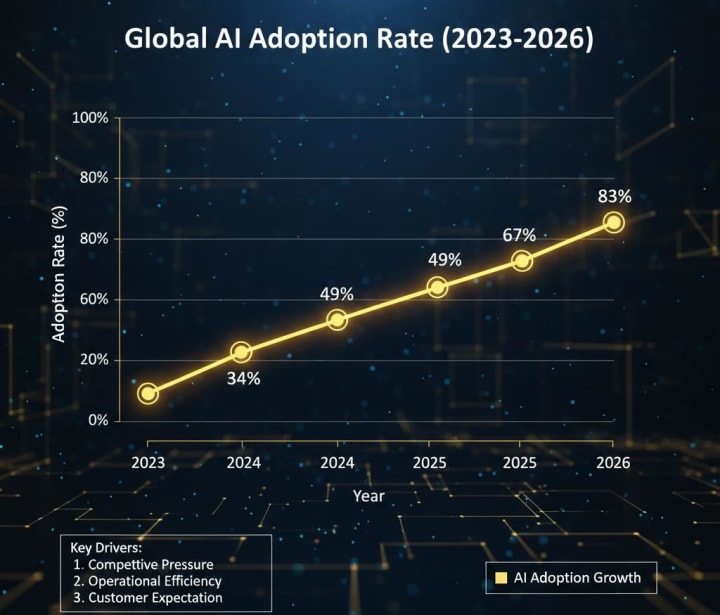
OpenAI’s technology plays a major role in this transition. Its models are embedded into enterprise tools, SaaS platforms, internal dashboards, and customer-facing applications. From drafting reports to generating video content, AI has become part of the daily workflow.
This adoption is driven by three factors:
- Competitive pressure
- Operational efficiency
- Customer expectation
Companies that fail to integrate AI tools risk falling behind in speed, personalization, and cost management.
Transforming Core Business Functions
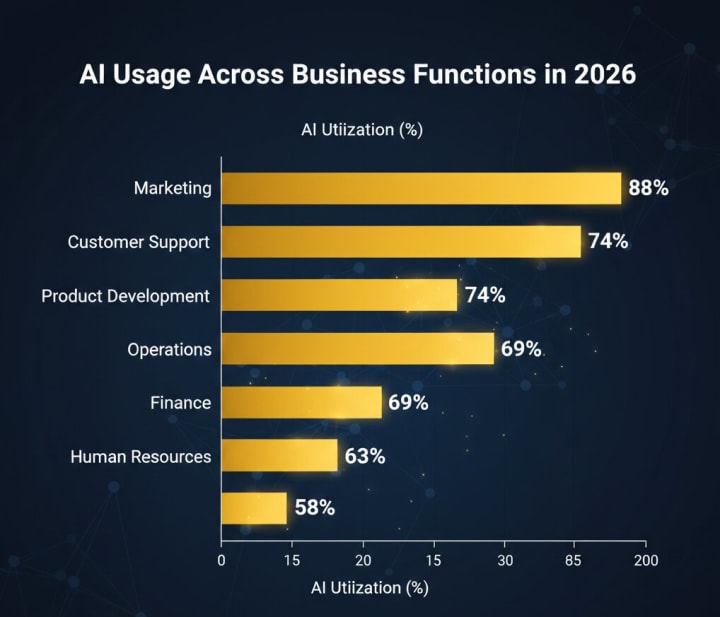
The second graph illustrates how AI is distributed across business functions in 2026. Marketing and customer support lead the way, but product development, operations, and HR are rapidly catching up.
Marketing and Content Creation
Marketing teams use OpenAI tools for campaign ideation, SEO content generation, customer segmentation analysis, and personalization at scale. What once required large teams can now be handled by leaner departments supported by AI-driven research and drafting tools.
Video generation capabilities, including tools like Sora 2, are expanding the way brands produce visual content. Instead of hiring full production crews for every concept, companies can prototype campaigns quickly, test variations, and scale storytelling across platforms.
This shift does not eliminate human creativity. It enhances it. Teams move faster from concept to execution, using AI as a collaborator rather than a replacement.
Customer Support and Conversational AI
In 2026, AI-powered assistants handle a significant share of customer inquiries. OpenAI-driven systems manage tier-one questions, guide troubleshooting, and escalate complex cases intelligently.
The result is:
- Faster response times
- Lower support costs
- Higher customer satisfaction
Instead of replacing support teams, AI allows human agents to focus on complex emotional interactions and high-value cases.
Product Development and Innovation
Product teams use OpenAI models for rapid prototyping, user feedback analysis, and feature brainstorming. Developers leverage AI-assisted coding tools to accelerate development cycles.
Generative video capabilities, again including platforms like Sora 2, are being used in product demos, virtual walkthroughs, and immersive marketing experiences. This reduces time-to-market and improves investor and customer presentations.
The innovation cycle shortens dramatically when ideation, simulation, and iteration can happen in hours rather than weeks.
ROI and Business Impact
The third graph shows estimated ROI growth from AI integration between 2024 and 2026. Returns are accelerating as companies move from basic implementation to strategic alignment.
Early adopters saw efficiency gains. Mature adopters are now seeing revenue growth driven by:
- Personalized customer experiences
- Faster product launches
- Smarter pricing strategies
- Data-driven decision making
OpenAI’s impact is most visible where AI is integrated into business strategy, not just daily tasks.
Enhancing Decision Intelligence
Beyond automation, OpenAI tools improve decision quality. Businesses now use AI to:
- Analyze large datasets in real time
- Predict customer behavior patterns
- Simulate market outcomes
- Identify operational bottlenecks
Executives in 2026 rely on AI dashboards that summarize trends and highlight risks before they escalate. Instead of reactive management, companies move toward predictive leadership.
The ability to process unstructured data such as emails, feedback, reports, and social conversations gives businesses a clearer view of their environment.
Democratizing Creativity
One of the most profound changes in 2026 is how AI democratizes creative production. Smaller companies can now compete with larger enterprises in branding and content.
Tools like Sora 2 enable businesses to create high-quality video concepts without traditional production budgets. Marketing teams can test visual narratives, build explainer content, and design immersive storytelling campaigns rapidly.
This levels the playing field. Innovation is no longer limited to companies with large creative departments. It becomes accessible to startups and small businesses.
Operational Efficiency at Scale
OpenAI’s role in operational innovation is just as important as its creative applications. In logistics, finance, and supply chain management, AI systems analyze patterns and recommend optimizations.
Examples include:
- Inventory forecasting
- Automated contract review
- Fraud detection
- Dynamic workforce scheduling
These systems reduce waste and improve resource allocation. Companies operate leaner while maintaining higher output.
Efficiency gains are particularly important in uncertain economic conditions. AI allows organizations to adapt quickly without massive restructuring.
Ethical and Governance Considerations
As AI becomes deeply embedded in operations, governance becomes critical. Businesses in 2026 must address:
- Data privacy
- Bias mitigation
- Transparent decision-making
- Responsible deployment
OpenAI’s enterprise frameworks increasingly emphasize safety, monitoring, and human oversight. Organizations that innovate responsibly gain trust, which becomes a competitive advantage.
AI-driven innovation without governance risks reputational damage. In contrast, companies that align innovation with compliance build long-term credibility.
Workforce Evolution
AI integration is not eliminating work. It is reshaping it.
Employees in 2026 are expected to:
- Collaborate with AI tools
- Interpret AI outputs critically
- Focus on strategic thinking
- Enhance emotional intelligence
Routine tasks decline, but creative, strategic, and relational roles expand. Businesses investing in AI literacy training see stronger adoption and higher ROI.
OpenAI’s influence extends into corporate education, where internal AI assistants help employees learn faster and access knowledge instantly.
Competitive Advantage in 2026
The companies leading in 2026 are not those using AI occasionally. They are those building AI into their core operating model.
OpenAI’s ecosystem supports:
- API integrations
- Enterprise customization
- Multimodal capabilities
- Scalable deployment
Organizations that treat AI as a strategic asset outperform those treating it as a productivity shortcut.
The future of business innovation is not about replacing people. It is about amplifying capability.
Looking Ahead
As 2026 unfolds, OpenAI’s role in business innovation continues to expand. From conversational intelligence to generative video, the tools are becoming more integrated and more intuitive.
Businesses are moving beyond experimentation toward systemic transformation. AI is no longer a department initiative. It is a company-wide framework.
The trajectory shown in the adoption and ROI graphs indicates that AI-driven innovation is still accelerating. The next phase will likely focus on deeper personalization, more autonomous systems, and stronger governance standards.
OpenAI stands at the center of this evolution, shaping how organizations think, build, and compete.
FAQs
How is OpenAI driving business innovation in 2026?
OpenAI provides AI tools that enhance automation, creativity, decision-making, and operational efficiency across departments.
What industries benefit most from OpenAI tools?
Marketing, customer support, product development, finance, healthcare, and logistics are among the biggest adopters.
How does Sora 2 contribute to business innovation?
Sora 2 enables rapid video content creation, helping companies prototype campaigns, product demos, and branded storytelling efficiently.
Is AI replacing human workers in 2026?
AI is reshaping roles rather than replacing them, shifting focus toward strategic thinking and creative collaboration.
What challenges come with AI integration?
Governance, data privacy, ethical deployment, and workforce training are key considerations for sustainable innovation.
About the Creator
Scott Andery
Scott Andery is a Marketing Consultant and Writer. He has worked with different IT companies and he has 10+ years of experience in Digital Marketing.
Keep reading
More stories from Scott Andery and writers in Journal and other communities.
Expert Tips for Enhancing Cloud Computing Security
As businesses increasingly migrate their operations to the cloud, securing cloud environments has become a critical priority. Cloud computing offers unmatched flexibility, scalability, and cost efficiency, but it also introduces unique security challenges that can compromise sensitive data, disrupt operations, and damage reputations. Implementing robust cloud computing security measures is essential for organizations of all sizes. This article explores expert insights and actionable cloud computing security tips to help protect your business in the cloud era.
By Scott Andery26 days ago in Journal
~ Fired ~
— Ai Intrusion ~ Are you Next ~ Is Ai Evolution after your job? — Few workplaces haven't been affected. Ai is in supermarkets, at doctors' offices, and even monitoring farms. I just can't think of anything this machine is not getting into, can you? For instance: Education ~ Law and Tech jobs will one day have a major influence or be taken over by these inanimate machines, with accuracy and vigor. From mechanics' diagnoses to a wide variety of everyday jobs, including fast food workers, with this input having the ability to cut their unnecessary work hours. I'm certain all of us have been touched by this with our short stories and colorful headings, have you? Even comments are very questionable 'Non-Robot' insertions.
By Jay Kantor17 days ago in Journal
Designing Adaptive Robotics for Evolving Industrial Environments
Automation in a Dynamic World Automation is no longer defined by repetitive, preprogrammed motion. Modern industrial systems are expected to operate in environments that change constantly. Factory layouts shift, materials vary, and human workers move unpredictably within shared spaces. Robotics must now function with awareness, adaptability, and resilience.
By Michael Mollodabout 10 hours ago in Journal




Comments
There are no comments for this story
Be the first to respond and start the conversation.