
The Power of Protest in American History
From Revolution to Hashtags—How Dissent Shapes Democracy

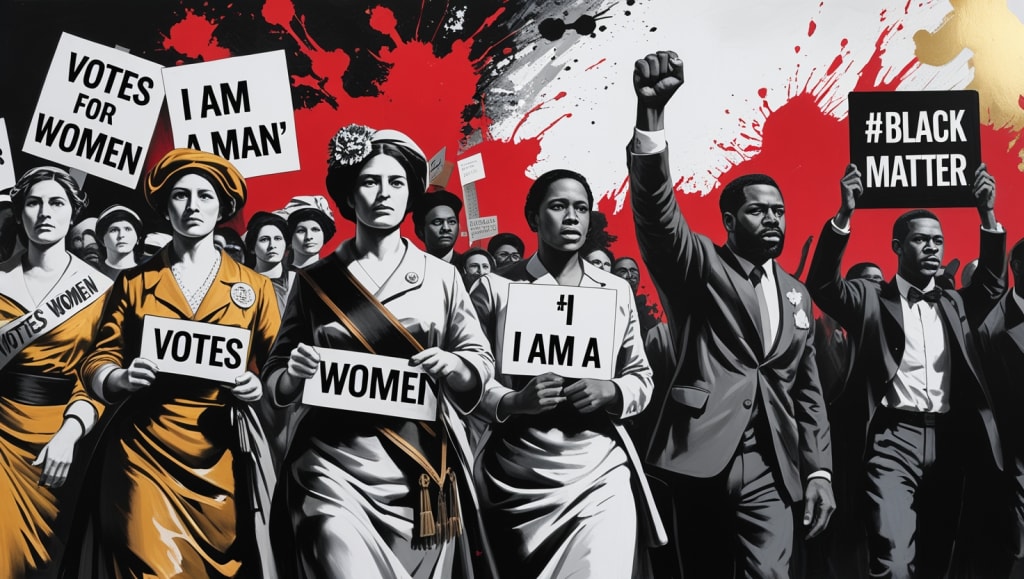
The Rhythm of Rebellion
America was born from protest. The Boston Tea Party, abolitionist pamphlets, and Stonewall riots are not mere footnotes—they are the heartbeat of a nation that reinvents itself through dissent. Protest is America’s oldest tradition, a tool to dismantle injustice and reimagine freedom. This article (penned with grit, not gigabytes) traces how grassroots movements, from the 18th century to today, have turned whispers of discontent into roars for change.
I. Foundations of Fury: Revolt in the Revolutionary Era
1. The Boston Tea Party (1773): Performance Art as Politics
A band of colonists, disguised as Mohawk warriors, dumped 342 chests of British tea into Boston Harbor. More than a tax protest, it was a symbolic strike against monarchy’s chokehold. The act proved that rebellion could be both theatrical and strategic—a blueprint for future movements.
2. Abolitionist Underground: Ink, Quilts, and Freedom Songs
Long before TikTok, abolitionists used pamphlets like The Liberator and quilt patterns as coded maps to guide enslaved people north. Harriet Tubman’s spirituals, sung in fields, doubled as covert instructions. These acts fused creativity with resistance, showing that art could be a weapon.
II. Battles for the Ballot: Suffrage and Civil Rights
1. Suffragists’ Suffering: Hunger Strikes and Silent Sentinels
In 1917, Alice Paul and the National Woman’s Party picketed the White House for 18 months. Arrested protesters endured force-feeding in prison, turning their bodies into billboards for equality. Their relentless visibility forced Woodrow Wilson to endorse the 19th Amendment—proof that endurance outlasts oppression.
2. Selma’s Bloody Sunday (1965): Bridges and Broken Bones
When John Lewis and 600 marchers crossed the Edmund Pettus Bridge, Alabama state troopers attacked with clubs and tear gas. Broadcast on national TV, the brutality galvanized support for the Voting Rights Act. The bridge, named for a Klan leader, became an ironic monument to progress.
III. Modern Movements: From Streets to Screens
1. AIDS Activism: Silence = Death
In the 1980s, groups like ACT UP stormed the NIH and St. Patrick’s Cathedral, demanding research and compassion for AIDS patients. Their pink triangle logo and die-ins forced a bigoted government to act. Their legacy lives in movements like #Pride and Medicare for All campaigns.
2. Standing Rock and #NoDAPL (2016): Water as Sacred Protest
Thousands of Indigenous activists and allies camped for months to block the Dakota Access Pipeline. Livestreams of attack dogs and water cannons sparked global solidarity, merging ancient stewardship with digital advocacy. The fight, though unresolved, redefined environmental justice as a human right.
3. #BlackLivesMatter: Hashtags to Highway Shutdowns
Born in 2013 after Trayvon Martin’s killer walked free, BLM evolved from a tweet into a global reckoning. The 2020 uprising after George Floyd’s murder saw murals replace Confederate statues and corporations awkwardly pledge “allyship.” Yet organizers stress: true change requires defunding police, not performative hashtags.
Conclusion: The Unfinished Symphony
Protest is not a phase—it’s a perpetual work in progress. For every victory (marriage equality, OSHA laws), there’s backlash (voter suppression, Roe’s fall). Today’s activists inherit the tools of their ancestors: pamphlets become podcasts, sit-ins become TikTok storms.
The lesson? America’s soul isn’t found in its statues or stock markets, but in its streets. As long as inequality exists, there will be fists in the air, phones recording, and voices chanting, “This is what democracy looks like.”
About the Creator
Shohel Rana
As a professional article writer for Vocal Media, I craft engaging, high-quality content tailored to diverse audiences. My expertise ensures well-researched, compelling articles that inform, inspire, and captivate readers effectively.
Keep reading
More stories from Shohel Rana and writers in Journal and other communities.
Author’s Advice
If you would’ve asked me 20 years ago did I know I’d become a writer and an author, I would’ve said “nope, ain’t happening”. As fate would have it I did become an author and I can honestly say I’m loving it so far. It really does feel good to be a writer. I’ve learned a lot on this journey and I feel like with even me being as new to this world as I am, there’s some wisdom I need to share with every other aspiring author.
By Joe Patterson4 days ago in Journal
Alopecia Isn't Just Hair Loss...
I don't know whether I've said this in passing comment before on my reviews, but I'm pretty sure it's somewhere: for the past few years I've suffered with alopecia and it has increased in its charge against the system in the last 18 months for reasons I'm not willing to discuss right now. But in the last 18 months alone I have had seven blood tests, two dermatological scans and most recently, you guessed it, another blood test. So, we all know that alopecia is all about hair loss and as you can imagine, I have lost an awful lot of hair. In my first struggle with alopecia it was clumps of my hair that came out, but more recently it was a more 'drop everything' approach where I would more than often wake up with less and less hair every day until finally - yes, I have no hair. It's all wigs.
By Annie Kapur5 days ago in Journal




Comments
There are no comments for this story
Be the first to respond and start the conversation.