
The Pit Season 2 Episode 1 Review: Clocking Back Into Chaos
Is there going to be the Pitt season 2?

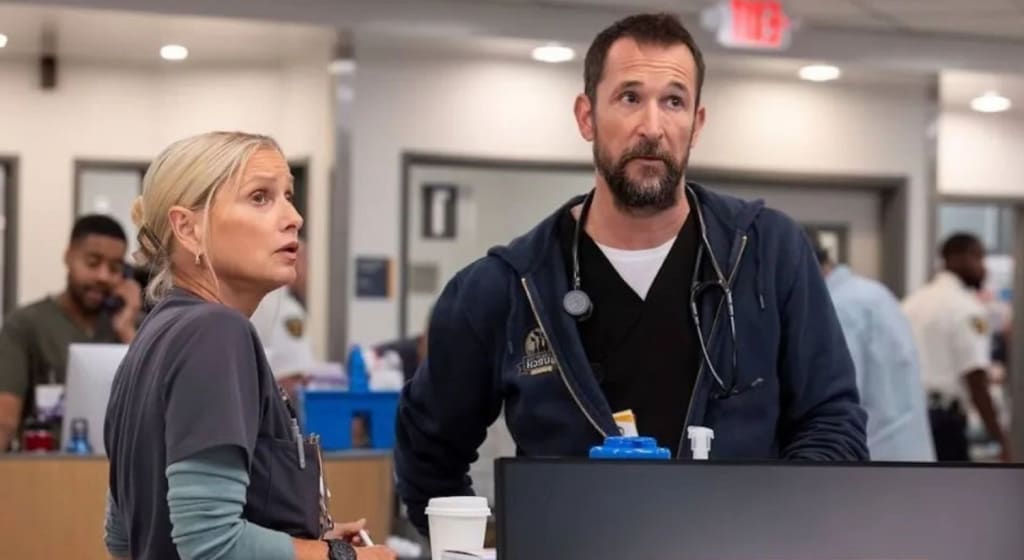
The multi-award-winning series The Pit has officially returned for season two, and it wastes absolutely no time throwing us back into the deep end. The season premiere drops us right into Dr. Robbiey’s final shift before he heads off on a months-long sabbatical—and this isn’t just any shift.
Set across a relentless 15-hour window on the 4th of July, the episode immediately signals that the pit is about to descend into full-blown chaos.
This opening chapter focuses on establishing the environment, reintroducing key players, highlighting new character dynamics, and laying the groundwork for the stories that will unfold over the rest of the season. It also leaves us with a chilling cliffhanger involving Dr. Al-Hashimi and a mysterious baby, one that lingers long after the credits roll.
So with that, let’s clock into the shift and break down everything that matters from The Pit Season 2, Episode 1.
Spoilers ahead.
Dr. Robbiey’s Internal Conflict Sets the Tone
From the very first episode, it’s clear that Dr. Robbiey’s arc is going to be central this season. Two major sources of tension are already weighing heavily on him.
The first is the arrival of Dr. Al-Hashimi, whose approach immediately clashes with the established way things are done in the pit. She’s not just new—she’s actively pushing change. Whether it’s introducing ideas like a patient passport, altering how students are addressed, or even suggesting renaming the pit itself, she’s stepping into sacred territory.
Robbiey makes it very clear—politely but firmly—that he wants her to keep her distance for now.
The pit isn’t just a workplace to him. It’s a living, breathing ecosystem built on shared trauma, experience, and trust. You don’t walk in and overhaul it overnight. And even though he’s about to step away, Robbiey clearly fears that everything he’s helped build could become unrecognizable by the time he returns.
The Brewing Tension Between Robbiey and Dr. Al-Hashimi
The friction between these two feels deliberate and volatile. Dr. Al-Hashimi isn’t portrayed as outright unlikable, but her presence undeniably disrupts the rhythm and tone of the pit.
Robbiey sees the pit as a family—everyone in it together, surviving the worst moments side by side. Al-Hashimi, on the other hand, represents structure, reform, and clinical distance.
If she pushes too far, this conflict feels like it could explode—and soon.
Frank Langdon’s Return and the Weight of the Past
The second source of Robbiey’s turmoil comes in the form of Frank Langdon, who has returned after time away in rehab and confronting his addiction.
Frank’s re-entry into the pit is uncomfortable by design. Everyone reacts to him differently. Some are guarded. Some are cold. Some are quietly supportive.
We see Frank actively seeking forgiveness, most notably when he apologizes to Louise. But symbolically, his career has been reset. The moment that drives this home is when he’s assigned a low, undesirable locker, forcing him to quite literally start from the bottom again.
His body language says everything—he feels watched, judged, and desperate to prove himself.
Robbiey, however, isn’t ready to forgive. He can’t move past what happened, and that unresolved resentment feels like it’s going to sit at the very heart of this season’s conflict.
Robbiey’s Last Shift Feels Heavier Than Ever
This is Robbiey’s final shift, and you can feel the weight of it in every interaction.
On one side, he’s dealing with the growing headache caused by Dr. Al-Hashimi. On the other, he’s navigating the pit while actively trying to avoid Frank altogether.
Balancing those tensions during what’s shaping up to be the most chaotic shift imaginable is no small task—and it’s already taking its toll.
Why Was Dr. Al-Hashimi So Shocked by the Baby?
The episode’s biggest cliffhanger comes at the end of hour one.
After test results come back, Dr. Al-Hashimi looks down at the baby found in the bathroom—and freezes. Her expression isn’t just surprise. It’s shock, grief, and something deeply personal.
The atmosphere in that moment is heavy. Somber. Unsettling.
Naturally, the question becomes: what was on that paper?
There are countless possibilities, but one compelling theory is that this moment is meant to humanize Dr. Al-Hashimi. Perhaps the results connect to a past trauma—a child she lost, a niece or nephew with a similar condition, or an experience she’s never fully processed.
Maybe this abandoned baby reopens a wound she thought had healed. A reminder of something she couldn’t save. Or someone she loved but lost.
If the show wants us to see her as more than just a disruptor, this could be the emotional doorway.
A Strong, Immersive Season Premiere
Overall, this was an incredibly strong opening episode.
The Pit excels at immersion, and this episode delivers panic, fear, urgency, learning, and heartbreak in equal measure. The chaos feels authentic, like we’re only seeing a small slice of what these professionals endure every single day.
One thing that’s impossible to ignore is the gore. The blood, injuries, and medical detail are intense—almost uncomfortably so. Watching this early in the morning was not an easy experience.
But that realism is also what sets the show apart. It doesn’t shy away from the physical reality of the job, and that honesty commands respect.
The Young Girl’s Story Is Already Devastating
One of the most emotionally difficult storylines involves the young girl covered in bruises. Even in just one episode, it’s deeply upsetting, and it looks like the narrative may head toward some very dark territory involving her father.
If it does, it will need to be handled with care. But already, it highlights the painful reality that ER staff face—having to follow procedure, avoid assumptions, and move step by step toward the truth, no matter how obvious it may feel.
Joy Is Instantly Hard to Like
One character who immediately rubbed me the wrong way is Joy.
Her attitude is abrasive, dismissive, and at times downright cruel. Comments like “he’s dead anyway” about the stabbing victim, or her lack of respect when an elderly man passes away, make her incredibly difficult to sympathize with.
It’ll be interesting to see whether this is intentional groundwork for growth—or if she’s meant to remain a source of frustration.
Notable Character Arcs Worth Watching
Several quieter storylines were introduced that feel promising:
- Dr. Mohans, who planned to move away to support her mother, only to find her mother has sold her house and booked a year-long cruise. Her pairing with an elderly patient and overprotective son mirrors the dynamic she may soon face herself.
- Mr. Williams, who presents with a wrist injury but may be dealing with something far more serious—possibly memory loss. Given his age, this could become a heartbreaking arc.
- Mill, who is teased as being sued, provides much of the episode’s lighter moments. Her humor masks a deep fear of the unknown, especially with such a high-pressure day ahead.
Humor, Humanity, and Handheld Immersion
One of the show’s greatest strengths is its ability to balance heavy subject matter with moments of humor—like the homeless man in the waiting room whose smell becomes a running complaint.
It’s small moments like these that prevent the show from becoming overwhelmingly bleak.
Visually, the handheld, constantly moving camera work makes the pit feel alive. You don’t just watch events unfold—you experience them. Every death, every diagnosis, every shared glance between colleagues lands with emotional weight.
Final Thoughts: A Perfect Opening Hour
This episode does exactly what a season premiere should.
It establishes character conflicts, teases long-term arcs, immerses us fully in the environment, and leaves us with questions we can’t wait to see answered.
One hour down.
Fourteen more to go.
For now, I’m clocking out.
About the Creator
Keep reading
More stories from Info Post Gate and writers in Journal and other communities.
Massive Cuts: Why Amazon Layoffs Employees, Targeting Up to 30,000 Corporate Jobs
The global tech industry is once again facing a wave of large-scale staff reductions, and Amazon layoffs employees are leading the headlines. The e-commerce and cloud computing giant is reportedly preparing for one of its largest workforce reductions in history, with plans to cut as many as 30,000 corporate roles. This move represents a significant shift for the company, impacting nearly 10% of its office-based staff as Amazon focuses on efficiency and a leaner structure.
By Info Post Gate4 months ago in Journal
~ Fired ~
— Ai Intrusion ~ Are you Next ~ Is Ai Evolution after your job? — Few workplaces haven't been affected. Ai is in supermarkets, at doctors' offices, and even monitoring farms. I just can't think of anything this machine is not getting into, can you? For instance: Education ~ Law and Tech jobs will one day have a major influence or be taken over by these inanimate machines, with accuracy and vigor. From mechanics' diagnoses to a wide variety of everyday jobs, including fast food workers, with this input having the ability to cut their unnecessary work hours. I'm certain all of us have been touched by this with our short stories and colorful headings, have you? Even comments are very questionable 'Non-Robot' insertions.
By Jay Kantor28 days ago in Journal
It's 2026. Songs Turning 10 This Year
In 2016, we saw the rise of short form videos and what would lead to the birth of TikTok. We cannot forget the Snapchat filters no matter how cringe worthy some of them might have been. It was also the year in which the hit series Stranger Things debuted.
By Jasmine Aguilar6 days ago in Beat


Comments
There are no comments for this story
Be the first to respond and start the conversation.