
THE PALE LADY
The history of a character from scary stories told in the dark
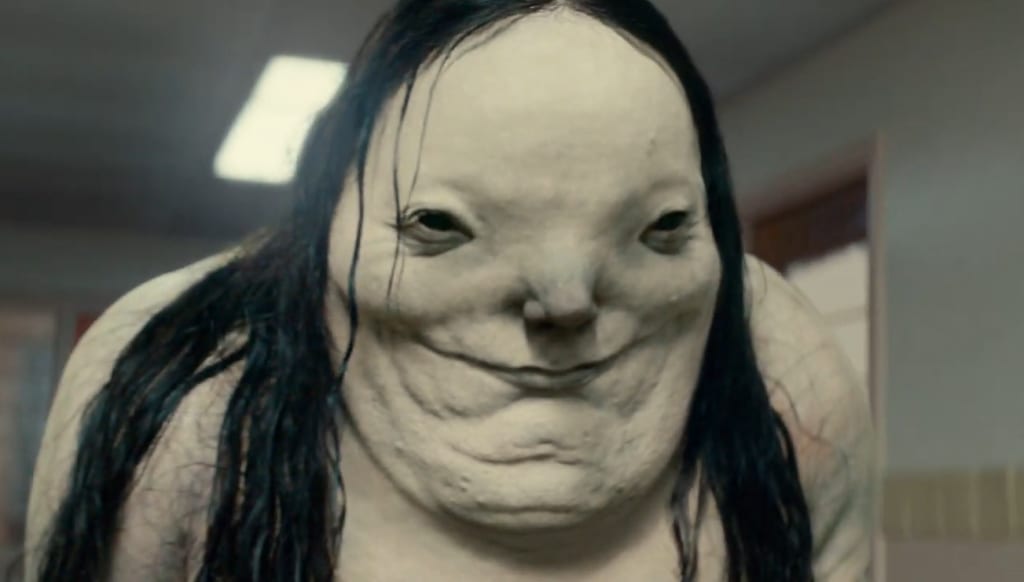
If you grew up in the 80s, 90s, or early 2000s, you probably remember the figure that terrified you during your childhood: a demon you suffered from during sleep paralysis, and most likely based on illustrations by Stephen Gammell.
His frightening drawings turned the Scary Stories to Tell in the Dark series into one of the scariest books for children to read, thanks to Gammell’s ability to take simple ideas and transform them into something that invokes deep fear, sometimes even from very everyday things, like a girl holding a baby.
Gammell’s illustrations are a central part of the series' success, which has made these stories a classic that has stayed with us for decades. With his highly distorted architectural style and eerie atmosphere, he turned all visuals into nightmarish horrors. One of the most famous stories in the series is that of the Pale Lady, a figure that has recently received widespread attention as the scariest character in the series.
In a recent poll, the Pale Lady garnered the most votes and was chosen as the scariest character among all the figures in the series. Out of over 30,000 respondents, half of them named her the most terrifying.
This is interesting because, despite being depicted as a disturbing figure, when readers forget the illustrations and focus only on the story itself, the character doesn’t seem all that scary. In the story where she appears, she’s nothing more than a talking demon who looks like a simple nightmare, thus provoking more fear in our thoughts than in reality.
The story in which the Pale Lady appears is The Dream, a tale from the Scary Stories to Tell in the Dark 3 book. The story follows Lucy Morgan, a traveling artist who goes on a tour of the world’s beautiful and historic cities. After staying in the town of Garder for a week, she decides to continue toward Kingston, but one night, during one of her dreams, she experiences a terrifying event that will change the course of her life.
In the dream, Lucy finds herself climbing long, dark stairs until she reaches an old door, which opens to reveal a room full of blocked windows and carpets that look like trap doors. After staying there, she wakes up with the Pale Lady standing above her, with skin as white as a ghost, empty black eyes, and thin, neatly arranged hair.
The figure does not harm her, but softly tells her, "This is a bad place. Run while you can." When she touches her and makes her flee the room, Lucy wakes up in a sweat, frightened. She can’t fall asleep again until the sun rises, and with the rising sun, she decides to change the course of her trip.
Lucy didn’t tell many people around her, but she refused to continue toward Kingston and decided to head to the small town of Dorst, a place very similar to Garder.
In Dorst, she meets an old man who directs her to a small house on a hill, where she finds a kind elderly woman who takes her into a room and offers her to stay there for a few days. As Lucy goes upstairs with the elderly woman, she starts to feel a sense of déjà vu—the house looks exactly like it did in the dream, with carpets that resemble trap doors and blocked windows.
After the elderly woman leaves to make tea, a knock on the door interrupts Lucy’s thoughts. When she opens the door, she meets the Pale Lady once again. The same black, thin hair, empty eyes, and ghostly face—just as in the dream. Lucy doesn’t wait to speak and quickly runs away, not looking back.
What makes the story so disturbing is not necessarily what happens, but how it is presented. Lucy goes through relatively routine experiences: she has a dream, decides to change her travel plans, meets the Pale Lady, and flees—but all of this is conveyed in a way that leaves room for the imagination of the readers. Elements like the vague mention of "the carpets like trap doors" and the constant feeling of discomfort create an atmosphere of fear that transcends the words.
The story doesn’t give us many answers or explanations—we’re left with open questions. Is the Pale Lady a bad figure, or is she helpful? If Lucy hadn’t fled, would she have met the same fate? What is so terrifying about meeting such a figure, if nothing truly harmful happens?
The character of the Pale Lady doesn’t fit with the typical image of a demon. She has compassionate sides, and she is neither dangerous nor violent in the original story. In the film adaptation, which presents a new version of the character, she represents more compassionate aspects—she warns the characters, trying to push the danger away. The movie seeks to add an emotional dimension to the character, allowing her to be even scarier than in the original story.
In some ways, this character may also have been inspired by a true story from the 19th century. There is a story about a woman named Elizabeth, who suffered from visions of a pursuer who appeared both in her dreams and in real life. As a result, she developed an unexplained illness, which led to her mysterious disappearance. Alvin Schwartz took inspiration from this story and found the seed for the motif of a character appearing in dreams and warning of dangers.
About the Creator
ADIR SEGAL
The realms of creation and the unknown have always interested me, and I tend to incorporate the fictional aspects and their findings into my works.
Keep reading
More stories from ADIR SEGAL and writers in Journal and other communities.
Snow White's Multiverse
Since its inception, Disney has been considered the "ugly duckling" of the entertainment industry and innovation. However, thanks to the desire to make the imaginary possible, it became a golden duckling. And when such assets are in your hands, you need to build them the strongest nest possible, and to ensure they stay in place without any connection to art, it's best to add at least seven pillars of support. Like any self-important corporation, Disney claims it built it from scratch, disregarding all those who made it what it is today.
By ADIR SEGAL5 months ago in Journal
📢 Raise Your Voice Thread: 03/05/2026
Our “Raise Your Voice Threads” are hosted most alternating Thursdays at 12PM ET to offer creators more avenues to uncover exceptional stories on Vocal. As we are continuously searching for fresh creators and inspiring stories, this thread provides an opportunity to exchange and discuss the stories that have moved and motivated us on Vocal.
By Raise Your Voice by Vocal5 days ago in Resources




Comments
There are no comments for this story
Be the first to respond and start the conversation.