
The Men — Piergiorgio Corallo’s human landscapes at the Museum für Fotografie, Berlin
Between expressionism and survival: painting the fragile persistence of form By Nora Engar — The Global Verge

Berlin, September 18–29, 2025.
At the Museum für Fotografie, Italian painter Piergiorgio Corallo presented Gli uomini (The Men), a cycle of paintings that reinterprets European expressionism through a Mediterranean sense of structure and restraint. The exhibition, part of the museum’s autumn program dedicated to contemporary figurative languages, quickly became one of the most visited solo shows of the season.
Berlin’s art scene, often dominated by conceptual minimalism and political irony, rarely encounters a painter who approaches the human form with such sincerity and intensity. Corallo’s work proposes a form of post-industrial humanism: figures stripped of rhetoric, marked by exhaustion yet alive in gesture. In a city historically tied to the trauma and ethics of expressionism, his vision felt at once foreign and familiar — a southern echo that revived the discipline of looking at faces, bodies, and silence.
The anatomy of endurance
The exhibition revolved around three paintings — Solitudine, L’Anonimo Pugliese, and Tregua — each offering a different register of survival.
Solitudine introduces the viewer to a solitary head that appears to disintegrate beneath the tension of color. The brushstrokes, both impulsive and deliberate, layer turquoise, crimson, and grey with incised black lines that cross the face like fractures. The result is unsettling: neither portrait nor abstraction, but a field of resistance. The subject’s faint smile — if it is a smile — becomes the only trace of vitality, a gesture of endurance rather than expression.
Critics in Berlin noted how the painting reclaims the moral gravity once found in Oskar Kokoschka and Emil Nolde, while refusing their theatricality. Corallo’s solitude is geological: matter holds emotion the way stone holds fossils.
In L’Anonimo Pugliese, the tension shifts inward. The space is domestic, yet disoriented — a flat, silent room reduced to zones of orange, violet, and black. In the foreground, a veiled figure lies or rests, uncertain between object and memory.
The architecture absorbs the human presence, becoming a metaphor for identity itself: something built, fragile, and unfinished. This work connects more directly with Italian modernism — the metaphysical stillness of Morandi filtered through the spiritual restlessness of Scipione. What remains is a sense of interior exile: a man existing within his own walls, nameless and dignified.
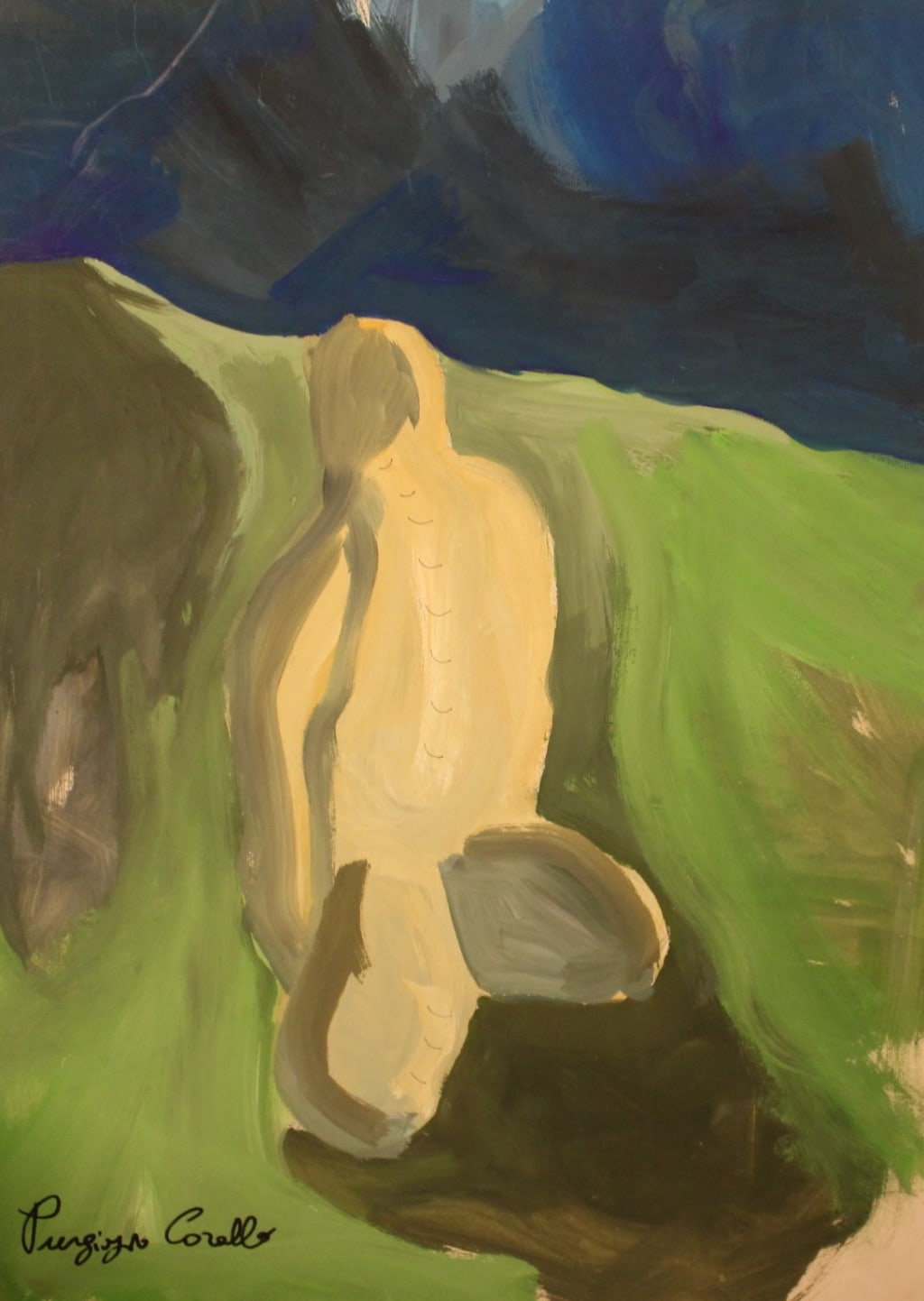
Tregua, the third painting, closes the cycle with a shift in tone. A figure kneels on a muted green slope beneath a storm-colored sky. The brushwork slows down; space opens. The scene conveys calm without peace, fragility without despair. The title — “Truce” — implies suspension rather than resolution. The landscape absorbs the body until the boundary between flesh and soil disappears. Here, Corallo reaches an unexpected tenderness: an empathy between the human and the earth, between fatigue and shelter.
Light, space, silence
The exhibition design reflected the psychological depth of the paintings.
Curated in semi-darkness, with isolated lighting and minimal wall text, Gli uomini avoided any narrative path. Instead, viewers moved as if through chambers of introspection. The lighting struck the canvases obliquely, revealing the density of pigment, the subtle erasures, and the traces of earlier layers beneath the surface.
A critic for Kunstblatt Berlin described the experience as “a descent rather than a walk, where painting becomes confession.” Others remarked on the exhibition’s audacious simplicity: only three works, but each one heavy with time, weight, and presence. The silence of the room — no soundtrack, no video, no didactic context — reminded the audience that painting, even today, can still speak without mediation.
A European language of matter
Corallo’s work belongs to a broader European conversation about the human form and the ethics of depiction.
While much contemporary painting relies on irony or aesthetic detachment, his approach returns to sincerity — not as sentiment, but as structure.
The lineage is clear: Kokoschka’s psychological turmoil, Nolde’s chromatic violence, Licini’s metaphysical solitude — yet Corallo moves beyond influence. His vocabulary is sculptural, mineral, Mediterranean. The color palette — iron oxide, graphite, burnt sienna — seems borrowed from industrial ruins and southern soil alike.
This dual heritage allows his paintings to resonate across geographies: they speak to Berlin as much as to Taranto, the artist’s native city marked by its steel industry and human contradictions. The texture of his surfaces, often scratched and reworked, evokes corrosion, decay, endurance — but never defeat.
The gesture of painting itself becomes an act of ethical persistence, a refusal to vanish quietly.
Beyond disciplines
Corallo’s practice extends beyond painting: he is also a musician and writer, known for the album In via di sviluppo released earlier this year.
Though in different mediums, both the music and the paintings share a consistent vocabulary — rhythm, abrasion, tension, silence. Each examines how form can survive entropy.
In this sense, Gli uomini operates as the visual counterpart to his sonic work: both articulate what remains when expression is stripped to its essentials.
For many Berlin critics, this convergence between disciplines signals a renewal of expressive integrity in European art. It demonstrates that independence need not mean isolation — that an artist can remain rooted in matter and still address the digital age with gravity and irony-free conviction.
The resonance of endurance
By the end of the exhibition’s second week, the Museum für Fotografie reported one of its highest attendance rates for a solo painter that season.
Visitors spoke of the show’s emotional clarity — its quiet power to suggest humanity without spectacle.
In an era of accelerated consumption and conceptual exhaustion, Corallo’s work reclaims slowness, density, and faith in gesture.
“Corallo paints as if the act itself were survival,” wrote Der Tagesspiegel, “and perhaps it is.”
Indeed, Gli uomini does not offer consolation. It offers recognition — that being human means to resist, to endure, and to remain visible, even if only in fragments of pigment and silence.
More than a stylistic statement, Gli uomini is a moral proposition: to keep painting the human face after everything that has erased it.
Written by Nora Engar, Berlin, 2025 — The Global Verge
Artist official site: https://piergiorgiocorallo.com
Press & links: https://piergiorgiocorallo.com/rassegna
Tags: art, painting, expressionism, berlin, museumfurfotografie, piergiorgiocorallo, theglobalverge
About the Creator
The Global Verge
Independent culture & music press reporting from Europe and Latin America.
Keep reading
More stories from The Global Verge and writers in Journal and other communities.
Cybernetic Boy — Piergiorgio Corallo’s digital alter ego
There’s a reason certain songs feel like mirrors. They don’t flaunt virtuosity; they hold it back. They don’t drown you in metaphors; they choose a few sharp images and let them echo. “Ragazzo cibernetico,” from Piergiorgio Corallo’s project 'In via di sviluppo', is one of those pieces—an electronic rock miniature that uses economy as a form of clarity.
By The Global Verge3 months ago in Journal
The goals I did not achieve
Every writing goal I made for the year is a wash. It has been this way for a while, but I think it's important to be open about my failures and the reality of how life can get in the way. This is especially true considering the several times I have posted on Vocal about my writing goals, how I was changing my approach, and where I was hoping to be for the upcoming year. I will probably do that again in a couple months, but for now, it is time to acknowledge where I am today.
By Kay Husnick24 days ago in Journal
The Role of Confession in Spiritual Growth
Confession, also called the Sacrament of Reconciliation, is one of the most powerful and transformative practices in Catholic life. Through this sacrament, Catholics seek God’s forgiveness for sins, experience His mercy, and receive spiritual guidance. Far from being a routine obligation, confession is a vital pathway to spiritual growth, healing, and deeper communion with God. Understanding its purpose, benefits, and proper approach can enrich a believer’s faith and daily life.
By Sound and Spirit6 days ago in Journal


Comments